I recently purchased Hank Meal’s, The River, a local’s guide to hiking trails surrounding the Yuba River. On a rainy afternoon, my friend, Kitten, and I got cabin fever; we opened Hank’s book and chose the Rock Creek Nature Trail (located in the Tahoe National Forest) as our tonic. Once the site of a lumber mill, Hank described this one-mile loop as an easy and accessible trail that meanders beneath 11 varieties of trees and alongside Rock Creek.
“Looks like we have the place to ourselves,” I beamed when we pulled into the empty parking lot.
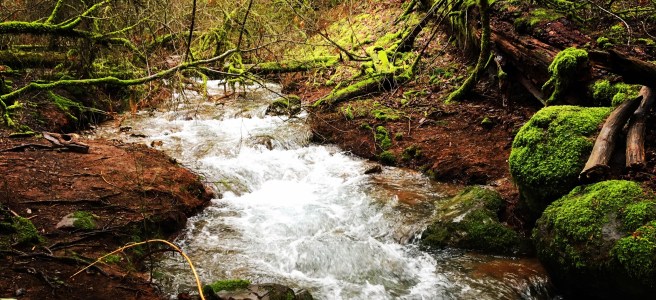
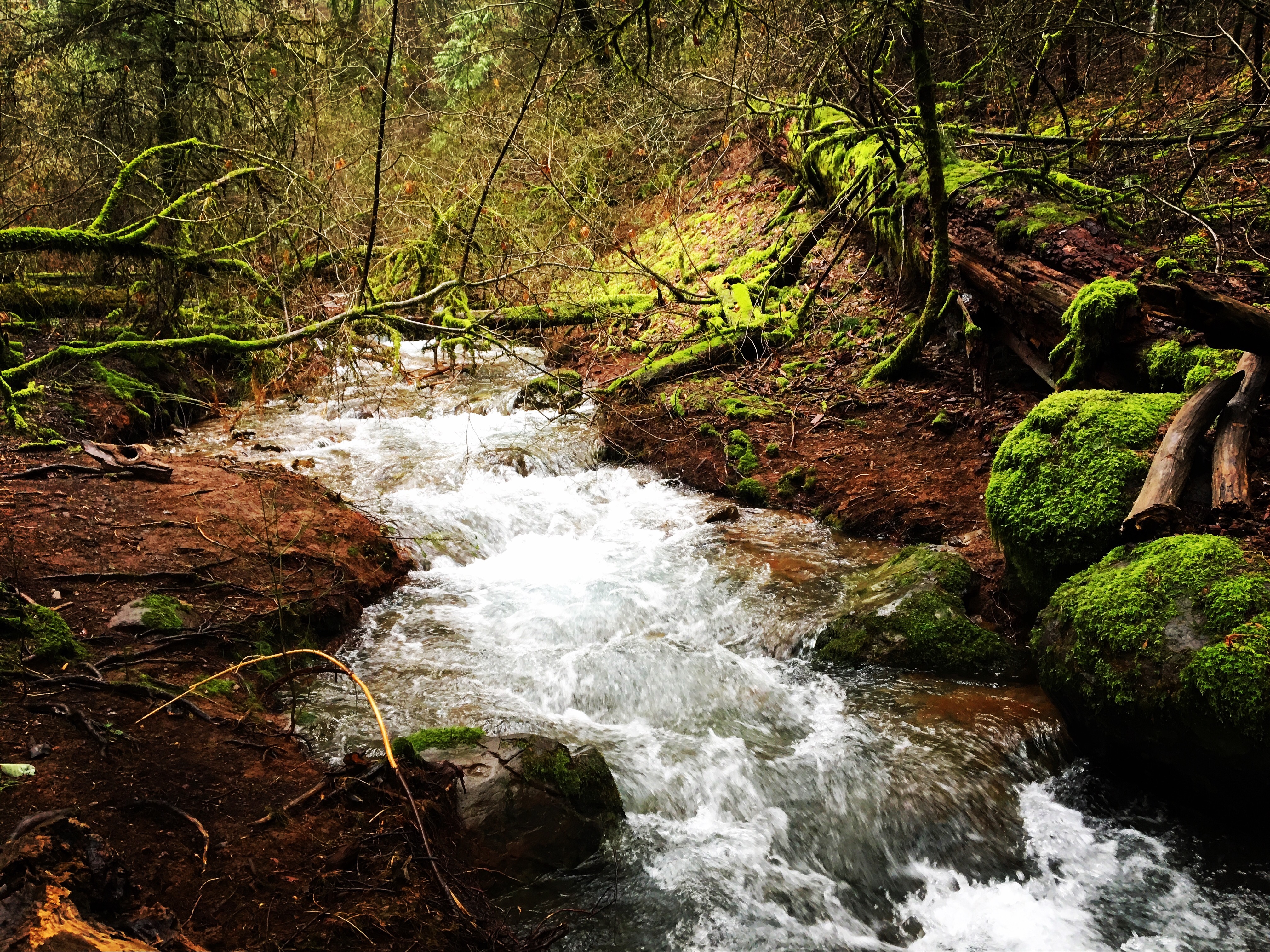
The ground was completely saturated — water pooled around our every footstep. Light rain floated to earth, accompanied by large, sporadic drops falling from tree branches, tapping an intricate percussion on land and water. The creek rushed past us, beckoning us onwards.
“Look at all this debris,” Kitten said. “These recent storms have been brutal!”
“The other day, I saw a group prayer going around Facebook asking for the storms to be gentle on the forests, and I don’t know how I feel about that.”
“Why?”
“California needs water. I’m not eager to pray the rain stops.”
A stream carved its way down the hillside and onto the path, turning the path into a waterway and making us walk along its edge. Branches, leaves, and pine needles littered the area, and the Rock Creek Trail felt less like a nature walk and more like a rugged adventure, like we were the first explorers. At one point, we had to climb over a large, fallen tree.
“All this damage is from the drought,” Kitten said. “Tree roots retract closer to the trunk and become less dense. And the branches die. So when a big storm hits, it uproots trees and branches fall.”
“Makes sense.”
“Now I bet this will be a tinderbox in summer — this and every other forest in California.”
“Let’s hope not! If we get enough rain, the dead stuff will get mushy and become fertile. With fewer trees and branches blocking out the sun, new life will grow. Regeneration is one of the most incredible aspects of nature, in my opinion. Didn’t the guidebook say this land was harvested for timber not long ago? I wonder what that looked like!”
“I hope we get the rain, too, of course. Shame if it burns. I’d rather see the land heal.”
“Did you know illegal campfires start a lot, if not most, of California’s forest fires? The drought makes everything dry, but it’s singular humans messing up on top of that.”
“Hitting Nature from both sides: the macro and the micro.”
We passed what Hank described as a relaxing welcome bench, knocked out of the ground and thrown on its back.
“I’m ready for all humans to live in harmony with Nature.”
“Now that’s a good prayer.”
We stopped to inspect a fallen tree. It made a sturdy bridge over the creek and it’s roots were exposed in an unchanged unit, still holding rocks they had grown around.
“This makes me think of my inner work,” I said, ducking beneath a branch.
“What do you mean?” Kitten asked.
“Self-reflection can sometimes hurt. After a long period of unconsciousness or trauma, like a drought, the medicine of awareness can feel destructive — it’s painful to look on all aspects of myself — lessons can be hard, truth can hurt. Guilt, disappointment, shame, and anger surface. And when that happens, it feels like I’m being destroyed. Like my guts are being ripped out or my heart torn apart.”
Water cascaded down the creek bed over rocks and debris, navigating curves, eddies and pools.
“I think the commitment,” I continued, “is to give myself sustained compassion, like rain, so that which has been knocked over can become the fertile grounds for new life — or a bridge to enlightenment. To continually give myself compassionate attention and embrace myself instead of pushing myself away — that is the way.”
“I see. If you have the painful, seemingly-destructive insight and you don’t follow it up with compassion, it’ll catch on fire and consume you when someone starts an illegal fire,” Kitten said.
“Definitely.”
We crossed a wooden bridge before we completed the loop. Birds sang from the moss-covered trees, while a soft and steady drizzle, almost a mist, enveloped the forest.
As if drawn by a magnet, Linney and JC returned to Tahoe National Forest last week. Lucky enough to have some free time, I joined them one afternoon at the Jackson Meadows parking lot, roughly 20 minutes outside of Truckee. Linney and JC had brought all their dogs — four total, three of which belong to Linney. The dogs greeted me first with huge smiles and wagging tails.
JC stared at my car while we said hello. “Re-park your car and jump into Linney’s. Yours won’t make it to the lake; the road requires four wheel drive and clearance.”
“Re-park? But why?” I looked around at the vacant lot. “Do you think there’s suddenly going to be a rush of people?”
“You’re not even in a spot,” JC said sarcastically.
“How can you tell? There aren’t any lines.”
“You’re in the middle of the whole parking lot. Just — move to the side or something.”
I acquiesced and parked on the periphery in sight of the freeway; at least it gave me the idea that I was moving it for safety’s sake.
With all the gear and dogs, there would be no way to take just one car. Linney and I got into hers and JC led the way.
“Another adventure curated by our chaperone,” Linney beamed.
I have no way of knowing how long it took us to drive the rocky, uneven road. Linney and I were too busy catching up with our latest news and admiring Lacey Meadows to notice the time. Stretching the entire length of the valley below us, the meadow was only interrupted by a winding creek. The dirt road veered to the right and climbed the mounting, moving into a thick forest.
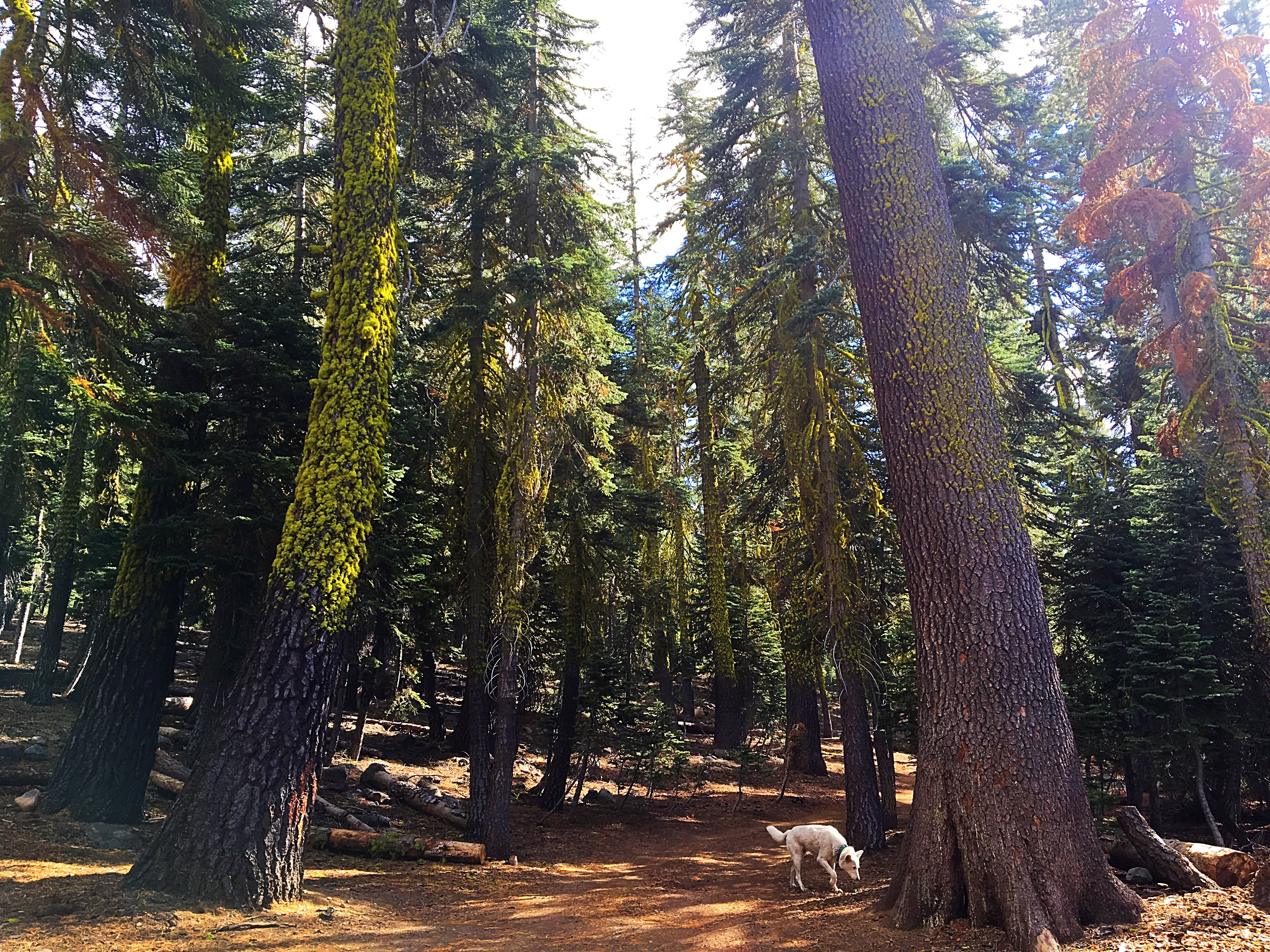
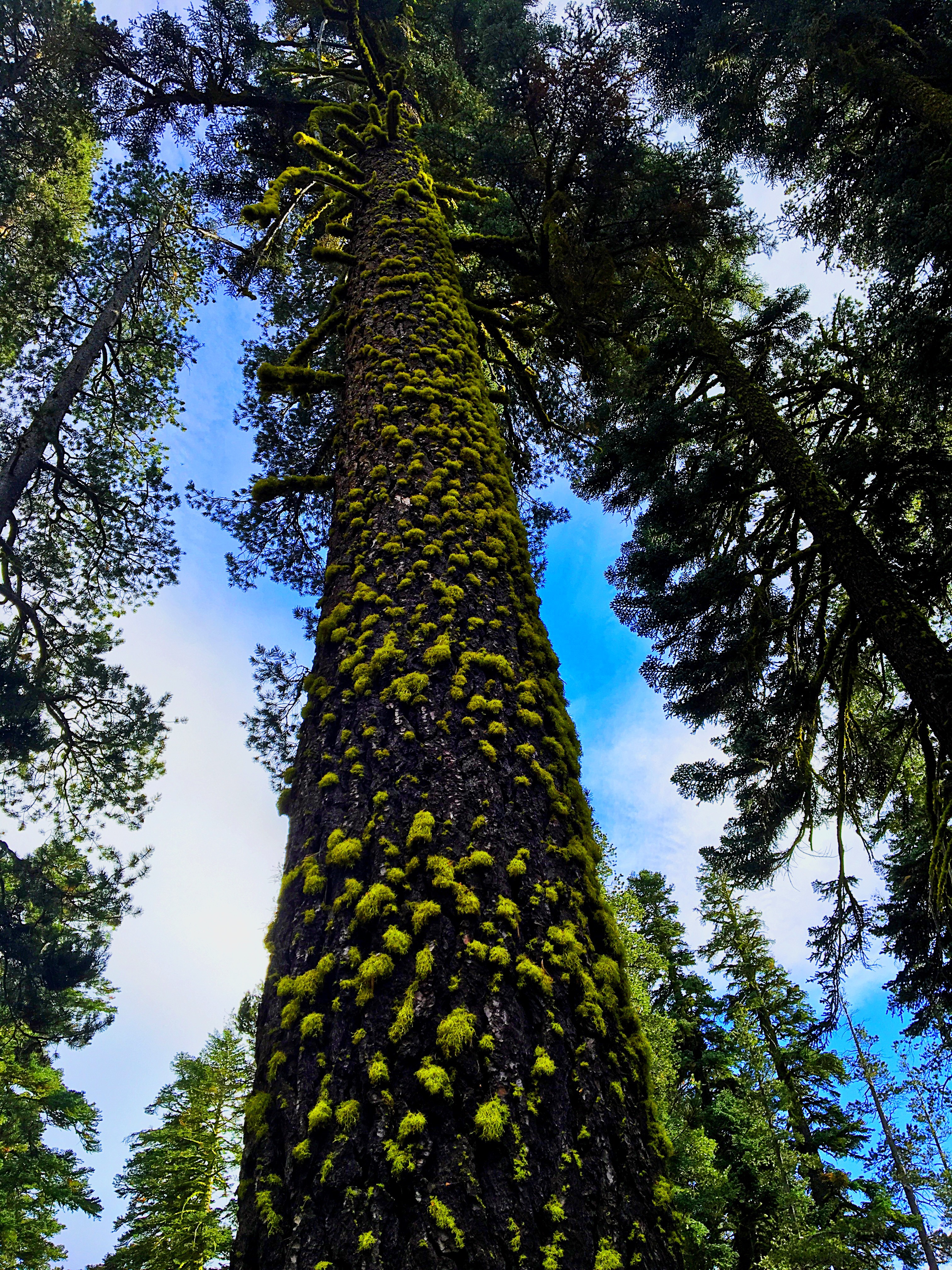
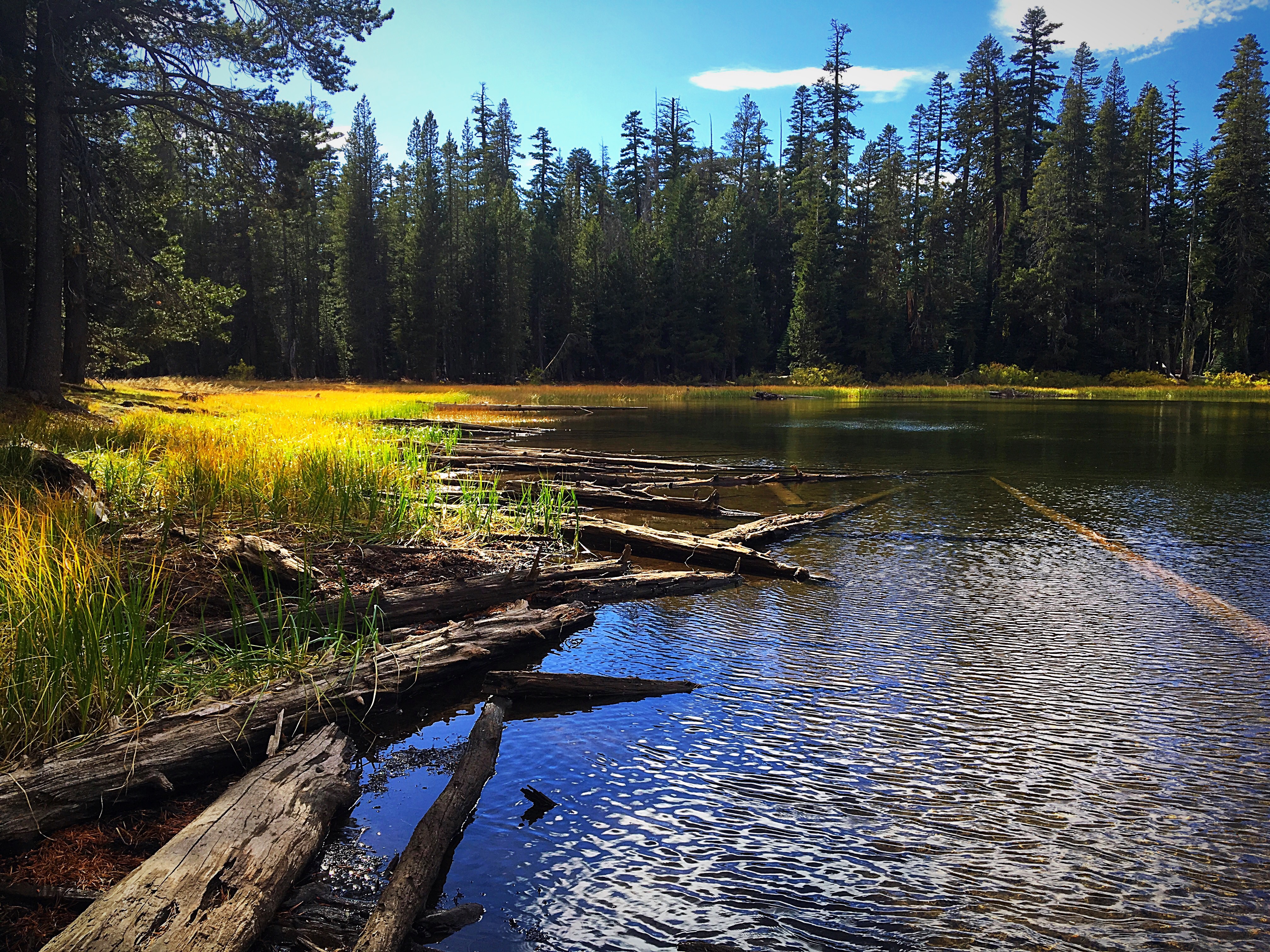
At last, we reached the campgrounds. We turned to the right and followed as the narrow road navigated between tall pines cloaked with lime-green moss. When we got to the end of the campgrounds, JC parked his car. We stepped out onto the ground, speckled with sunlight and made soft with pine needles. The dogs took off into the forest in wild bursts.
“This is beautiful,” Linney said as we walked towards the lake. “I feel like I’m in that book, The Hatchet.”
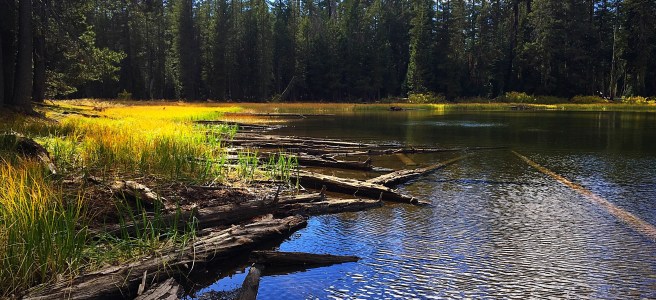
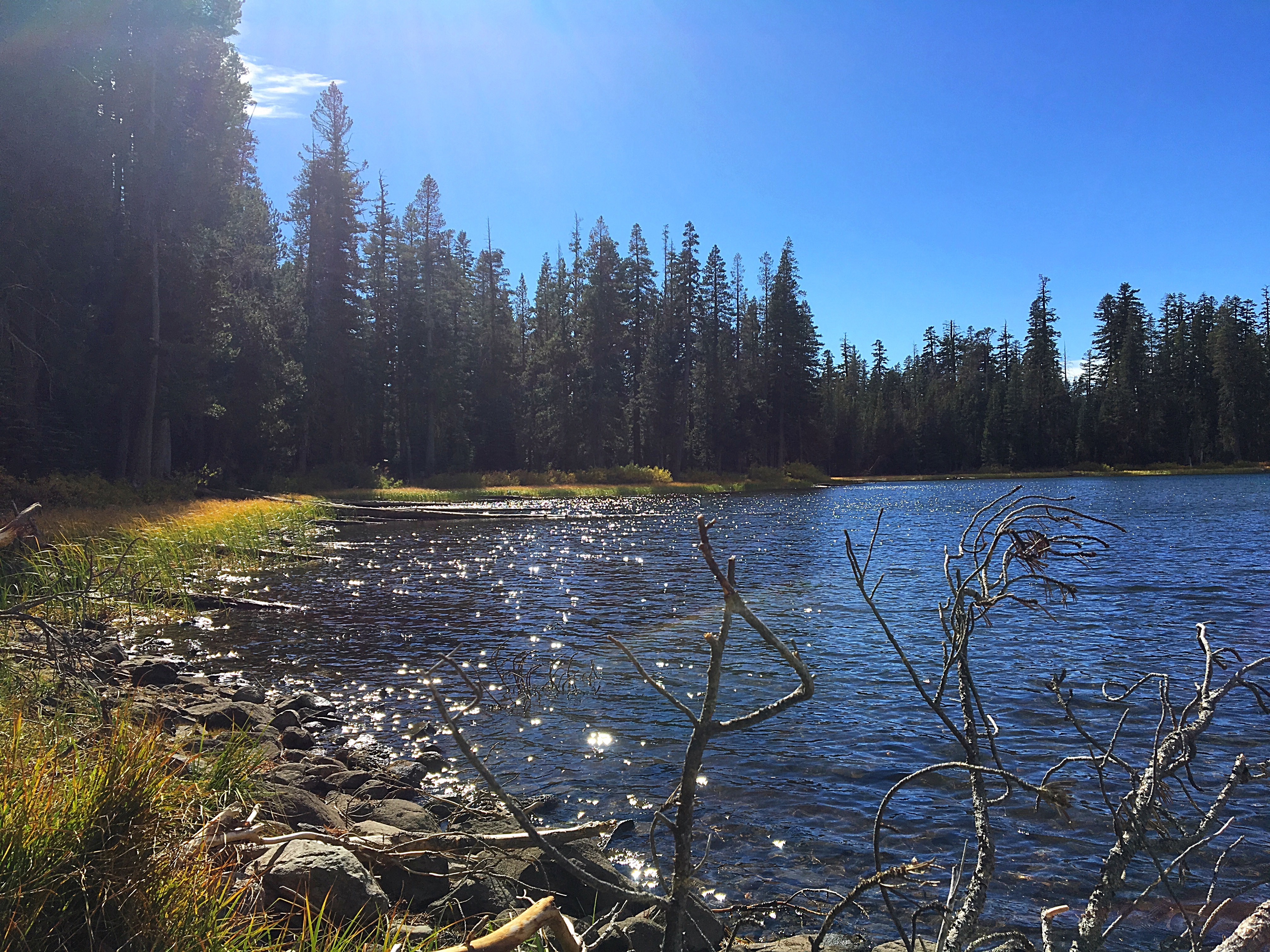
I listened to the small, frequent waves created by the wind. The gentle lapping at the shore soothed me. With the sunbeams glistening on the waves, they created bright sparkles of light. I felt effervescent, yet calm.
“Let’s go to the other side and get out of the wind,” JC said. “Last time I was here this was the side without wind. If we’re going to chill here for a bit we don’t want to be blown all over the place. It’s not relaxing.”
Once the dogs were collected, we got into the cars and turned around. Making our way back to the entrance, we continued along the road until we got to the restrooms. JC stopped his car and jumped out. He walked over to a large, brown box.
“What is he doing?” Linney asked.
“I could not tell you.”
“Remember I said I only had one shoe?” JC called out to us as he lifted a shoe from the box and laughed.
“Did he just take that shoe?” I asked Linney.
“I wonder if that’s his size. He said he was missing a shoe,” she said.
“This is very confusing.”
We ruminated over the shoe incident, searching for meaning, until we parked.
When we reconvened, JC explained: “I saw the shoe and laughed, thinking, ‘look some idiot left their shoe.’ And then I realized it’s mine!”
“That’s your shoe? Your actual shoe?” I asked.
“Yeah, I was here a few days ago — I wasn’t sure where I’d lost it. It’s the best hiking shoe. Light and breathable, but totally waterproof. It’s a $140 pair of shoes, so really, that’s a $70 find!”
“Well, no, that’s a $140 find because what are you gonna do with one shoe?” I asked.
“Exactly.”
Linney walked on a log into the lake.
“This isn’t creek-fed,” JC told me. “It’s a natural occurring glacial lake. Theres a more fun, scientific term: moraine, moraine dammed, something. This is an incredibly pristine lake.”
“It wins the Most Pristine Award,” Linney called with an air of elegance.
“It got a 96 on the Pristine Scale,” JC riffed. “Linney be careful. That mud is gnarly. If you step into it you’ll go up to your knees.”
Linney came back to the shore and we began to walk around the lake.
“Is that your fishing pole?” JC pointed to the ground. “Dude, somebody left a really nice fishing pole.”
“Mine now,” Linney said.
“Linney it’s your new fishing pole, I found it for you,” JC insisted sarcastically.
“Shouldn’t we leave it on the box like your shoe? What if they come back?” I asked.
“Nobody would come back for that,” JC said.
“Do you have a fishing pole, Linney?” I asked.
“I used to,” Linney said. “And then JC borrowed it forever.”
“No, no, I didn’t borrow it forever.”
I inspected the pole closely, “oh look, it even comes with bait!”
“Brand new,” JC said. “You can tell from the zip tie on there. Brand new zip tie.”
“There’s a question you always gotta ask, you know, when you find something,” I said. “Did you manifest this or are you stealing? I think a pole in the woods you’re manifesting it.”
“We don’t have to feel like we have to give back just because the shoe was there,” JC said. “The shoe — the shoe is its own independent thing.”
“With bait included,” Linney said. “Although, I feel like I should pass. I’ll leave it for someone further on the -sient side of glamsient.”
“Oh my God. The dogs are so stoked right now. I knew they’d love it here,” JC smiled.
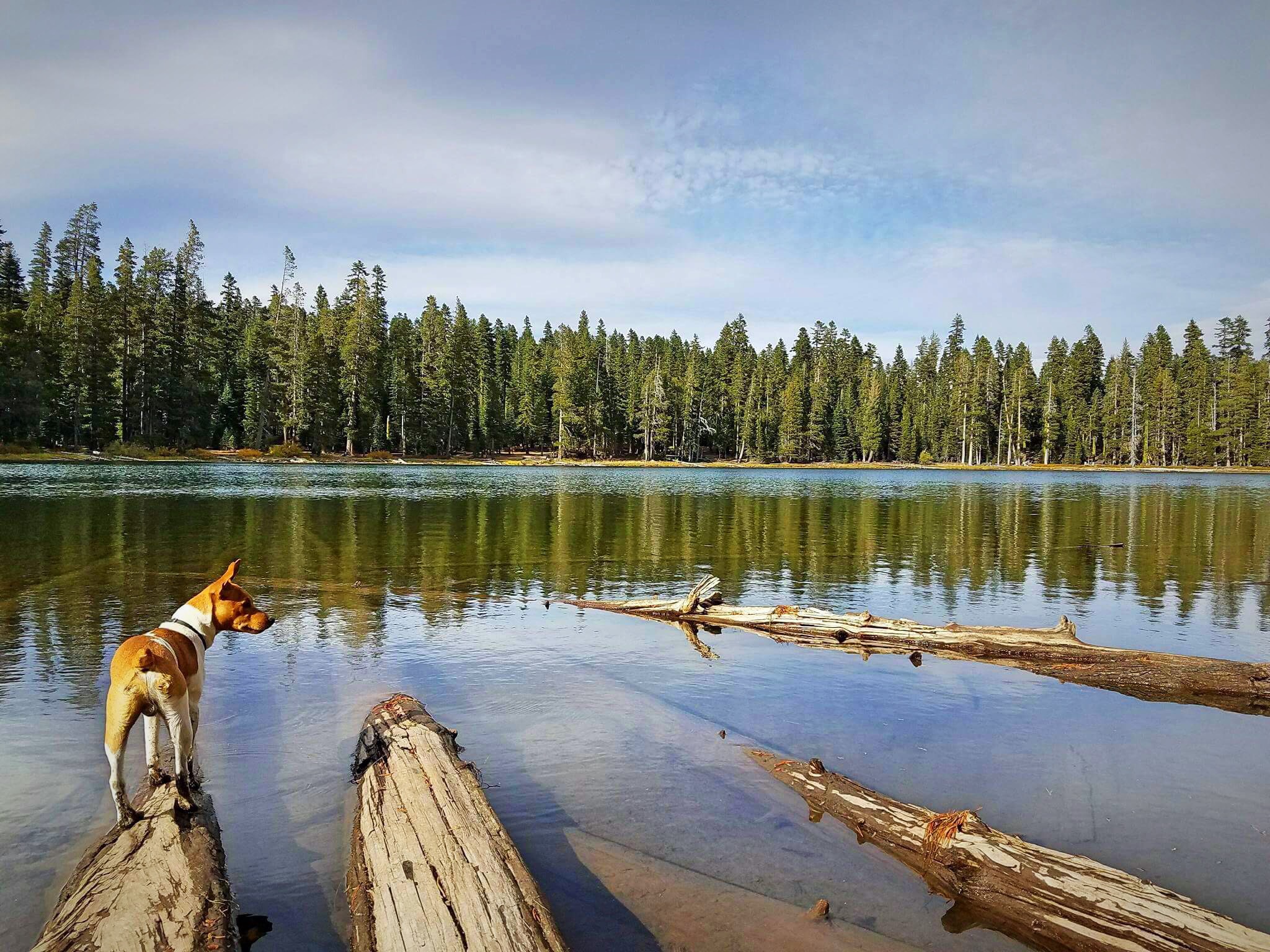
The older dogs bounded through tall grasses in the meadow and the younger dogs plodded through the mud in the lake picking up their legs one at a time, stained with three or four inches of mud.
“I was telling JC I feel like I should be on some horseback ride through the countryside with them, fox hunting or something. They look like such fancy, weird little dogs,” Linney smiled at me.
“They need little top hats. Or you need a top hat if you’re going fox hunting,” I said.
“Oh this is super epic,” JC pointed to the sky. “Abalone-vagina clouds. When they get the ripple and the waves and the rainbow in them like that. I call them abalone-vagina.”
I admired the rainbow in the cloud. “That’s so cool! You could just call them abalone clouds.”
“Yeah,” Linney agreed. “You could totally just call them abalone clouds.”
“No because the ripple isn’t the same as the abalone. It’s the curviness, too. It’s the waviness –”
“Abalone have ripples,” I said.
“Accept the beauty of the yoni as a cloud, OK? Jesus Christ.”
“Sorry, I’m just a little sensitive with all this Trump –”
“Pussy grabbing,” Linney finished.
“Yeah, that has absolutely nothing to do with how I appreciate clouds and abalones and yonis all at once.”
We sat at a picnic table.
“Hey, look at this little bonsai tree,” JC motioned to a small pine.
Linney looked around, “there are so many little bonsai trees. I love them.” She stood up and walked to her car to get snacks.
“I have little baby trees growing in my garden and I’m not going to rip them out. I want little bonsai like these,” I said.
“No, take them out,” JC said. “They’ll take over your garden.”
“But they’re so cute.”
“You can transplant them into a pot. And make them a bonsai.”
“Brilliant.”
“Just put them in a pot and then you gotta learn how to shape them. I mean, if you want to cheat you could dig one of these up — it’s horti-torture, you’re ruining it’s life. Taking a beautiful tree, but –”
“No, no, no. These stay here. In their home. I have ones I can use. I’m not going to ruin some wild tree’s life. Like, ‘Come back to my garden and be my Frankenstein.'” I said in an evil voice.
“‘Take you from your family and hold you hostage in a little, teeny, shitty clay pot,'” JC joked.
“This is a sad conversation to have on Indigenous People’s Day.”
“At least we’re celebrating Indigenous People’s Day at the beautiful, untouched, pristine lake,” JC said. “I would not, however, call this place Lake of the Woods. It’s a horrible name. I would call it the moist cove or something to do with –”
“Moist cove?” I asked. “No one likes that word.”
“I know you hate that word,” JC laughed. “Moist bay?”
“No, no moist is the word we want to get rid of.”
“Land of Special Water.”
“Land of Sacred Water — or Ancient Water.”
“Yeah, because there’s water here and it doesn’t come from a stream. There’s magically water here. Do you see how the grasses here are super green and perfect?”
“I honestly can’t believe this is a free campground. And it’s completely empty. We’re literally the only ones here.”
Linney laughed at her dogs as she walked back to us, “they’re amped. They’re having so much fun.”
“They should be,” I said. “Look at this place!”
“The wind through pine trees sounds like the waves of the ocean,” Linney said.
Taking a moment to listen, I closed my eyes and realized the truth of her observation.
After a few beers and some chips and salsa, we drove out of the campground as the sun was setting and made our way to Graegle where JC had rented a cabin.
In the morning, Linney and I left early; we wanted to stop in Truckee for coffee and breakfast.
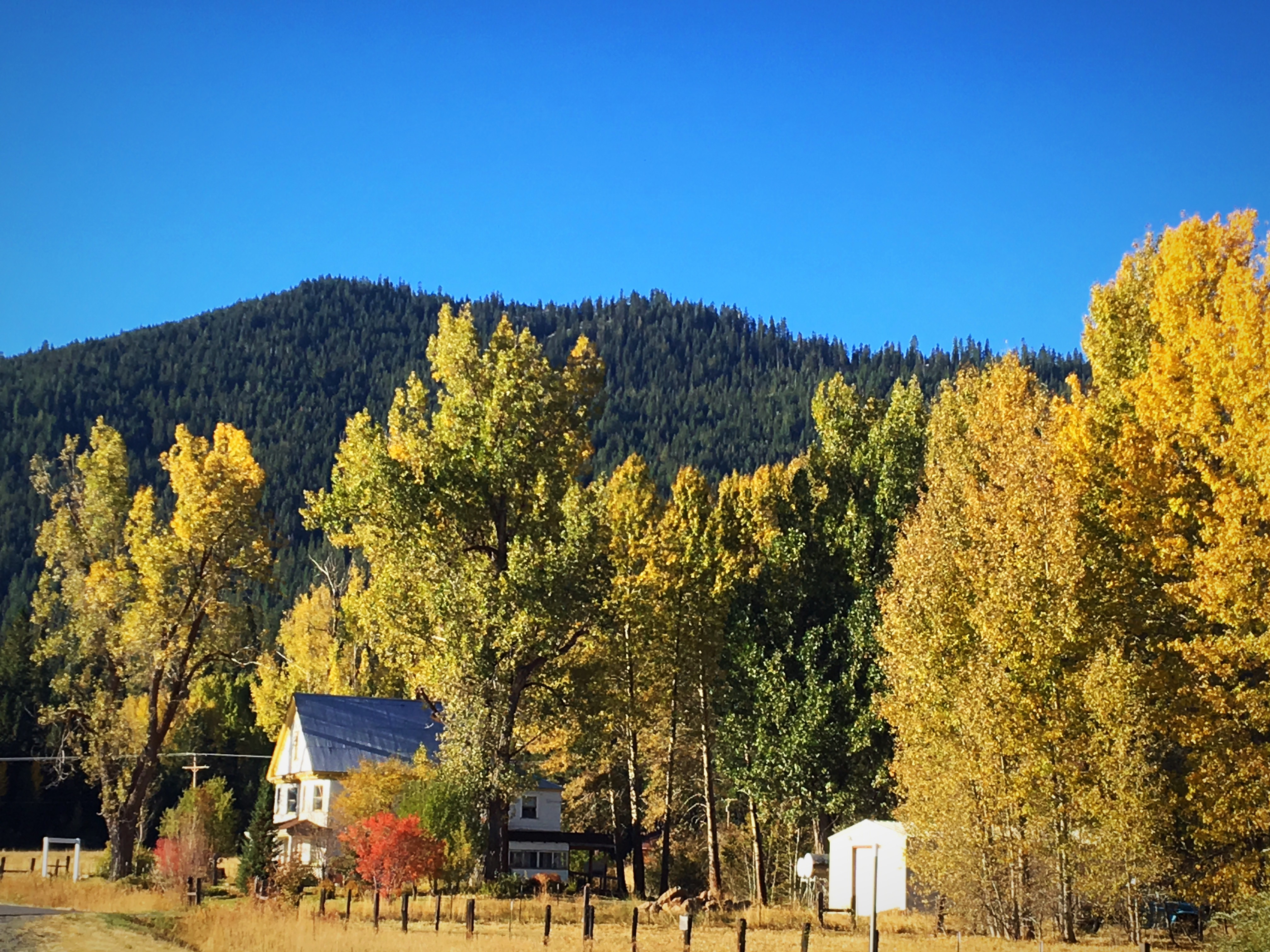
Driving along Highway 89 in the early morning light through Sierraville felt like magic. Yellowing aspen with leaves fluttering in the wind heralded the season. Quaint, rustic farms with historic buildings from the gold rush era marked every bucolic turn. Many had wrap-around porches and weather panes. Dilapidated sheds, cows, sheep, and pine trees made homes in the valley that sprawled between mountains on all sides. We saw hawks and geese and drove along a creek that is so picturesque, I know I have to come back in a couple weeks.
Peaceful beauty, undisturbed by humans, is the magnetic force — I realized — that brought Linney and JC back for more.
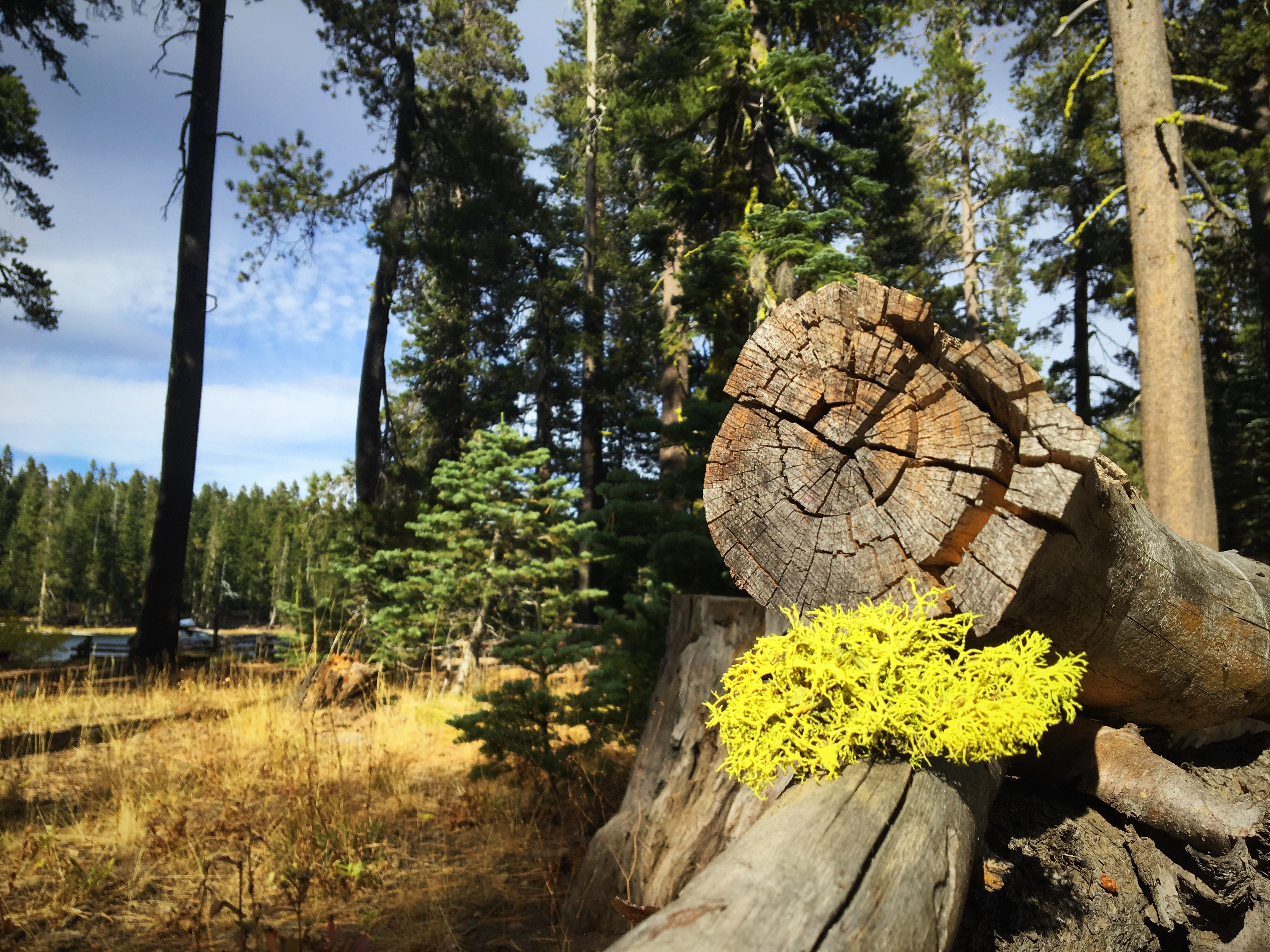
JC’s dog on the road that navigates the campgroundMossy treeSparkles on the Water One of Linney’s fancy dogs; Photo by Linney Yellowing Aspen in Sierraville
Keeping my vow, the day I left work, I headed straight to Pinnacles National Park. Luckily for me, a glamsient friend had the day off and agreed to join me. We started at the visitor center on the east entrance where I saw a sign announcing the arrival of a California Condor.”A new baby! How exciting,” I said to the ranger behind the counter.
“Yes, a girl. We are thrilled,” she said. “It’s from the only nest in the park!”
“Do you have any camping available for tonight?” I asked. Knowing that many California parks fill up months in advance during summer, I braced myself for her answer.
“Oh yes, there’s plenty.” She handed me a map of the campground. “Pick out an empty space, come back and let us know which one you want.”
We drove towards the back of the campground — it was virtually empty! With so much availability, we found exactly what we wanted: a site surrounded by trees and bushes to give us privacy and shade. High Peaks Trail via Bear Gulch Cave
For our first hike, we chose the High Peaks Trail by way of Bear Gulch Cave. My glamsient friend informed me this is the most popular trail in the park.
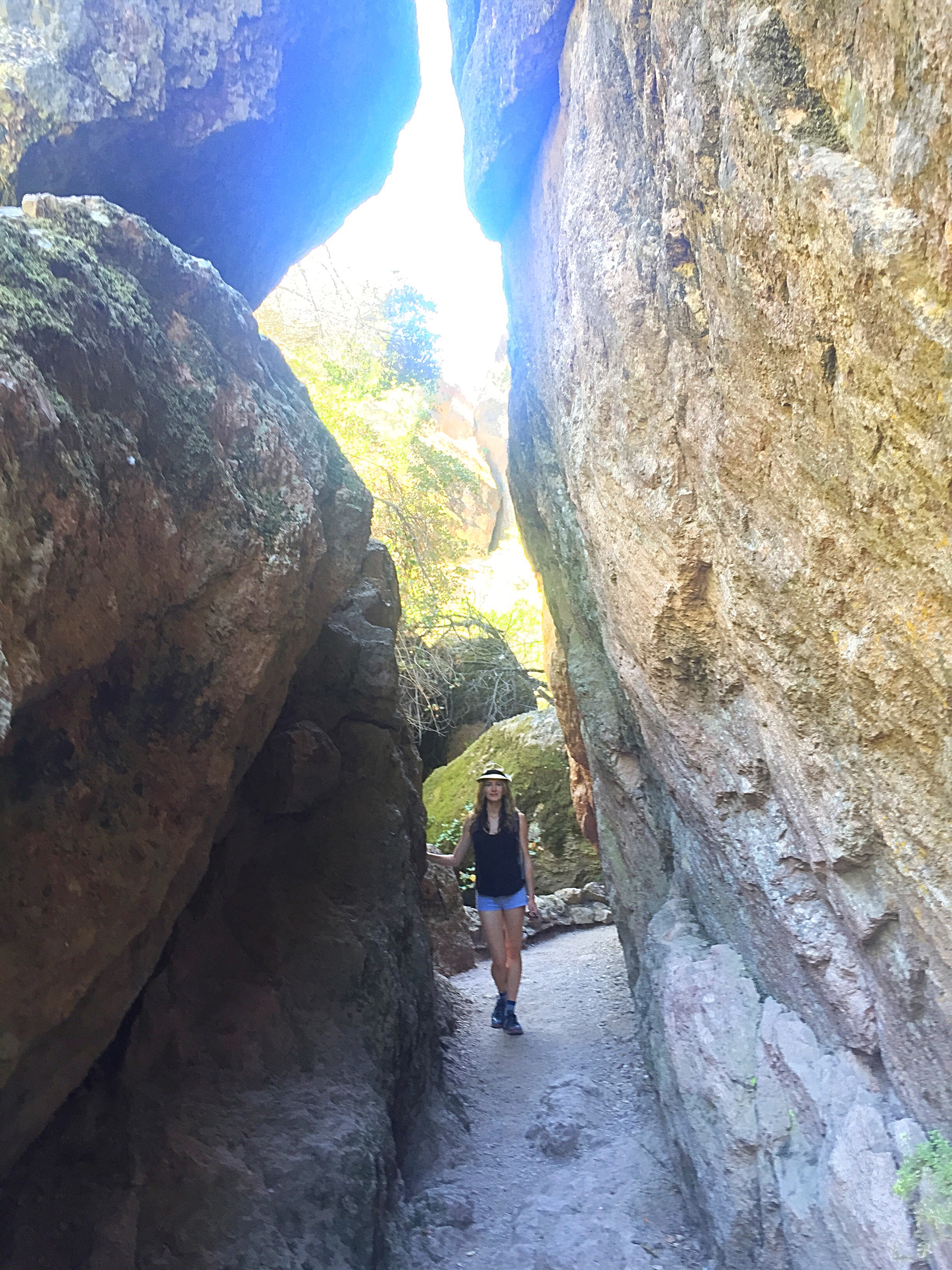
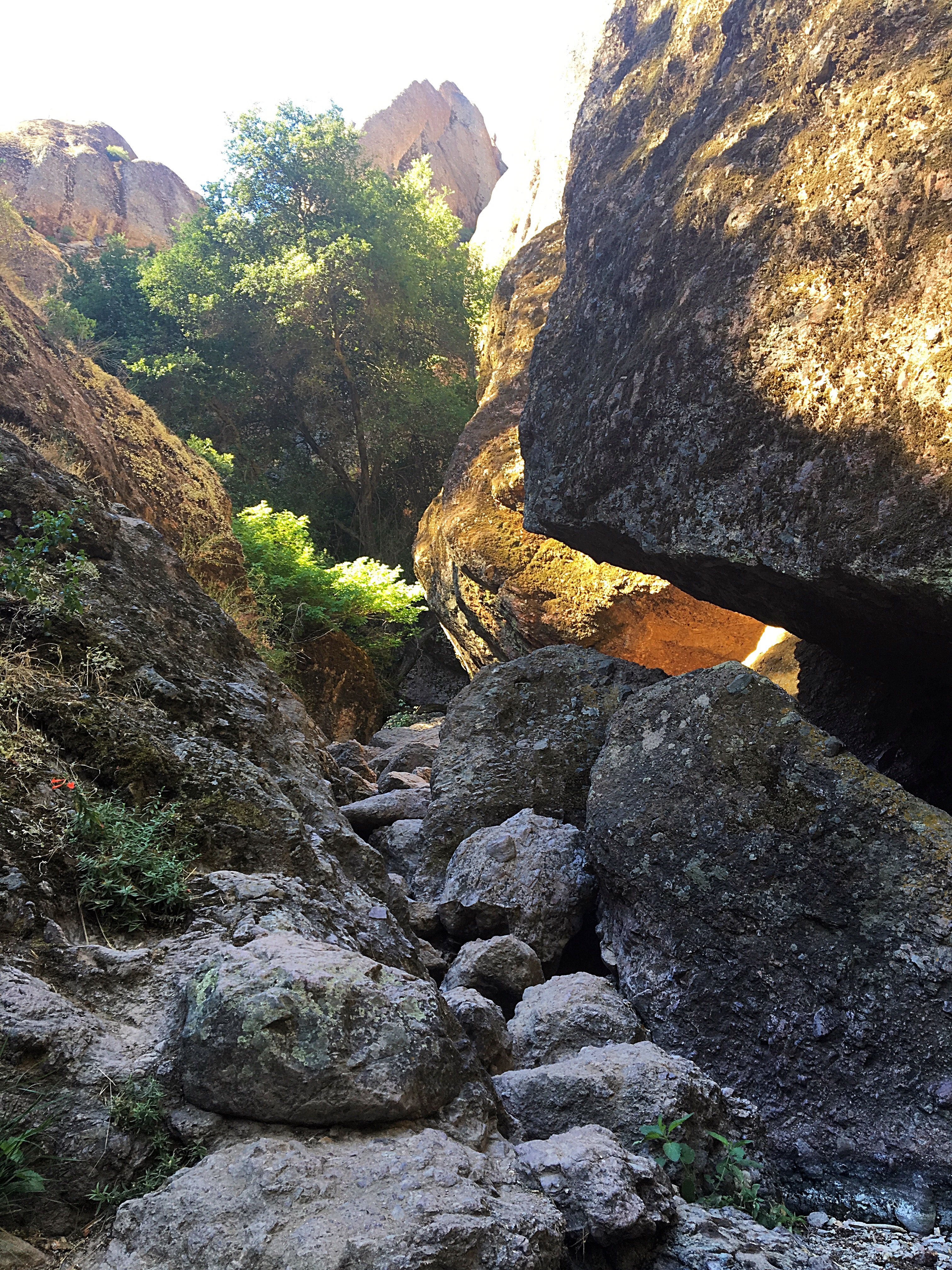
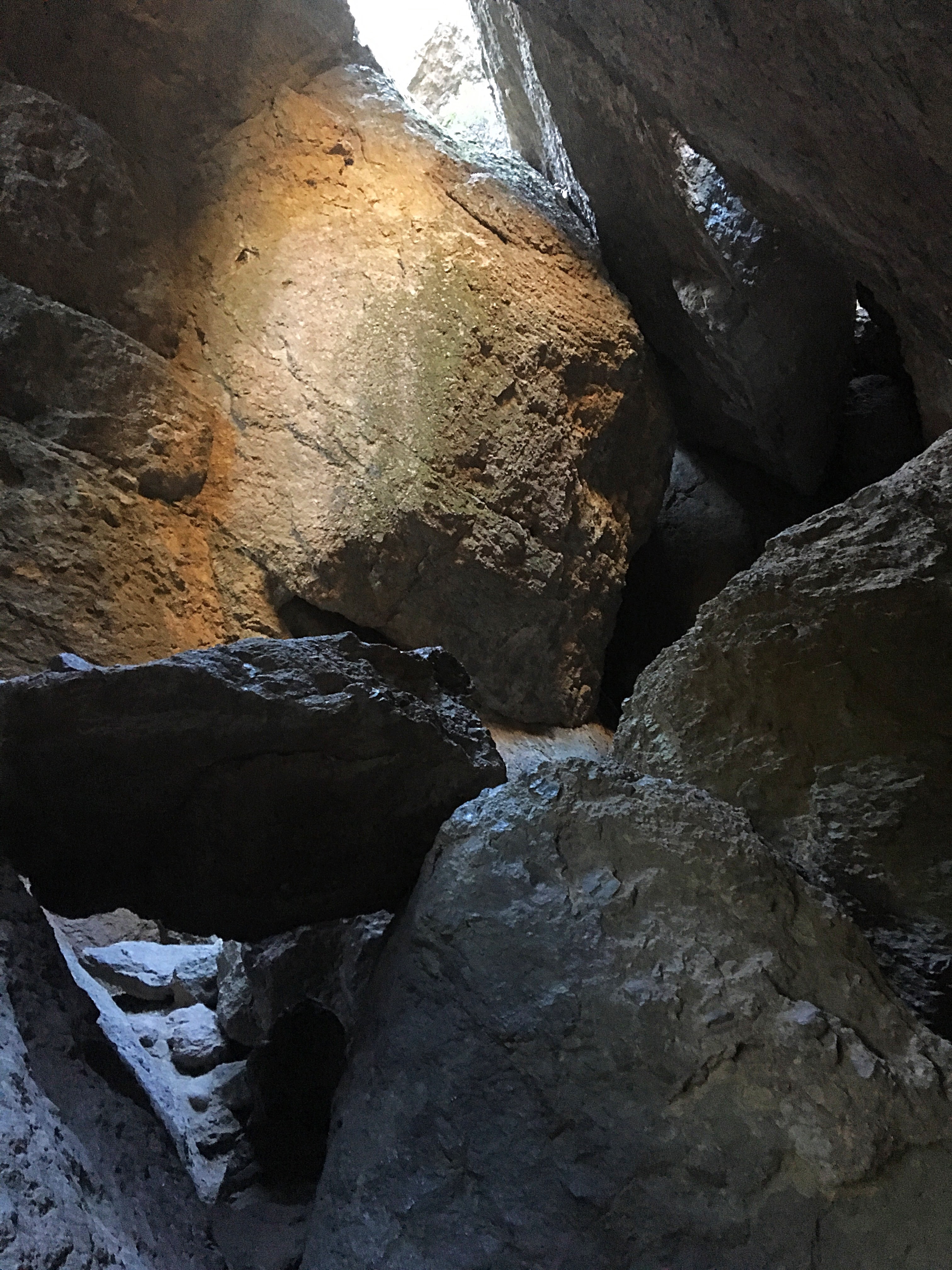
The first section guided us to Bear Gulch Cave, a rare talus cave thought to be formed in the ice age. The canopy of trees made this hike gentle and pleasant even in the middle of the afternoon. Created by large boulders that had fallen and wedged into narrow canyons, the cave was easy to navigate — sunlight made its way into the cave through open spaces to illuminate the path. We walked over bridges and up stairs created in the 1930s; part of the way, we had to crouch to pass underneath boulders.
“Wouldn’t want to be here during an earthquake,” my friend remarked. “The San Andreas fault is pretty close.”
For a popular destination at the park, the cave was by no means crowded; we saw only a few groups of people.
Leaving the cave, the trail led us to a small reservoir; that’s where the strenuous climb began to the High Peaks. Without the tree cover, under the blazing sun, every step moved me further uphill and every step told me that I am out of shape! I quickly realized this section of the trail would be much more enjoyable in cooler weather — either early morning in summer or a cooler time of year altogether!
(That being said, we saw many groups with children. They seemed fine. Hot, but fine.)
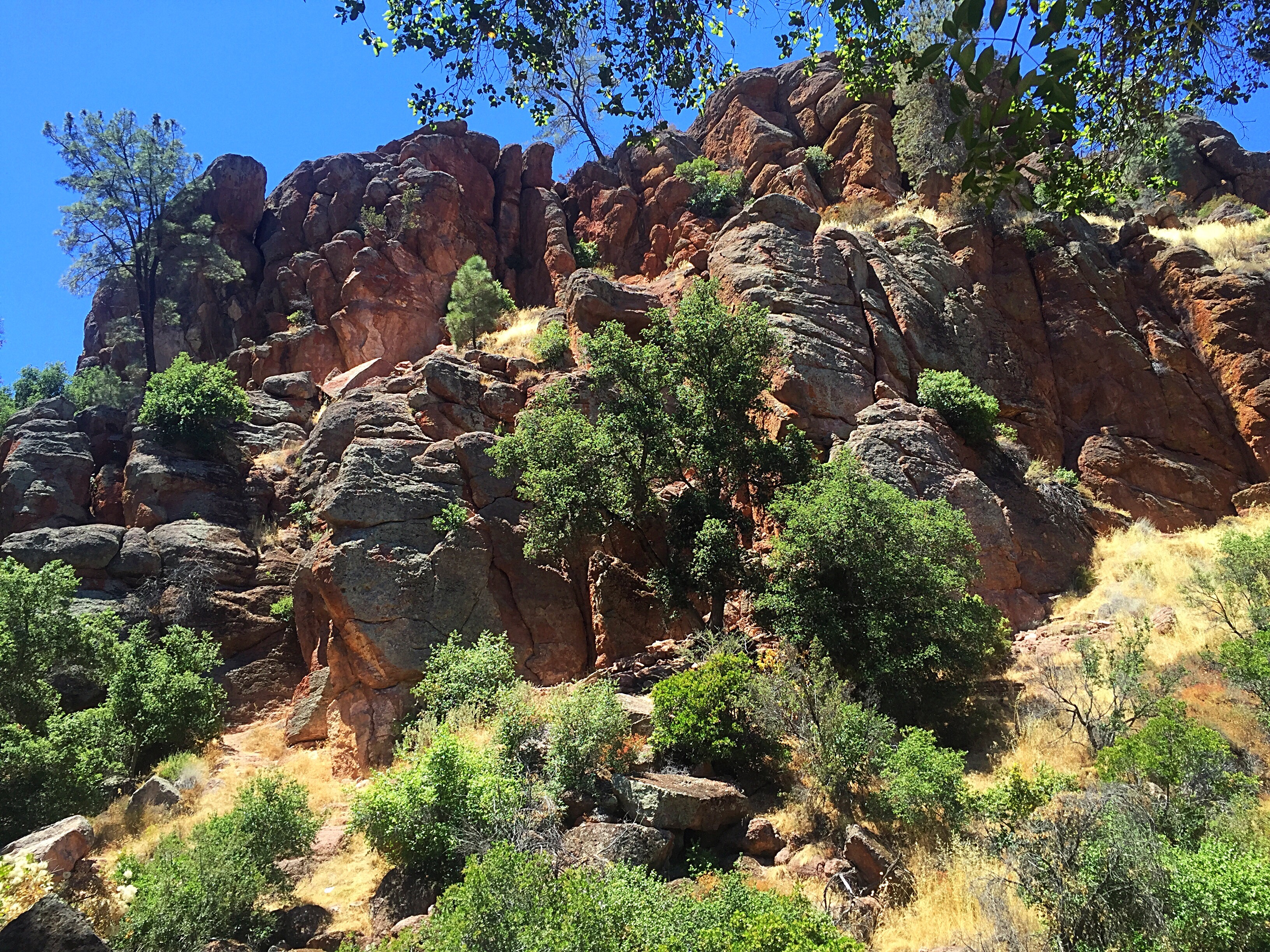
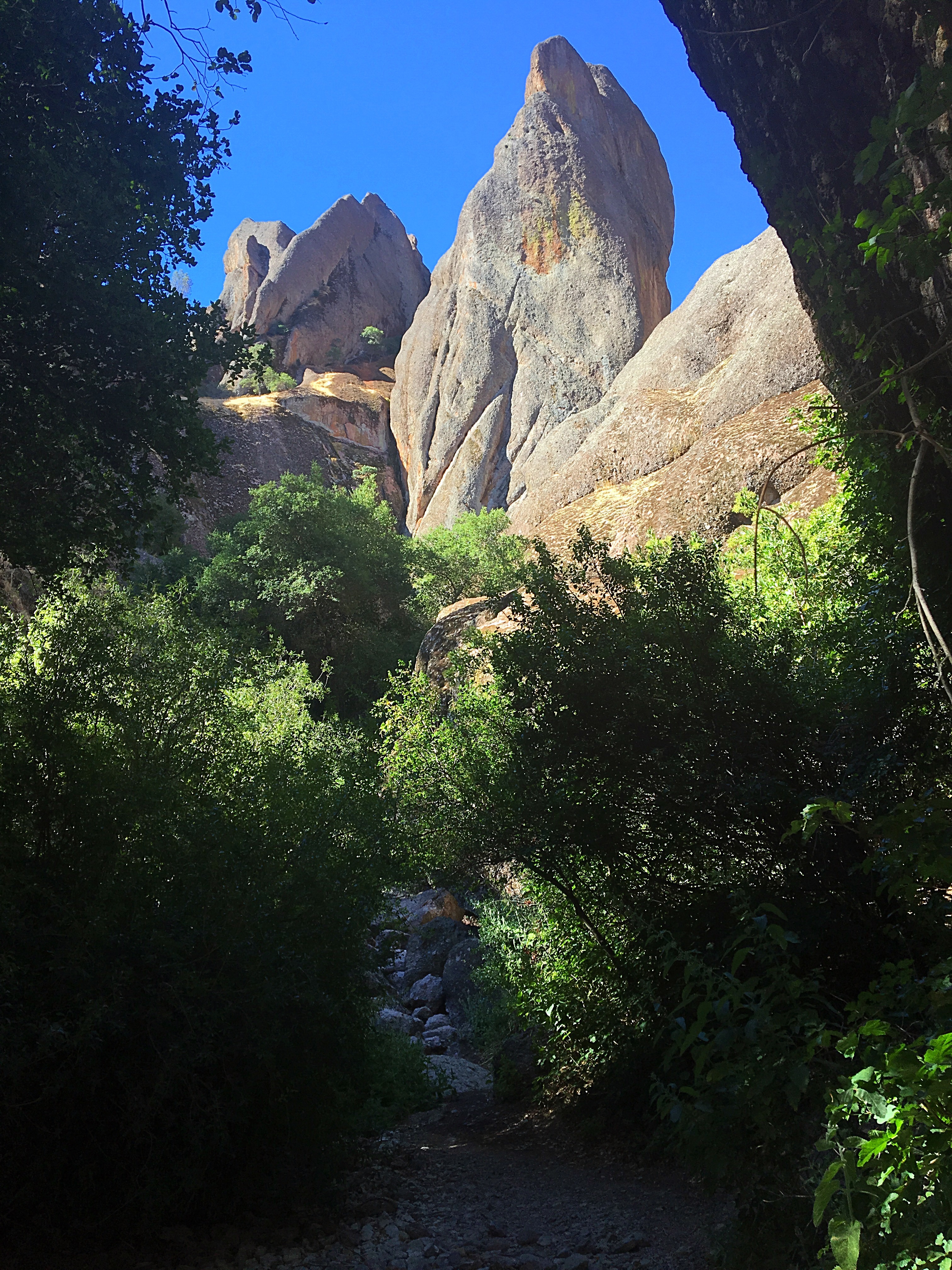
Ultimately, our effort paid off — the trail took us to an incredible peak revealing far reaching vistas of valleys, rock formations and mountain ranges to the east and west. The High Peaks trail showcases prehistoric rock formations; volcanic activity created these rocks 23 million years ago and erosion formed them into what we see today. It surprised me to learn seismic activity moved the solid, massive boulders over 195 miles northwest from the time of their creation.
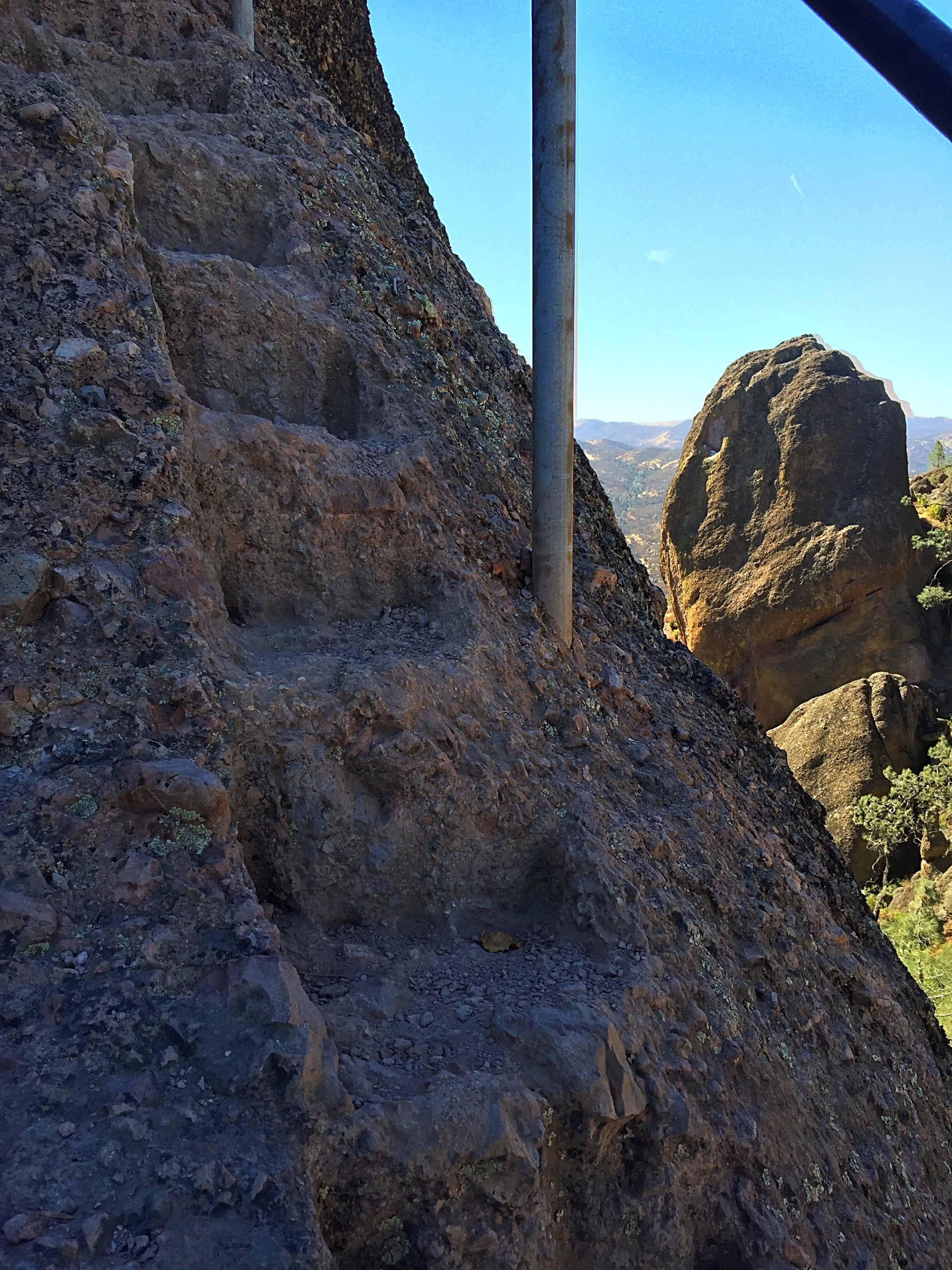
At the crux, we walked up and over boulders that created a long ridge — in many places, the trail was carved by dynamite into footholds and steps. We stopped to catch our breath, but lost it when a Condor flew overhead! One of only 36 wild in the park, we knew we were in the right place at the right time.
Shortly after we made our descent, we saw a couple on the trail.
“Is the peak much farther?” The young man asked. He sat in shade created by chaparral, his face was red and dripping with sweat. “We are thinking of going back.”
“You’re so close,” I told him. “Keep going.”
“It’s worth it,” my friend said. “The views and everything — you don’t want to turn back.”
“And there’s a cave on the other side,” I said.
Halfway down, we found a spot to rest and wait for the full moon. Despite my aching feet and jelly knees, seeing the moon — large and pink — rise over the mountains at sunset was a glory to behold.
It was dark when we returned to camp for dinner. Eating that night, I noticed a sense of vitality within me. My blood pumped through my veins, fresh air emboldened my lungs and my muscles felt active and alive! Balconies Trail
The next morning, my fellow glamsient left early for work. Part of me wanted to head home, but I quickly recognized that desire as my old habit of rushing to the destination. The Balconies Cave enticed me and, remembering to slow down and savor the journey, I chose to stay in the park.
Driving to the trailhead I saw quail, turkeys, and a doe with her fawn. The parking lot was empty apart from my car, and only the sound of birds accompanied me onto the path.
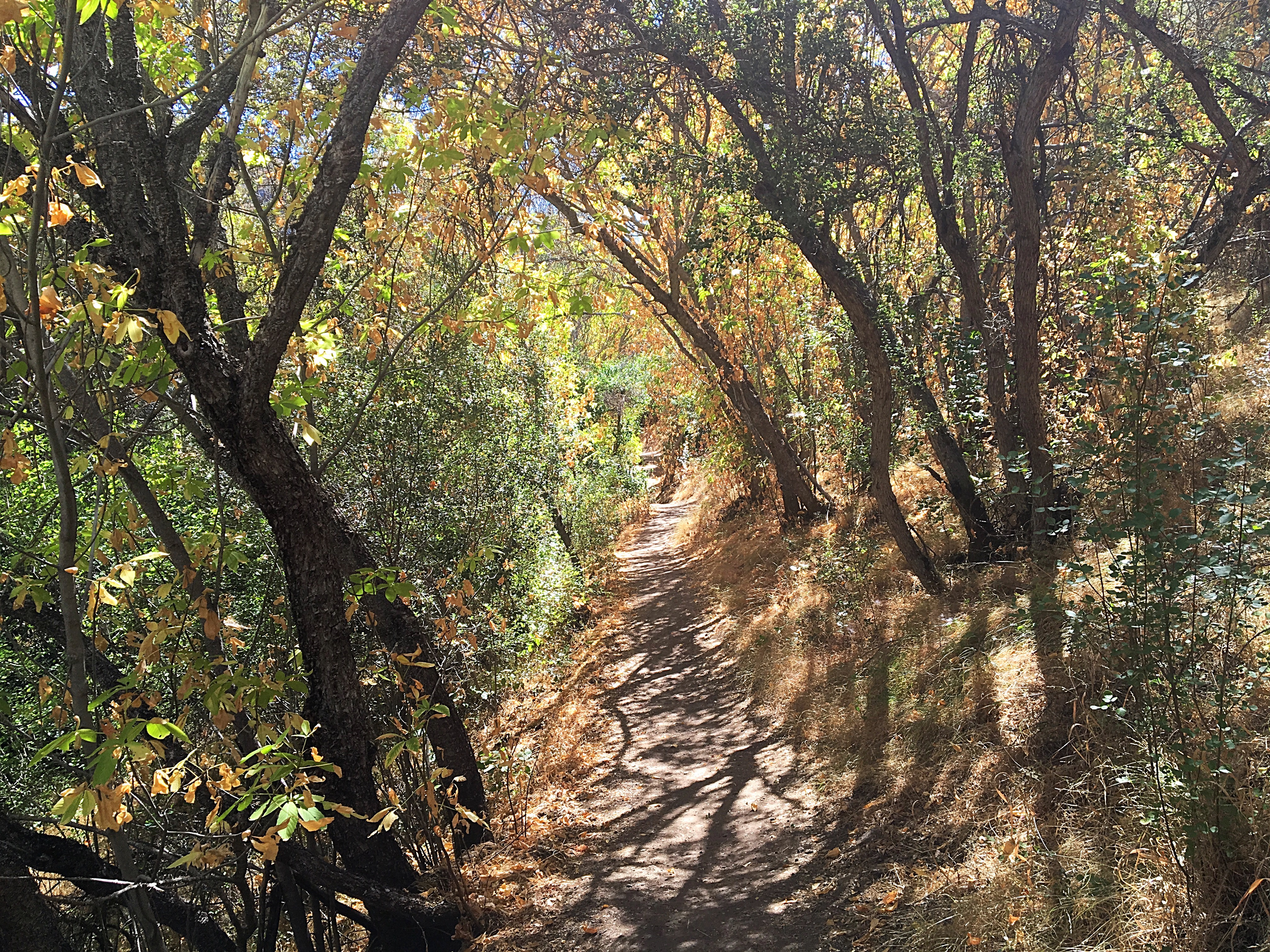
Meandering through trees, the Balconies trail is mostly flat — a perfect companion to yesterday’s strenuous hike. Yellow swallowtail butterflies greeted me as if to say I had made the right choice. I breathed deeply, enjoying the time to myself.
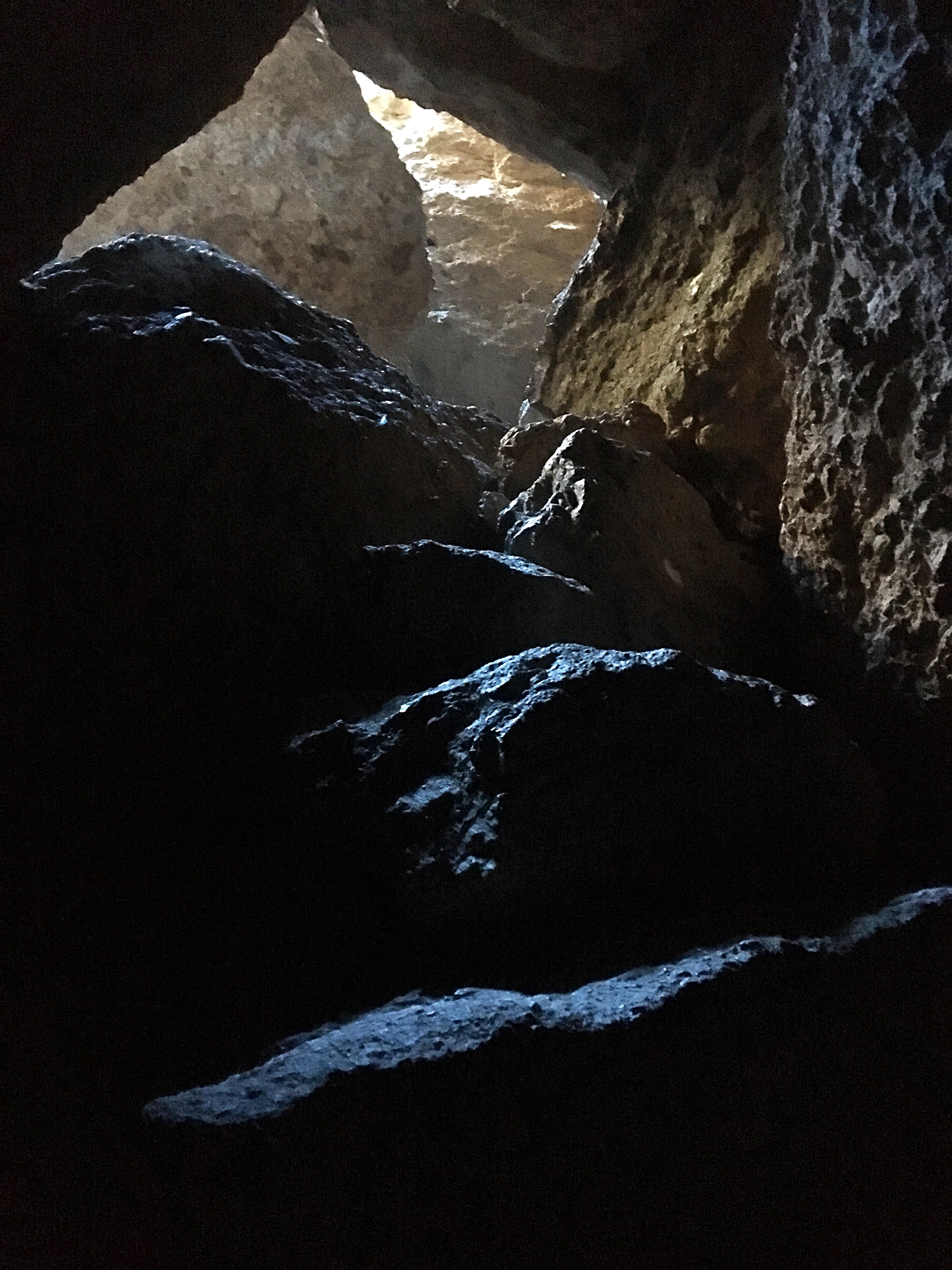
When I came to the entrance of the talus cave, I saw a large, metal gate. “Flashlights Required,” a sign read. Having seen a similar warning at the trailhead I had my headlamp — and thank goodness for that! The cave was pitch black; only little white painted arrows marked the trail.
Cool and dark, the deep quietude of the cave penetrated my being. I was completely alone, and instead of steadily moving through to the other side, I sat and turned off my headlamp. Surrounded by rock, my small, vulnerable body felt soft and humble, but I was not afraid. I felt held and supported. I seemed to dissolve, as if I were part of the rock, the air, the empty space. In perfect stillness, I tuned to the deepest part of me — connected and endless.
When I was ready, I moved forward through the cave. As soon as the first rays of sun beckoned me out I wanted to go back into the dark, cool, quiet chamber. It had given me a thrill unlike any other.
Hiking the next section of the trail — a moderate stretch with views of rock formations jutting out of the earth like balconies — my mind returned to my experience in the cave. Wholly grounding, yet also uplifting, I longed to return to the cave and the feeling of oneness.
Rock FormationsSmall and humbleA shady, gentle, empty stretch of trailFootholds in the trailRocky trailRock formations over the trailEntering the caveExiting the caveTaking in the view from the high peaks
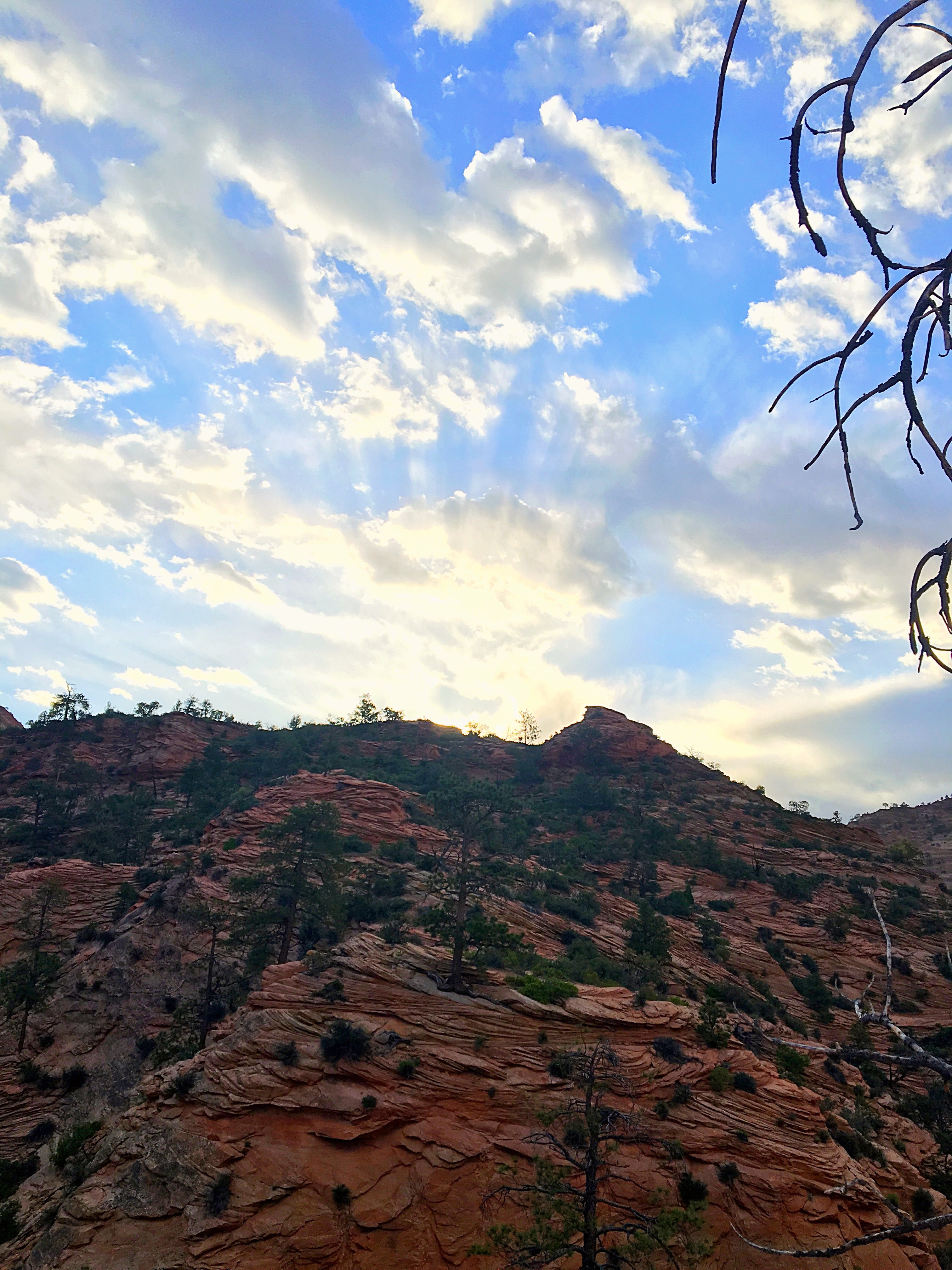
Alone at 6:00 am, watching the sunrise over rock formations, climbing natural staircases, feeling smooth buttresses with the palm of my hand, I come to sit on the top of a earth-made spier — I feel like the uppermost piece of a cairn. I sit patiently, open to a message from the landscape.
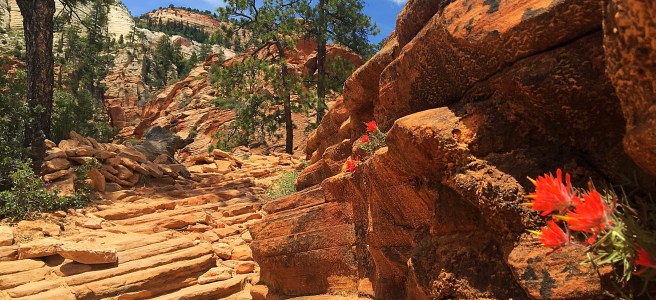
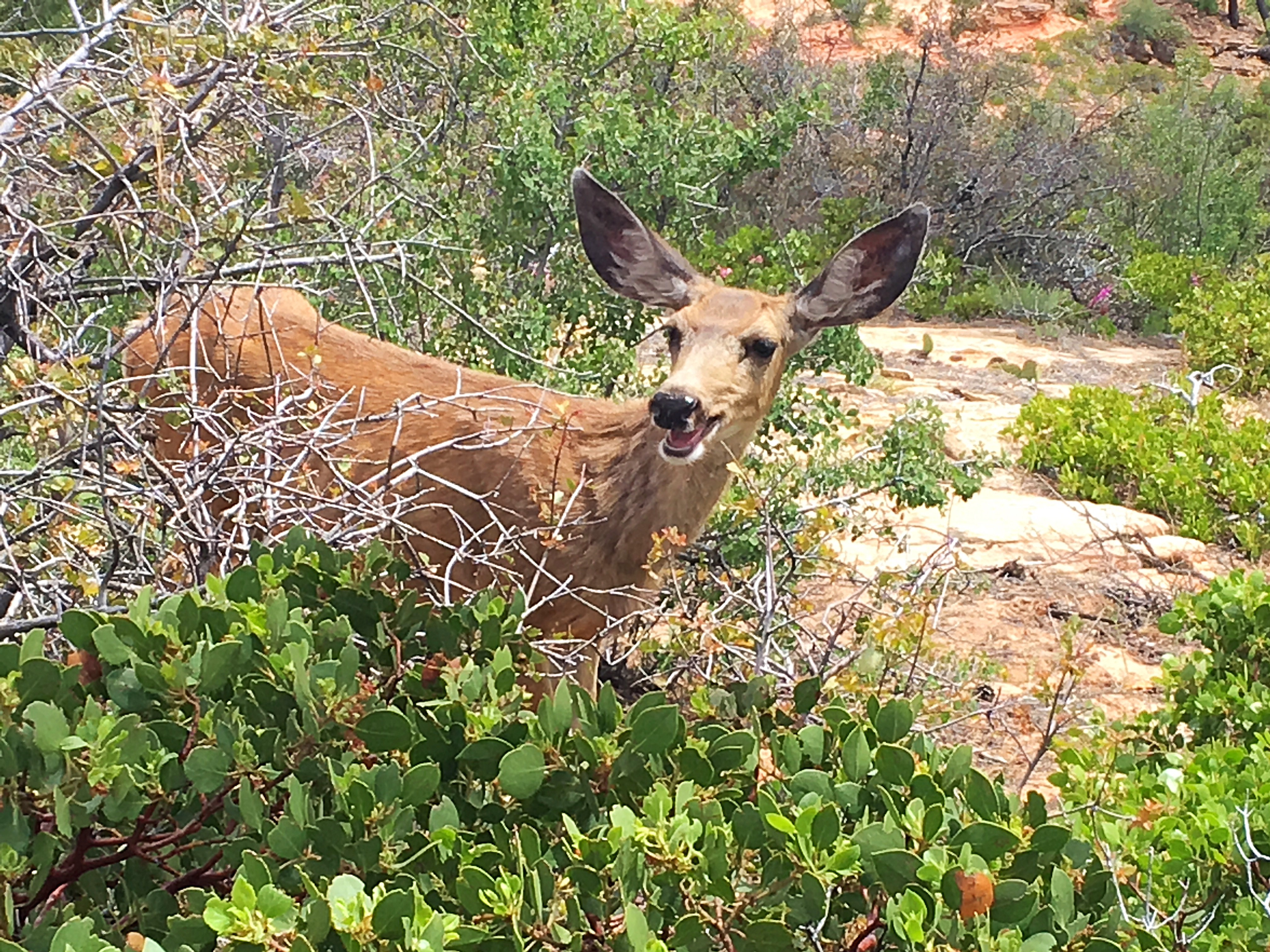
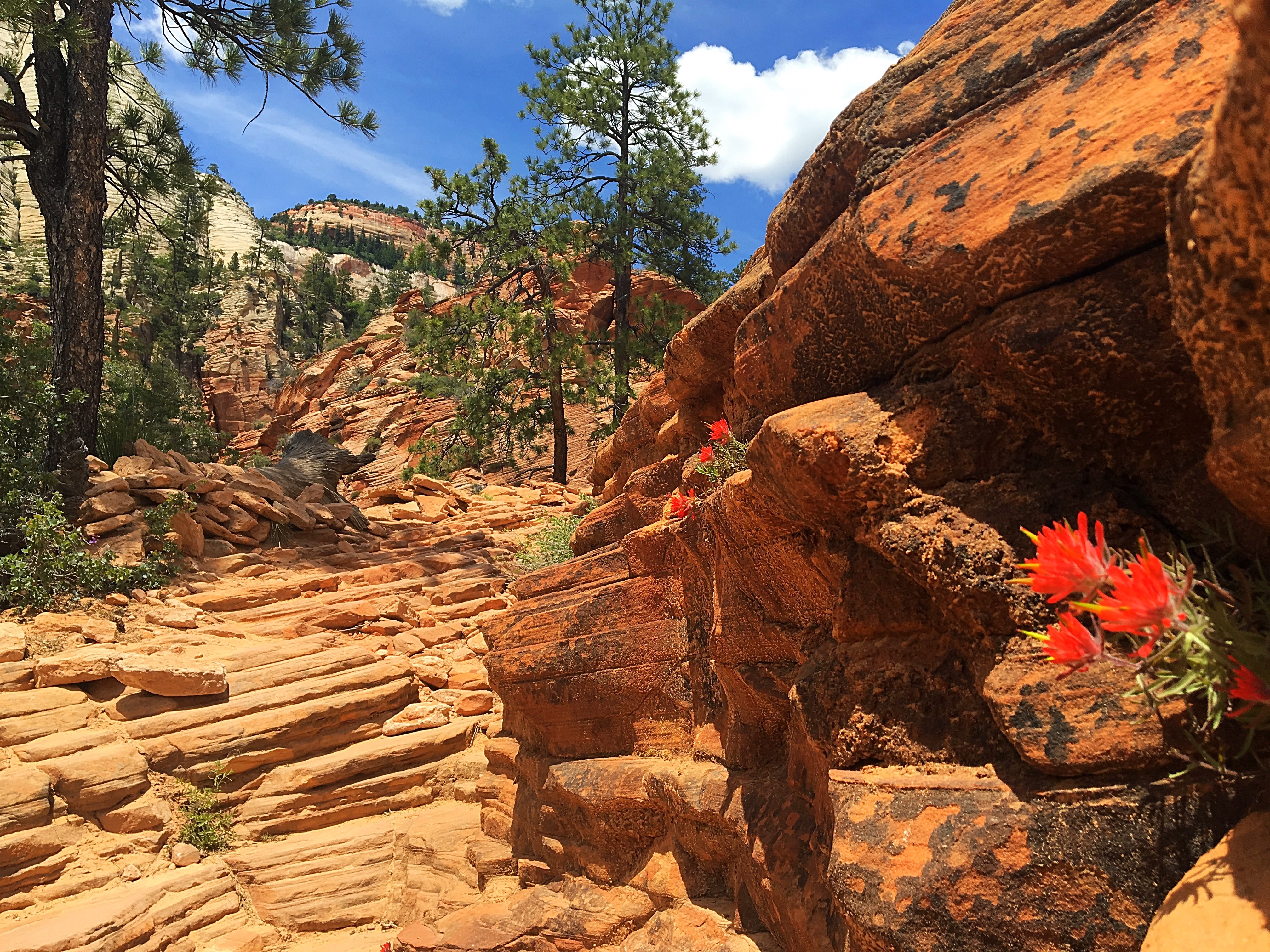
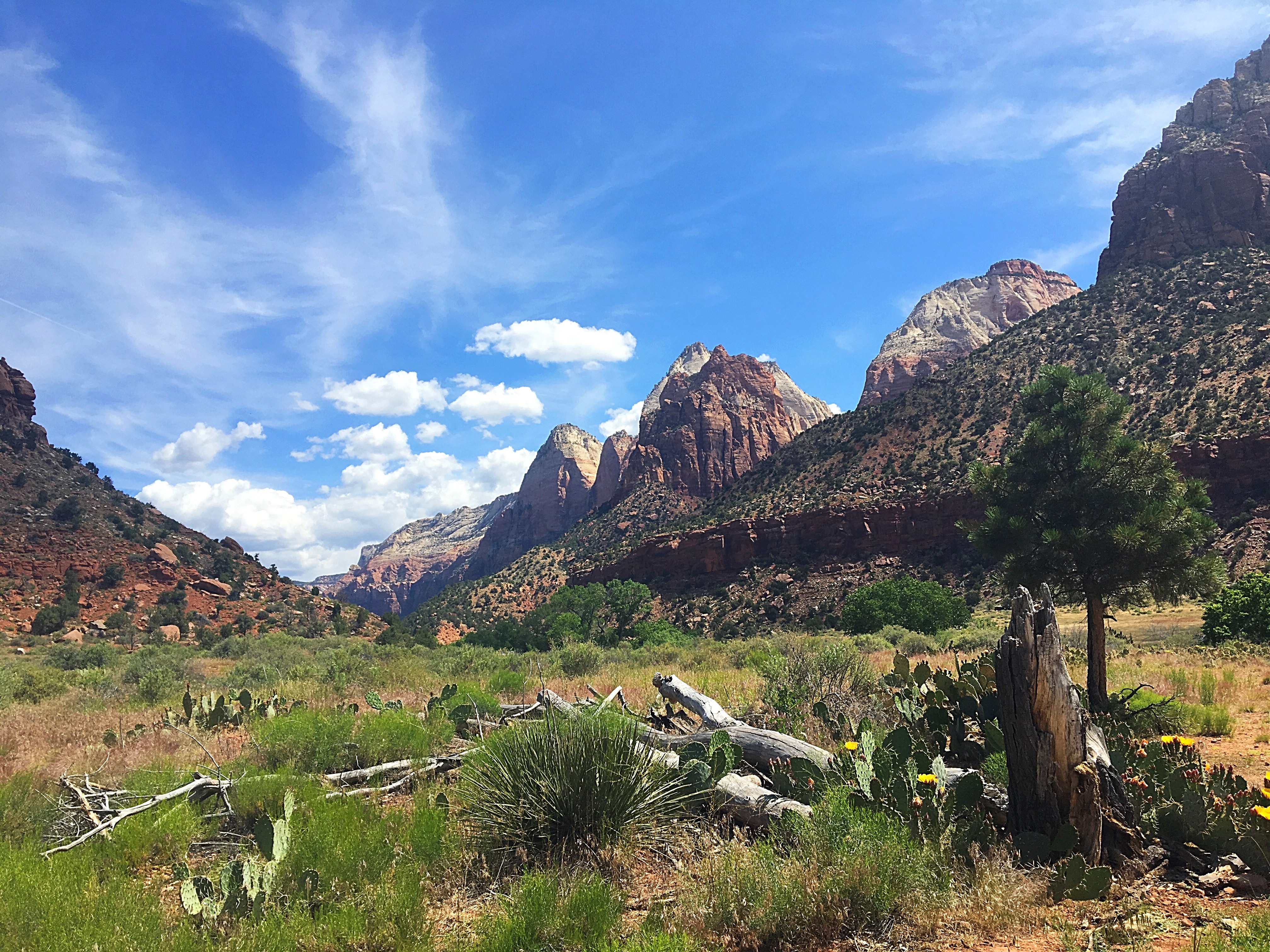
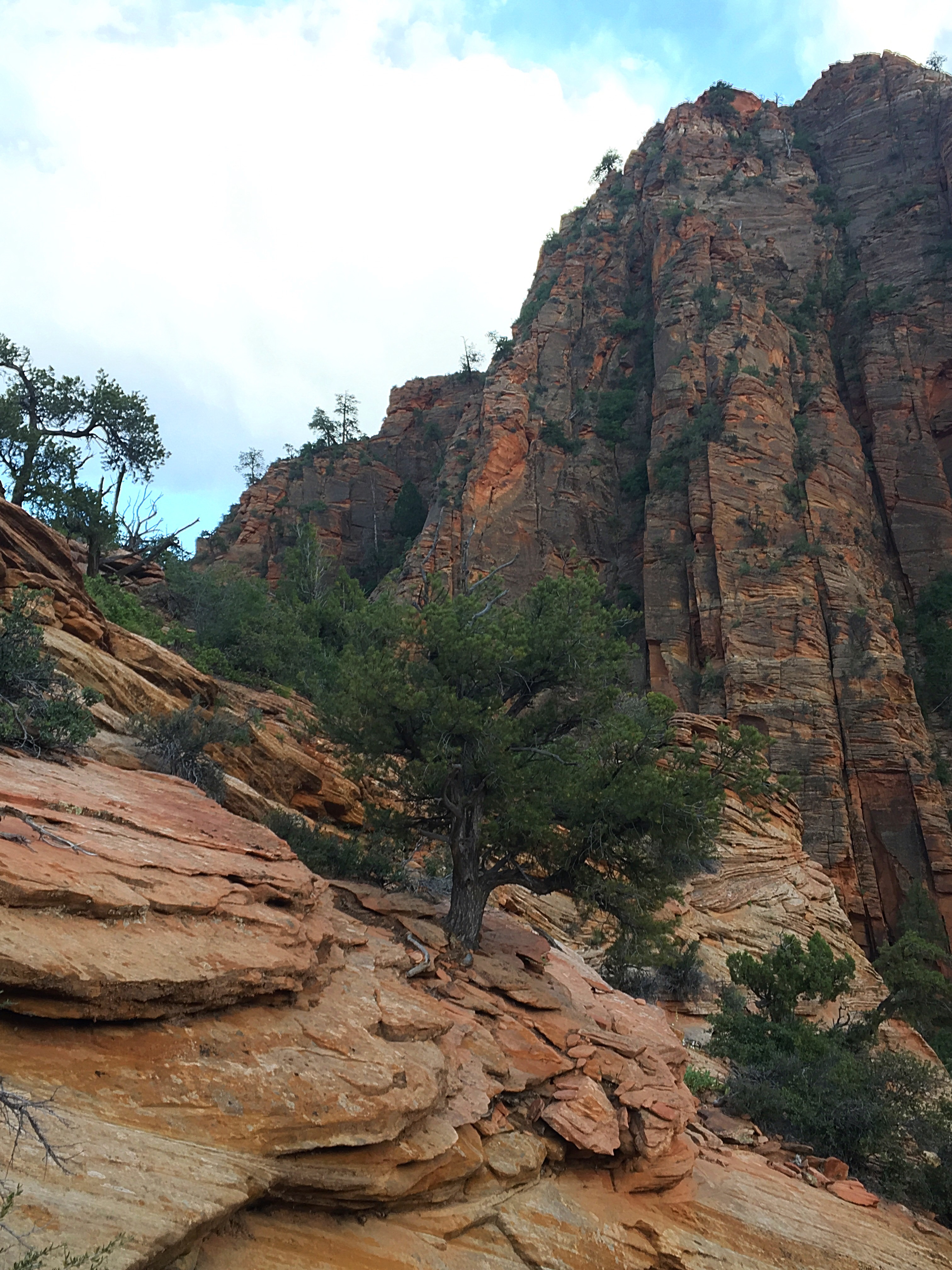
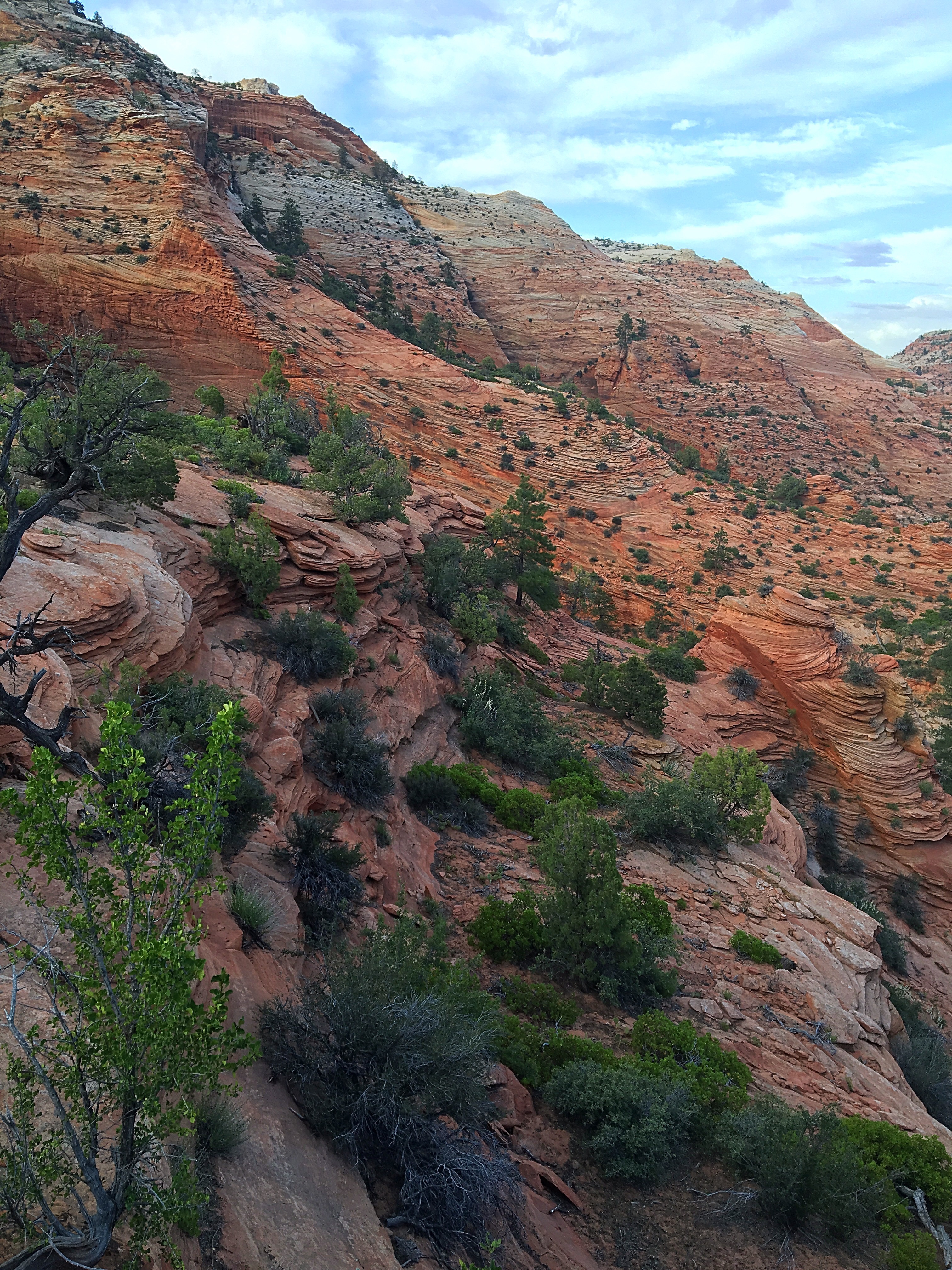
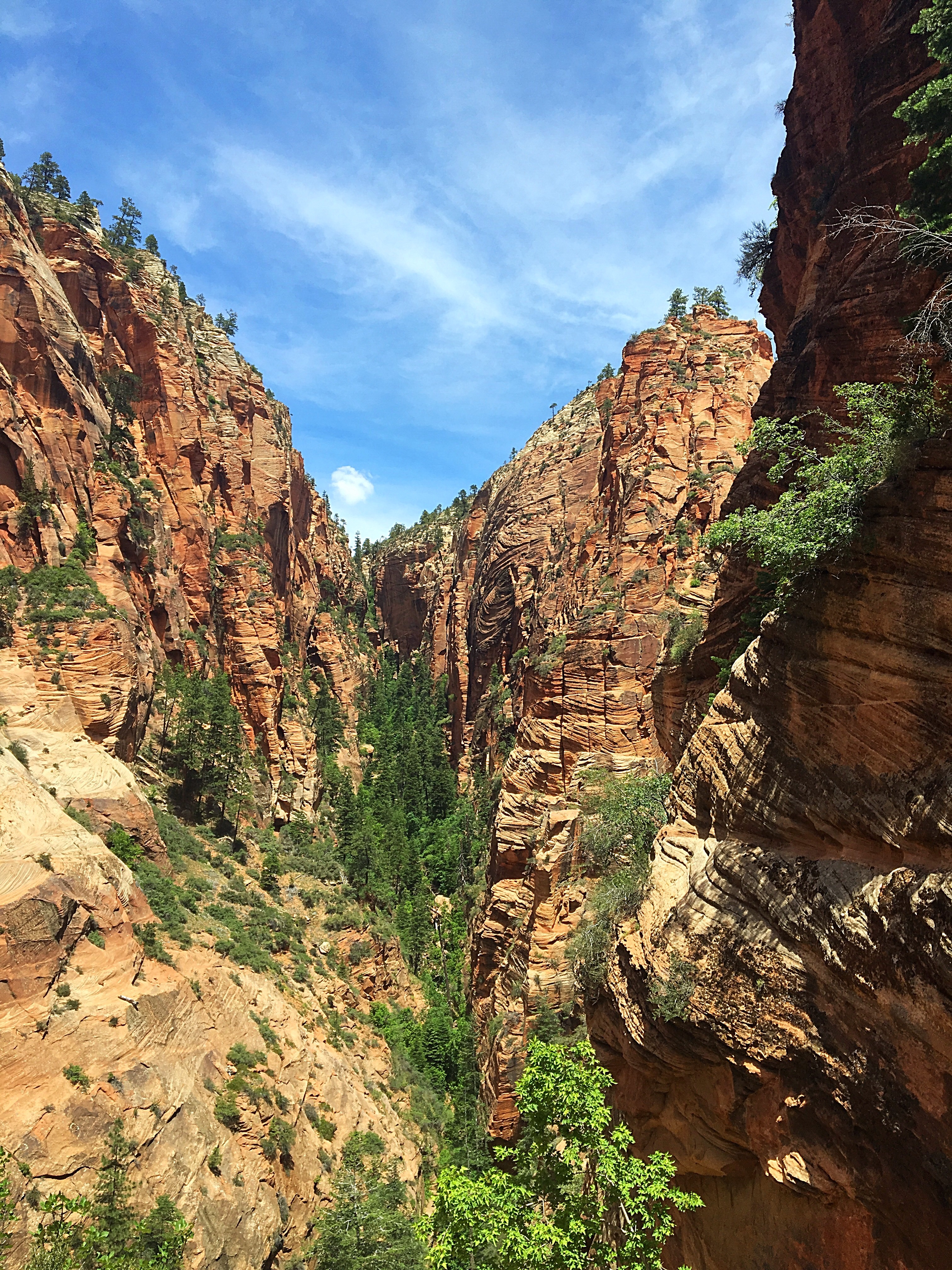
A sparrow flies in circles around me. Scat below my feet tell me deer enjoyed this view not long ago. I recalled the joy I felt seeing the hot and thirsty doe near Angel’s Landing the day before, and my surprise to see her at high altitude. A tree grows from a crack in the rock behind me — most of the trees and plants I see here seem to force their way through hard, impossible places. The sun’s rays pass by clouds, creating beams of majestic light that illuminate the red, yellow and orange striped rocks around me. Only birdsong breaks the silence of the dawning day.
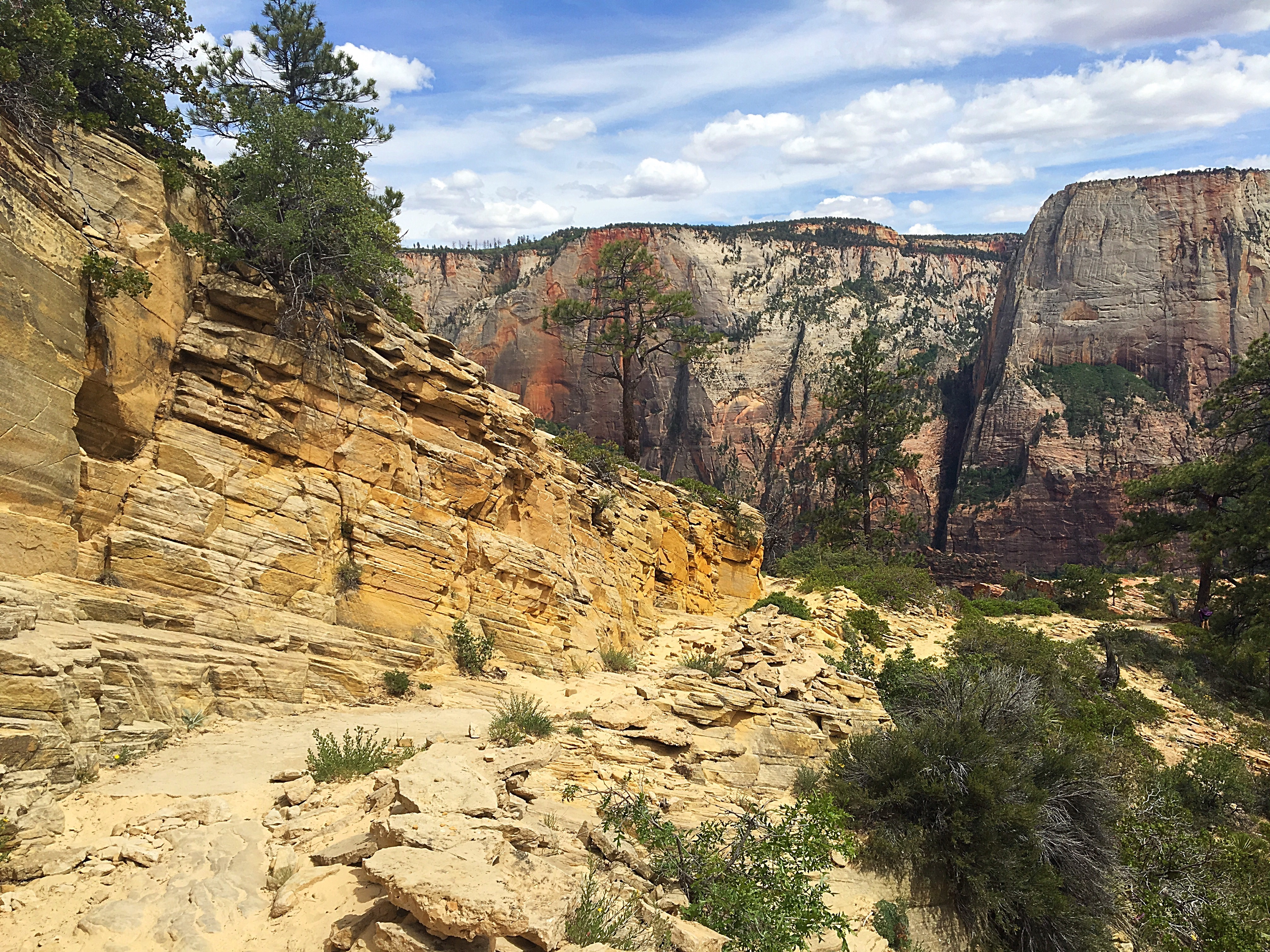
I look upon the earth before me. It is almost impossible to believe, sitting on a rock perch, that 275 million years ago this region was a flat sea basin. But it’s true: The iconic Zion landscape in Utah is the result of millions of years and five geological processes: sedimentation, lithification, uplift, erosion and volcanic activity. I look upon a working transformation — geological processes that continue today.
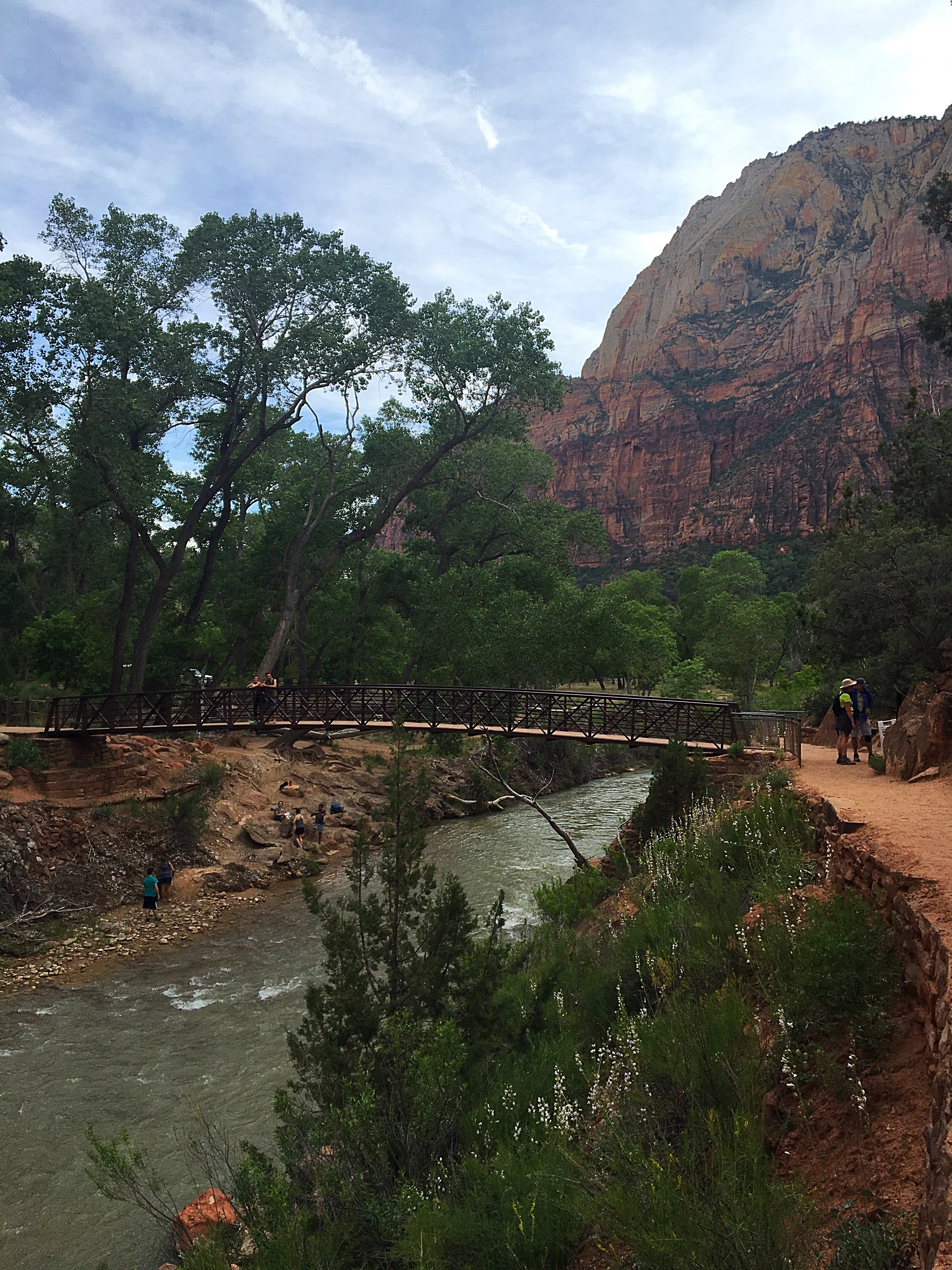
The resulting transformation is an unparalleled beauty that speaks to the soul of an unseen power. Several times while hiking I had to sit and pause in stillness and quietude to fathom the power of the rivers and the earth’s movements that created the structures and forced the earth towards the sky in vast towers and points.
I wondered, would the flat basin give home to the many plants and animals I had seen? Would the flat basin draw tens of thousands of visitors in a day with its grandeur? Could it provide the same inspiration to artists, have the power to pierce your heart, and take away your breath?
The spirit of Zion revealed itself to me with insight into myself.
I am a creature of change. I actively pursue transformation of my consciousness to become a more radiant reflection of human possibility — an instrument of equanimity, love and peace. I long to be transformed, to allow the processes within and without mold me and sculpt me into the shapes that I am destined to become.
The work of authentic transformation is ongoing and multifaceted: Zion is still changing. The rocks tell me to be humble, relax into the processes, accept and surrender to the unseen power. Growing pains must not be resisted or feared, but rather, seen as an effect of personal evolution. Life provides limitless opportunities for inner refinement; being present to reflect my true nature requires a Zion-like patience.
Sunrise; Zion National ParkDoe near Angel’s LandingOrange RocksYellow rocksOnce a flat sea basinA tenacious treeVirgin River; a major force in Zion’s transformationTrees growing out of striped rockNarrow Canyon






 glamsient.me