Canyon Meditation

We chose not to look at the map and found what we believed was a path. As we walked, the forest seemed to hold us while birds sang its melody. We passed elk tracks preserved in dry mud and saw a tree that had been used as an antler scratching post. I wished I could walk without knowing our destination.

Upon hearing human voices speaking languages from all over the world, we knew we were close — and suddenly — the forest opened.

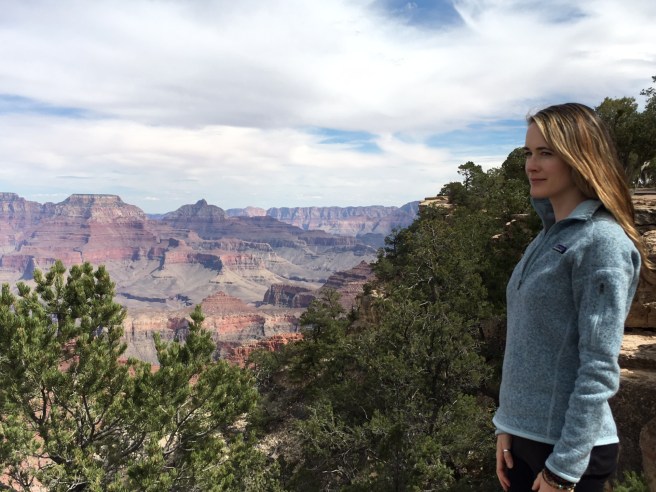
A magnetic pull from my heart led me to the canyon rim as though I were under enchantment. My body shook with adrenaline. Before me, a chasm ripped the earth and rocky, layered peaks formed colorful monuments, temples, pyramids, and fortresses. Spires and pillars rose from the ground like giants. Greater and larger than Stonehenge, than Chichen Itza, than man could ever be.

Nature’s chisel wielded by the Great Artist etched walls with shadowy crags and adornement. Creation coalescing into wonder from nearly two billion years of both violent and gradual evolution written in the rock. Lava and mud spreading and widening the canyon carved by wind and water, plateaus rising, glaciers melting, the continent crashing into volcanoes and making mountains. Erosion — pushing, pulling, forming megaliths and smiles that become wings of expanded freedom. A testament to my limited, human experience.

The river deepens the canyon as she moves to the sea — her former grandeur evidenced in decorated cliffs — she is now a mere trickle of what she must have been before dams and reservoirs closed her veins like tourniquets.

The Artist exhibits the freedom to transform, to shift — to evolve into beauty, into living inspiration.

Even with their loud voices, the other tourists don’t bother me. The vastness is large enough for us all. So large that I sense I can give all the heaviness of my heart to the canyon. All the pain of memories and attachments can release. And my heart will become expansive; my heart and the canyon will merge into one, magnetized like the continent and crashing into volcanoes. If I let it fall, it will tumble into the river and be swept away to the ocean. I can let it go — I can give it all to the One who is capable of transfiguration.

I hear the wind before I feel her. She comes up from the canyon depths and brushes my face. I feel the coolness of her touch. She is a whispering echo saying, “hush.”

Crows fly with feathers straight and light in the space between earth and sky. Above the canyon, below stars. Small, yet fearless. As we must be.

IMG_5645

The Inside Joke

After a full day building camp, several friends formed a group to go out. Of course I wanted to join! I grabbed my necessities (headlamp, toilet paper, goggles, emergency champagne) and hopped on my bike. As we turned onto the esplanade, art installations rose from the dust as far as I could see. I lagged to catch glimpses of them as we passed. Art or friends? Art or friends? Curiosity pulled at me. 
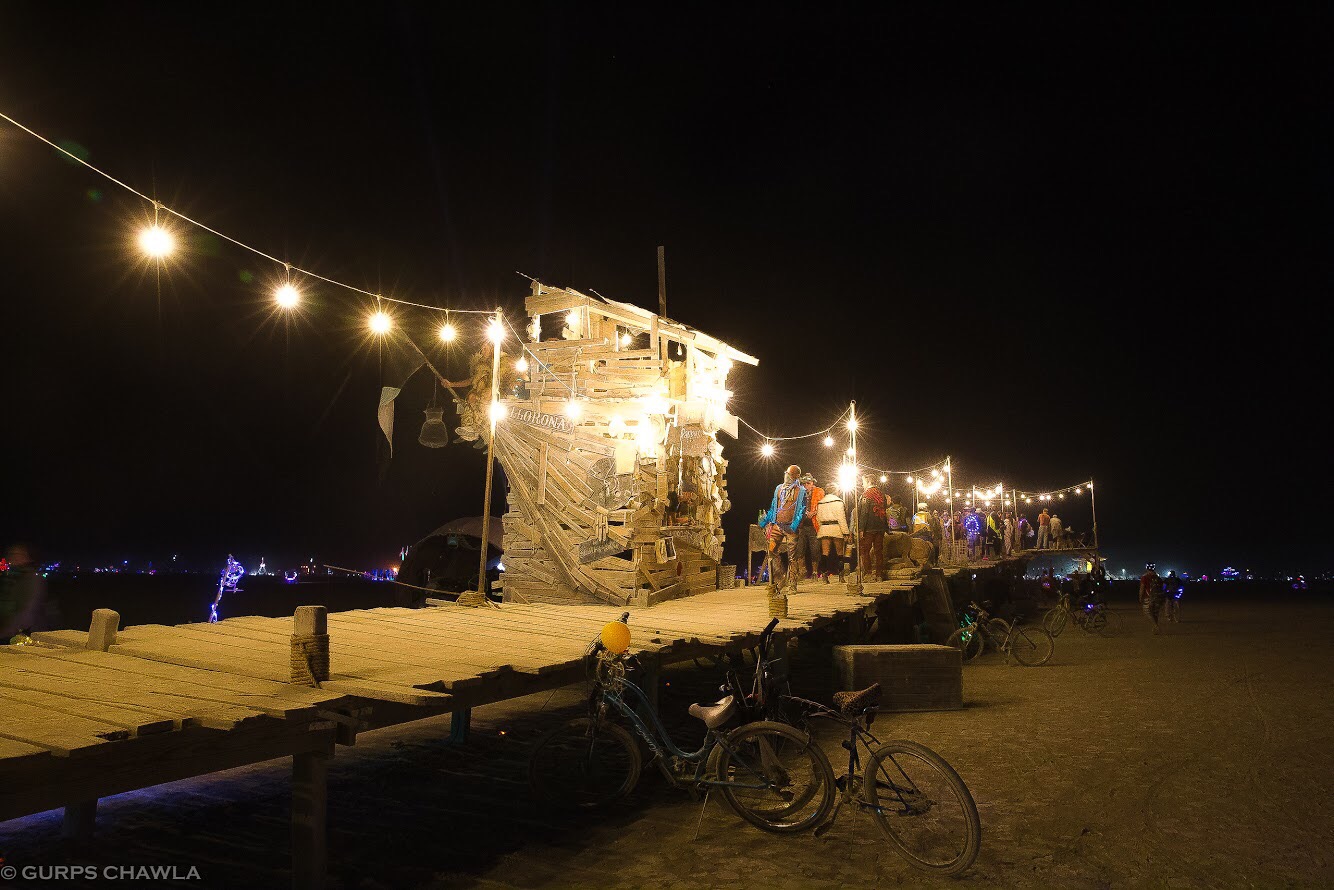
And then — we approached a pier. 
Group mission be damned! This was the emptiest the playa would be for the rest of the week, and soon the pier would be crammed with tourists.
I stopped and put my feet onto the dust. I pulled the scarf off my mouth and called to my friends: “Guys! I’m stopping to look at art!” Either they didn’t hear me or didn’t care.
Except for Kitten, my faithful companion.
“I can’t keep passing art installations. It’s our first night out,” I looked towards our group; they had already blended in with the other blinking lights.
“We have all week to find music, but we only have a week to look at art,” Kitten dismounted his bike.
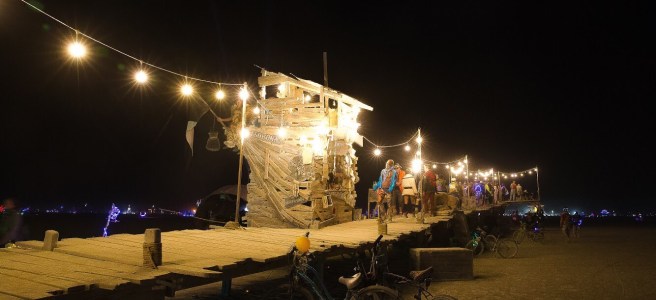
We stepped onto the pier. Nets and ropes hung between posts, hammocks swayed beneath the boardwalk. A long string of lights romanced me. I hooked my arm into Kitten’s.
The boards creaked under our footsteps — just like the old boardwalks I’ve wandered along in seaside towns. And for a moment, when I relaxed my eyes and looked up, it felt like we were at the sea. But looking down, seeing the dry lake bed below us, I thought of the sheer genius and manpower it must have taken to build this dock — from the concept to the design to bringing the materials and assembling them in the middle of nowhere without basic amenities like running water. 
We arrived at the midway tower. We leaned in to view its inner intricacies. Some people were gathered on the upper level; I’d be willing to bet they were drinking whiskey.
“Want to go up?” Kitten asked.
“Not particularly.” I felt content looking inside the tower at the details that made it seem more like a relic than a modern piece of art. It gave me a sense of nostalgia for a time I knew only in turn-of-the-century novels. Antique photographs, compasses, hourglasses, bound books, and glass bottles — in all colors, sizes and shapes — the scene piqued my curiosity to touch and pick up the items. Every detail existed for exploration, a mystery to be revealed, a reverie in which to lose oneself. It was a living, breathing piece of art that transported us to a different time and place. The curiosity, the wonder of it all, put me back into the frame of mind of a child: everything was new and strange and deeply interesting.
On the other side of the tower, we found an antique desk — the kind in which the door to the main compartment folds down to become the writing surface. My literary heart skipped a beat. 
“And what could be inside?” My curiosity whispered with glee. 
When I opened it, I found the cubbies, that once may have organized papers and mail, were filled with antique glass bottles. How odd. I touched a few, pulling them out of the compartments and examining their details, trying to understand their riddle. And then — I found one that contained a piece of paper.
“A message in a bottle!” I gasped. I lifted it with awe. The bottle’s long, skinny neck was jagged at the top. “What kind of message do you think it is? Profound wisdom?” 
Kitten shrugged.
I slowly put my index finger into the bottle, careful not to touch the toothlike edge, but my fingertip barely reached the paper. I pushed in a little more until the base of my finger rested against the pointed teeth. I could only move the paper around in circles along the side of the bottle. The shape of the neck made it impossible to drag the paper out.
“Don’t hurt yourself,” Kitten warned. “We are in the middle of nowhere and it’s dirty. You’ll want a working hand for the rest of the week.”
I sighed and pulled my finger out. “I’m just too curious.” I turned the bottle over and around, trying to see if I could read the message from the outside, but the paper was folded in half. Even more mysterious. I inverted the bottle and shook it, but the paper wouldn’t fall out.
“Oh well, let’s go,” Kitten said. “Slicing your finger is a bad way to start your Burn.”
“Let me try one more thing.”
I held the bottle so the paper was at the very base of the neck. I put my finger back in and pressed the paper firmly against the glass. It slid along the edge, I almost got it passed the base of the neck, but it slipped back. 
“Leave it, come on, there’s a lot more to look at,” Kitten said. “There’s bottles everywhere. Just look at all these bottles over here.” He motioned to a couple of antique suitcases behind us with bottles on top of them.
 “I have to know what it says!” I insisted. “I can’t just find a message in a bottle in a desk on the dock in the middle of the desert and just — walk away without knowing what it says! A message in a bottle at Burning Man. Who knows what it says? Maybe it’s written by the artist.”
I turned the bottle a little more, got my hand on the side with the shortest teeth and finally — I had the paper sliding up the neck and out of the bottle! I held it in my hand like it was a golden scroll of truth. “Yes!” I said to Kitten, my eyes wild with excitement.
I unfurled the paper and paused. I was hungry for the message I worked so hard to receive, but needed a deep breath. Delayed gratification.
“Come on, open it,” Kitten said.
I opened the paper. 
I read it aloud: “Go Fuck Yourself.”
Kitten and I looked at each other and burst into laughter.
“Oh that is good,” I said as I caught my breath.
“We should’ve seen that coming,” Kitten smiled.
“A special message from the artist,” I joyfully mocked myself as I folded the message and rolled it back up. “A message just for me! How absurd.” I laughed as I placed the paper back in the bottle, making sure it was all the way in for the next person.“Well worth the effort, I say.”
“It couldn’t have been more perfect,” Kitten agreed.
I put the bottle back exactly where I found it and closed the desk.
Kitten and I continued our walk along the creaking pier to the very end. I looked out at the playa — illuminated art installations dotted the landscape — and I realized this pier was on an endless sea of wonder.

“The Pier” by Gurps Chawla

The Cows of Black Rock City

My bike, with twinkling lights strung around its frame and the chain clicking in a dry loop, glides along the dust, creating tracks on tracks, crossing tracks without pattern or reason. 

The high desert, in the dark of night, mirrors the midnight sky.  

Now, the thin layer of dust on my bike, by week’s end, will gather as though it hasn’t been ridden for decades, but instead, left old and forgotten, in the recesses of a workman’s garage. Dust on my clothes, my skin and my hair. I wear a scarf over my mouth and nose, but there must be — there has to be — dust in my lungs. By week’s end, I will also look old and forgotten.

Colored lights move and spin and dance chaotically. We become our lights in the dark expanse; nothing else to differentiate between us and the nothingness, we put on our lights and become technicolor shooting stars.

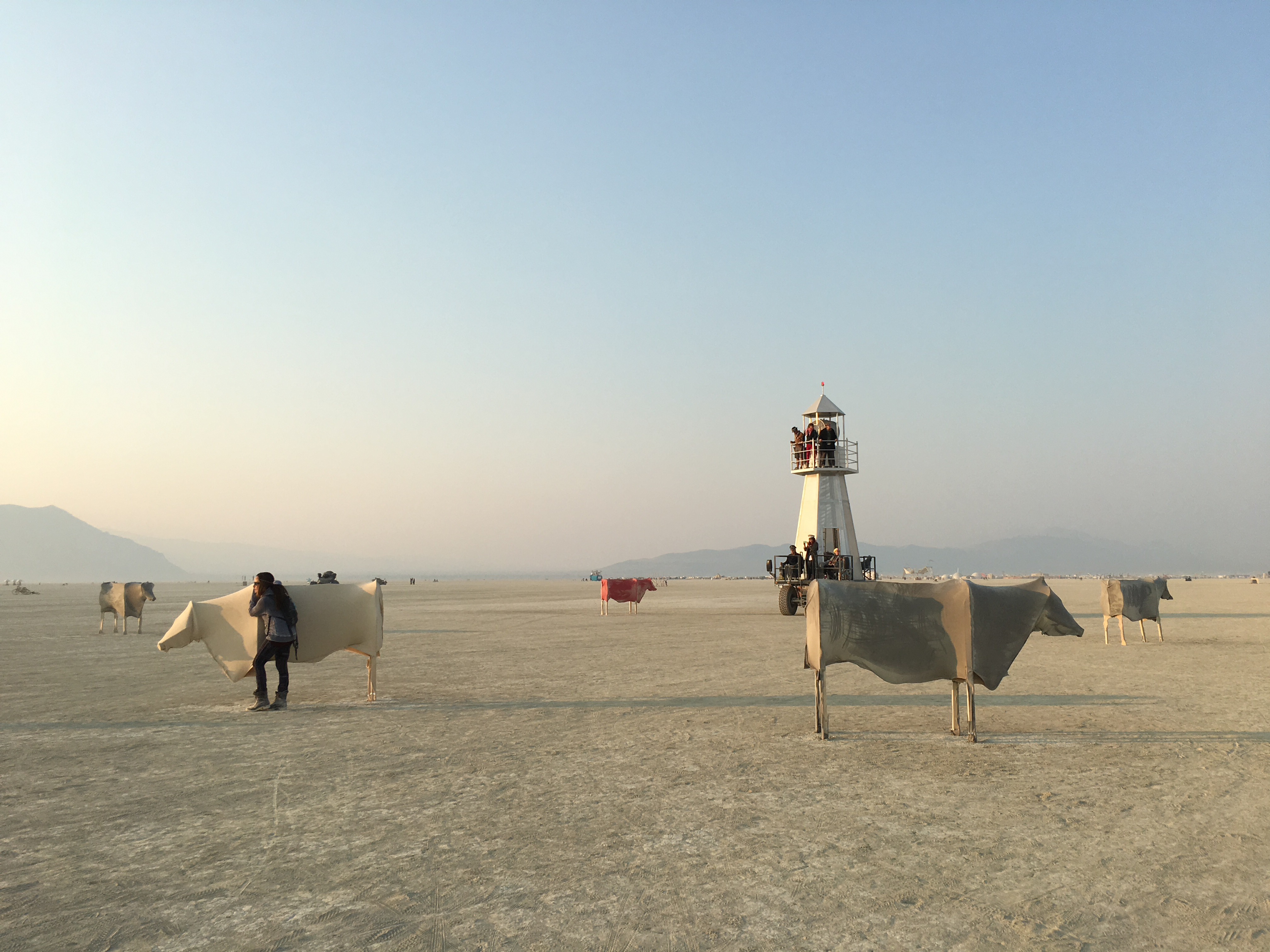
A herd of cows appears out of the dust and darkness, dim lights twinkle from their insides, the only thing differentiating them from the nothingness. I ride up to them. Stationary and unafraid, metal skeletons wrapped in translucent nylon.

Sadness wells in my heart.

Peaceful bovines, sacred cows. An object. Not a living, breathing, feeling creature. Yet these are the lucky ones, in the darkness of the playa, amongst the dust and the art; they are not trapped in a pit of manure, in line to die never having eaten a blade of grass or stepped foot in a meadow.

Their twinkling lights are the same as my own. 

Our shared reality — the degradation of life, the distortion of our divine nature. Yet I am one of the lucky ones, in the darkness of the playa, amongst the dust and the art; I am not trapped in a war torn city, used as a human shield.

I remember feeling this way last year — or was it the year before? The sadness of contrast, a melancholy inspection, sudden thoughts and emotions inspired by the depths of creation. Here in the dust — the critique of modern industry, modern society, modern greed — in the middle of nowhere, surrounded by darkness and lights.

The Herd of Cows in the morning

Burning Intentions 2017

It’s late and I’m watching the newly-waxing moon set in the west. I’m driving through the mountains, en route to Black Rock City for Burning Man. This will be my third time participating in the art and music festival. 
Last year, I set intentions that mainly focused on my interactions with other people. And although they were extremely elevated, I saw and felt my intentions manifest in some of my experiences.
I’ve been humbled and challenged this past year — especially recently — and my intentions reflect my need for deep nourishment and reflection.
To share our intentions is to empower them. Please read mine below:
I intend to reestablish my relationship with my creativity; to fully engage with the art installations at the festival and allow myself to be inspired and motivated by them. I need to reset my relationship with my creativity in order to create for creation’s sake without the desire to be seen, popular or make money. This will afford me the freedom I need in my artistic pursuits. I must reconnect with my truth that God’s gift to me is my creativity and my gift back to God is using it.
I intend to be open to receiving the keys I need to enhance my productivity and fulfillment.
I intend to continue the process of letting go of the pain and hurt I hold onto by releasing the people and events from my heart that continue to cause me suffering.
This year, I would like to feel and witness the expansive love that is my true essence, so that I will know who I am.


Photo by Juan P. Zapeda last year at Burning Man.

Sierra Hot Springs

The edge of a summer storm passed overhead breaking the monotony of blue sky. Patches of clouds cast temporary shade as they moved, releasing a misting drizzle, which fell upon us like a celestial blessing. Birds sang the glory of the day.

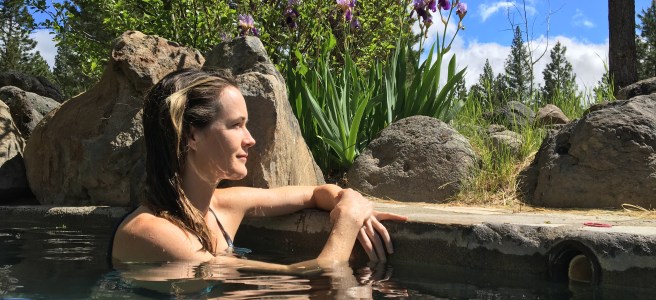
Stephanie and I relaxed in the large pool. She rested her head against the cement lip and closed her eyes; I faced away to look beyond the deck and view the Sierraville Valley.

People populated reclining chairs, others floated and bobbed in the pool. Stephanie and I were the only ones wearing bathing suits. 

Stephanie hadn’t spoken much since we left the silent dome and the hot pool it contained, but it didn’t bother me. I remembered my first time in the dome and the reverent silence that settled into my heart and mind as I slipped into a profoundly easy meditation facilitated by the heat of the tub, the arhythmic sound of water dripping into the two cold plunges, and the stained glass window — a woman resembling at once the Virgin Mary and Venus de Milo, pouring light into the waters through her outstretched hands. 

I looked to Stephanie; her face, perfectly serene, took on an ancient quality as if her soul had known this place years ago. 

Her visage made me want to rest my head against the cement lip, too, so I turned around. Just as I did, I saw a woman, floating on foam noodles — one under her shoulders, the other under her knees — as if she were in a chair. The woman’s eyes were closed, and like Stephanie, she hadn’t a care in the world. She could not see that her legs, spread in blissful comfort, moved towards the edge of the pool putting her naked groin on a direct trajectory for Stephanie’s face.

I poked Stephanie. She opened her eyes slowly until she realized a woman’s crotch was heading for her. 

With only a few giggles, Stephanie moved out of the way, and broke her silence: “want to check out the meadow pool you were telling me about?”

“Sure!”

We got our towels and walked onto the path. Pine trees filtered the sunlight into complex patterns on the ground.

“I love it here,” Stephanie said.

“Natural beauty and healing waters. What’s not to love?”

“Well,” she emphasized, “there is only so much hoochie coochie in my face that I can take.”

I laughed and then saw two porcelain tubs, just off the trail, nestled in the grass. They each had their own stream of hot water flowing into them from the ground. “Look at these, Steff! Here’s your solution!”

“We have to get in them,” she exclaimed. “How is this real?”

“Real magic,” I said.

We sat for a while, breathing in the novelty of relaxing in a bathtub on a mountainside, but we wanted to sit together and talk, so we continued our quest for the meadow pool. 

“I’m glad we sat in the secret tubs. The secret-not-secret tubs. They’re just right off the path, but they’re easy to miss,” I said.

“Everyone walks by, but not everyone sees,” Stephanie said. “I prefer that kind privacy, like the dome because nobody talks.”

“I was here one night and people were talking in there. I didn’t like that because it affected the depth of my meditation.”

Our feet crunched the path, adding a layer to the birds’ song.

“The big pool was a little extreme for me. I’ve never really been around that much nudity.”

“Oh, I didn’t know that.” 

“It was too much at once — naked people almost running into me with their parts. It happened twice. Once was a hoochie coochie and the other was titties.”

“Every time you close your eyes they come for ya, huh?” I joked.

“Seemed like it.”

We passed the white, Victorian Lodge built in 1870. Red poppies brightened the hillside.

“That hot pool, though,” Stephanie said. “It’s hard to explain what I felt. It was like pure energy. I felt a pulse — like a vibration.” 

“Because it’s so hot and the bottom is sand, I close my eyes and lose the feeling of having a body. It’s like my body becomes the water. Must be the closest thing to being in the womb.”

“It did feel like that! And that’s exactly how I felt when we were looking at the grass earlier. I had an out-of-body experience — a supreme oneness, like I was the wind.”

“Wow. Transcendental,” I looked to my left over the wide valley and the surrounding Sierra Nevada mountain range. “You’re so zen you don’t even need the dome.”

“A lady was crying in there.”

“I didn’t notice.”

“She was standing in one of the cold tubs with her face to the wall when we went in.”

“Oh, did she have her hand on the wall?”

“Yes. The dome felt like a place to…” 

“Open and release?”

“That’s how I felt. Completely safe. It was powerful. Every detail. The tiles, the wood, the stained glass. So natural and peaceful and somehow familiar.”

“I felt a release, too,” I said. “Before we walked in there I was angry about what was going on with work. I was thinking about it a lot.”

“I could tell you were trying not to, but you really were lost in thought.”

“But after going in the hot water and spending time in the dome, I feel like I released everything. Now I’m just kinda…dancing on the inside. Like I’m free.”

“Freedom is dancing on the inside. That could be your new motto,” she said as she looked at the trees who grew above us like guardians. “I like all the moss that’s growing.”

“I love mossy trees. And all the tall, lush grass,” I paused my step. “You know, earlier, when we were looking at the grass?”

“Yeah.”

“I was definitely lost in thought, thinking about that email. And you pointed to look out at the valley and the grass in the wind and there was a blue jay on a branch. That brought me back to the present moment and helped me let go.”

“That was it. ‘Come back. Come back,’ I was saying. I had that moment of oneness, but I knew how you were feeling, so I was like ‘hey, don’t forget to look around you and be here.’”

I breathed deeply, “next time I’m having a bad day I’m just going to come here.”

“Seriously. It’s so important to walk out. I feel the same in a lot of ways. You’re not alone.”

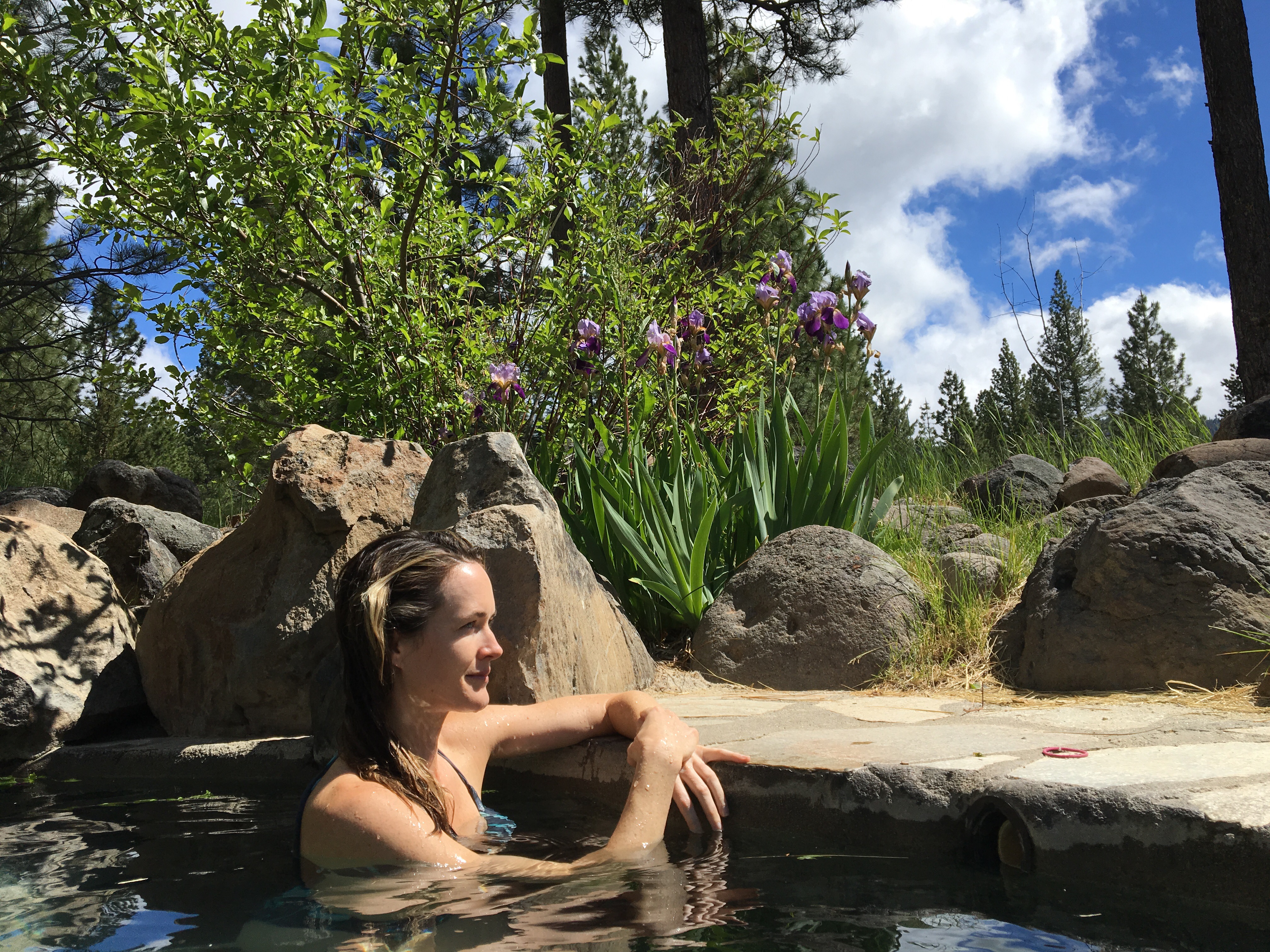
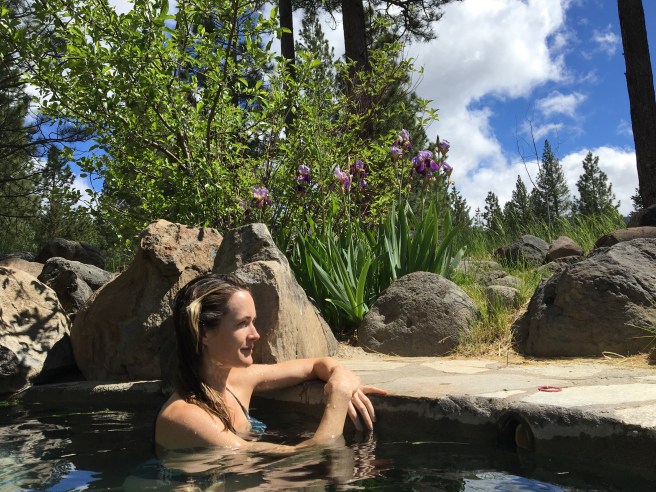
We approached the meadow pool and to our surprise, found we had the space to ourselves. A small tree grew behind boulders at the edge of the meadow. Purple irises bloomed in stately elegance. Flowers and leaves floated on the surface of the clear, blue water; we stepped in like queens. Our toes pressed into the soft, sandy floor.  

“I think I’m in the most beautiful place in the world,” Stephanie whispered.

“We’re in Faerlyland,” I said. “You know you’ve fully arrived in Faeryland when you come to the meadow pool and there’s mint and flowers floating in its waters.” 

“You described it like heaven when we were driving up here. And it really is.”

A wooden totem pole watched over the glistening water, speaking without words of the wildlife and civilization that lived in the valley before it was named Sierraville.  

“I love this aspen tree right here and the way the leaves flutter in the wind,” I said. “It reminds me of a wind chime my grandma had in her backyard. It was made out of thin, round, pearlescent shells. She had a lot of wind chimes, but I loved that one the most when I was a kid.”

“I know what you’re saying. Your grandma-angel is here. The Great Spirit is here.” 

I caressed the top of the water with my fingertips, creating swirling ripples. Birds sang from the trees in high tweets and whistles, forming the cadences and melodies of an unplanned symphony while clouds continued their slow and easy migration across the sky. 
 

I Come Back to Myself

Thoughts pour in; they swirl, forming a current, pulling more thoughts into the depths, growing tumultuous. They darken and become dangerous. I am caught, swept in by the undertow. 

It’s loud and I can’t escape. I try to distract myself with other people’s stories, but more words and information makes it worse. I resent the people on the other side of the screen.

I say to myself, “wherever you go, there you are,” but I start my car anyway.

Outside city limits, traffic thins until I am alone on the road. I slow my pace, enjoying the view: farmhouses, oak trees, cattails growing from wet earth. I crest over a bend to see a wide open sky and rolling hills. A lake rests between peaks. 

I arrive at the Buttermilk Bend trailhead. Signs announce Wildflower Tours at 11:00 am. It’s evening now, but I know I’m in the right place. I step onto the trail; the noise inside my head fades, replaced by the sound of the blue green river. 

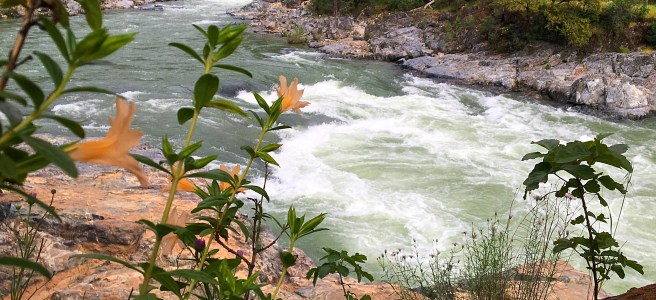
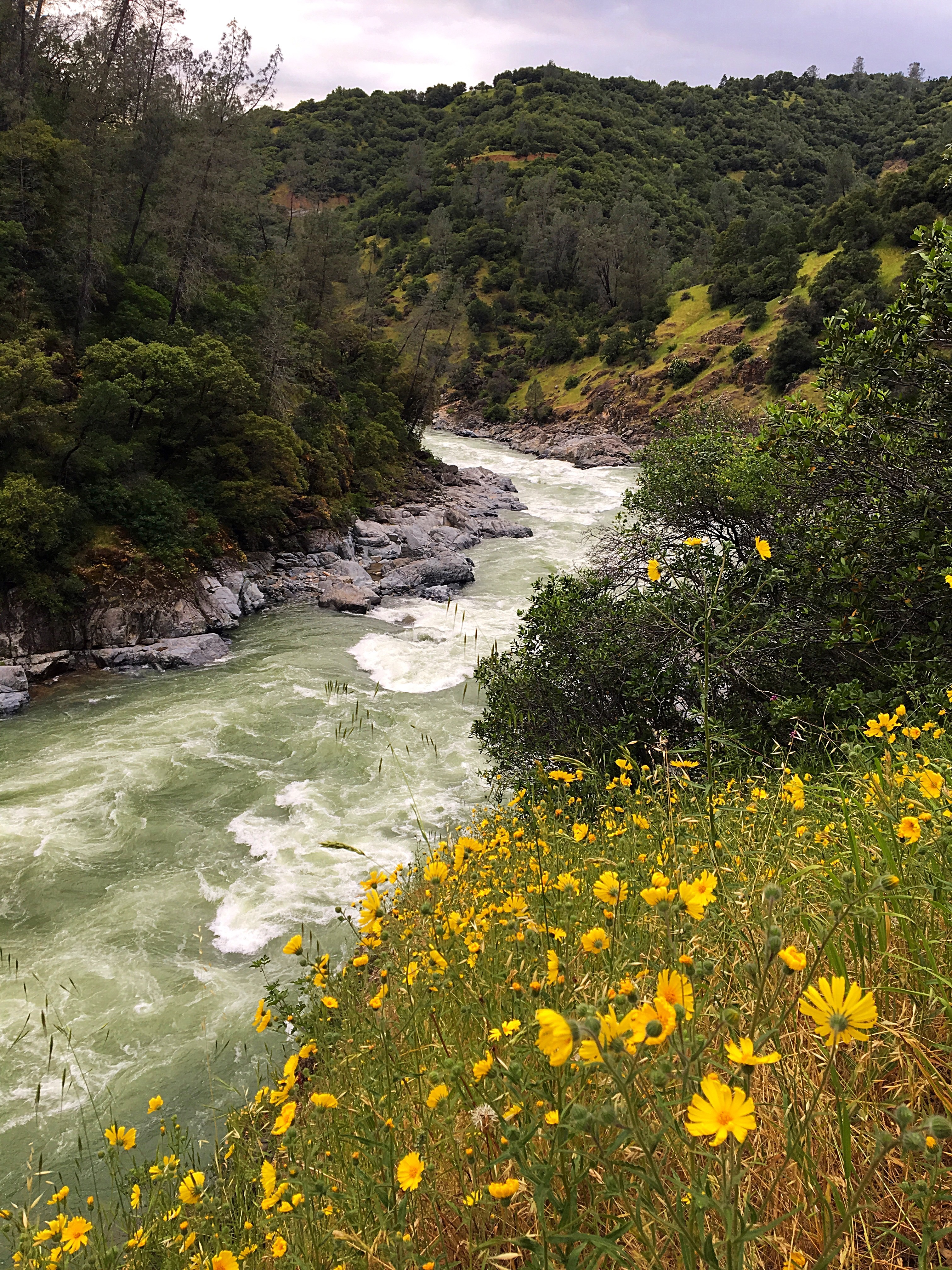
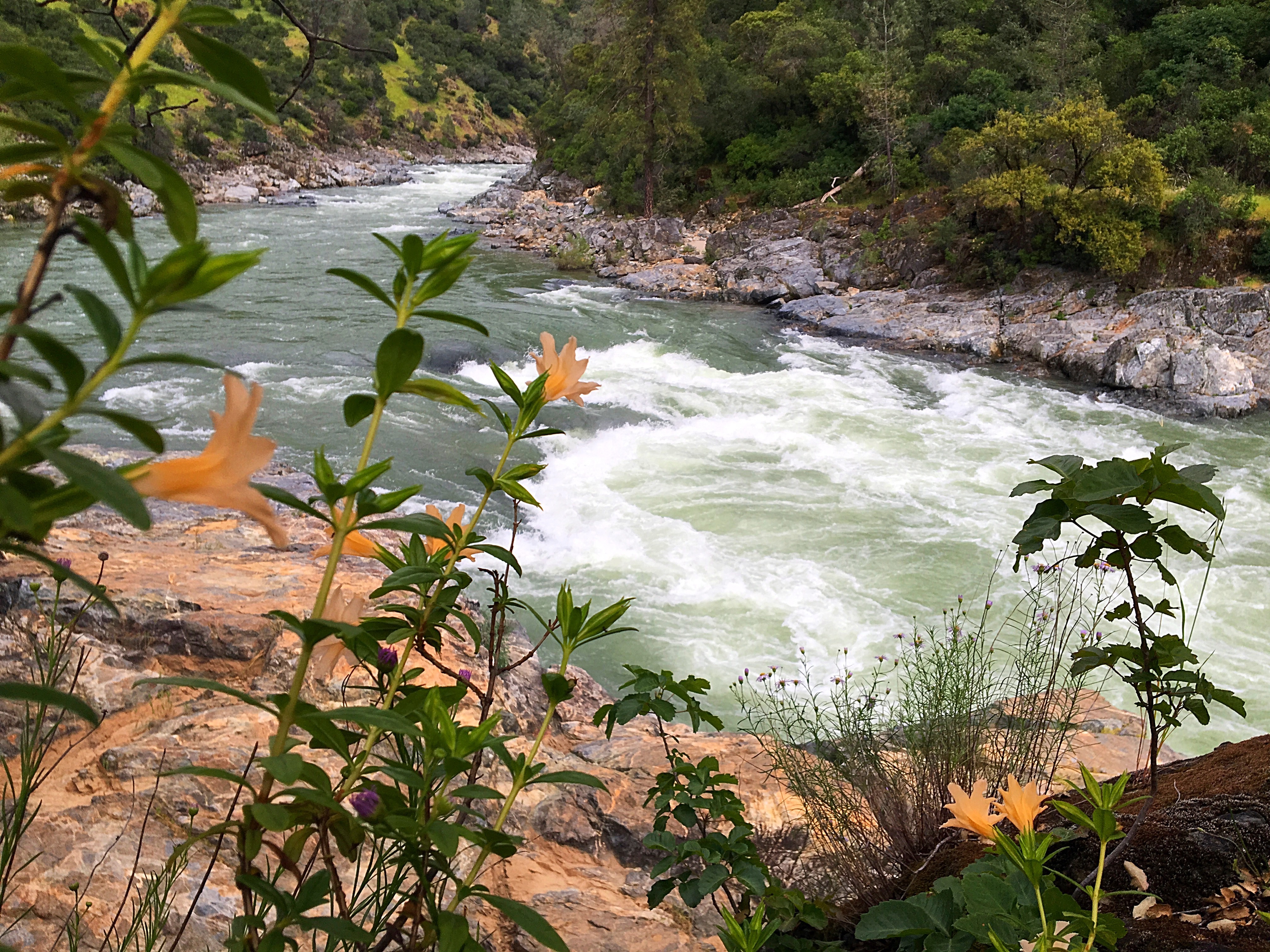
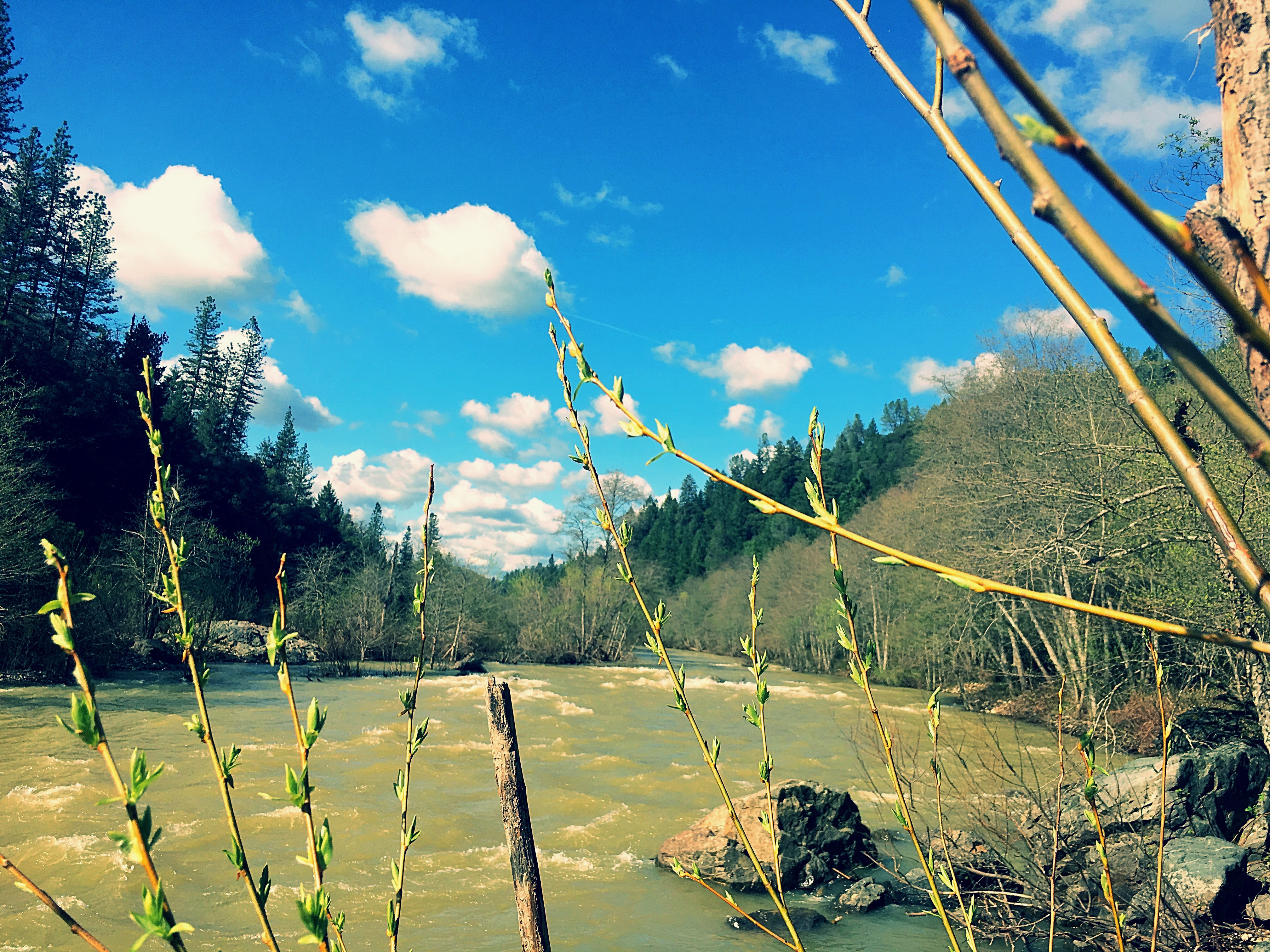
The Yuba rushes below me, through a valley she’s carved between foothills. I look into her. I see myself in her water; I am made of her, but she is greater than I. She is a force of life — mother to creation. She brings me back to myself, calling to her essence within my veins. I am not the dark and stormy waters of my mind; I am the observer of a free flowing river.

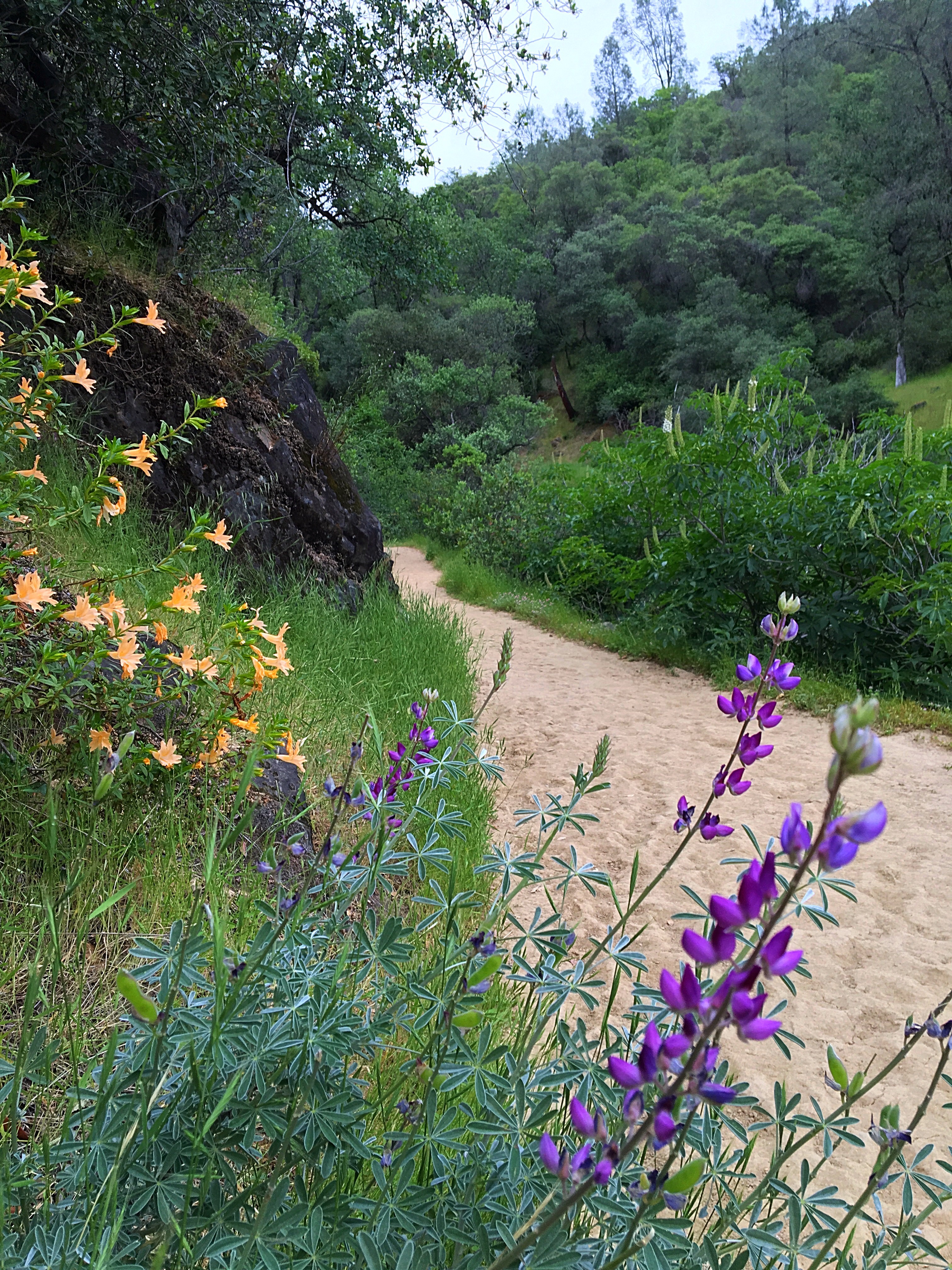
The trail follows the river’s path. We turn together. Curiosity ebbs and flows with the bends. Wildflowers line the path in blues, yellows, whites, purples, reds. They are compact, expansive, delicate, broad, intricate, simple, in boxes and in circles, fragrant and without scent. 

My plugged-in lifestyle, the one that makes my head loud, is like eating plastic information out of plastic bags; I scroll through photos that have been altered; I read inane comments; I watch videos of people pretending; I question every news article, every statement; the part of my life that is lived through squares plugged into outlets makes me forget my true nature. 

Wildflowers are a simple joy. When I see them, I feel a softening in my heart, a growing tenderness, an up-swelling of pleasant emotion.

The river sounds like the river primordial. It speaks the language of my soul. It washes my mind of the chaos and clutter I’ve accepted into it.  

Nothing to plug in, no buttons to push, nothing to sell or buy.

Amongst the wildflowers, next the river, I come back to myself — the pure, unaltered state of breathing and living.


The Broken Pot

The night before I left town, I needed to clean my house. I hate returning to a mess because it doesn’t feel restful, and the last thing I want when I get home is to feel like I have chores to do. 

Luckily, my house is fairly-tiny, and doesn’t take long to clean. I started with bathroom and then the kitchen, finishing with the floors. Everything was complete when I vacuumed my tiny living room. Except I quickly dusted my piano, realizing it was overdue, and repositioned the plants upon it.  

Satisfied with my clean home, I took a break to eat snacks before my next chore: packing. Both of my cats were downstairs with me. Sterling, a big, fat, fluffy cat laid next to the front door, which I had opened to bring in fresh air. A thin, transparent, gold curtain in the doorway kept the bugs out. My older, dominant cat, Shadow, sauntered past me towards the door. Like an arrogant king, he paused to look down at Sterling, who did not make eye contact.

Shadow sat just beyond the gold, transparent curtain and faced himself directly at Sterling. Only the thin veil separated the two, extra-large males. I barely noticed Shadow’s confrontational posture until Sterling was growling. He carried on for a few moments before I looked up from my phone and asked “what’s going on here?” 

As soon as I spoke, Sterling moved quickly and low to the ground. He stopped at the door behind me, which led to his cozy, safe space. He pawed at the door, trying to pry it open. 

I crouched next to him, inadvertently blocking him into a corner. “It’s ok,” I said. “You don’t have to leave. I’m not angry.” I pet him, but did not open the door. 

He breathed quickly, his agitation intensifying. He cowered beneath my touch. “Hey, it’s ok,” I placed my hand on his belly and gave him a rub. His eyes widened, his pupils dilated. “What’s up with you?” 

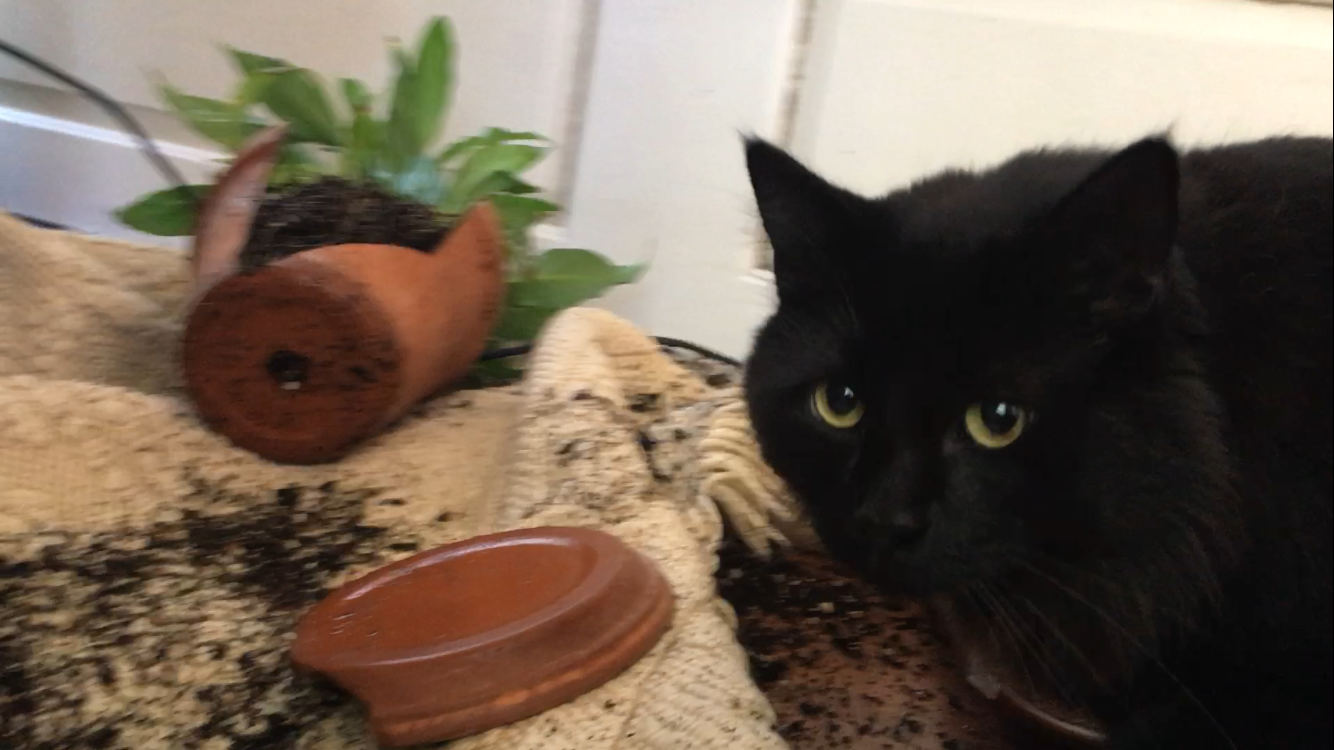
I heard the floor creak. I turned, surprised to see Shadow right behind me. I reacted with a slight jolt. Sterling clamored to his feet, scratching at the floor with his claws. He bolted to the piano as fast as his fat body could take him. He leapt with fear, not looking where he was going, and found himself face-to-face with one of the potted plants.

I watched as his claw caught the lip of the saucer beneath the pot. “Oh Shit!” I exclaimed as Sterling fell backwards and the pot banged deep bass notes, echoing my expletive, before crashing to the ground, breaking and flinging dirt across the floor.

For a split second, looking at the broken pot and the brand-new mess, I had to make a choice. 

I chose to be OK with what just happened. I chose to accept it, even though I had just finished cleaning the house and still had to pack and get organized; even though it didn’t feel OK, I chose to accept it with an understanding that it was OK.

I looked at the broken pot and the dirt on the floor. I looked at the little pile of dirt on the piano keys, the shards of pottery on top of the mound. I looked at the rug I inherited from my Grandmother, scrunched up where Sterling launched off it. In a way, the scene was aesthetically pleasing. Everything was beautifully chaotic, organically placed; it was an artistic expression of gravity and physics that no human could possibly recreate.

I kneeled beside the plant and stroked its narrow leaves — for at least a year it needed repotting, it had grown large and looked cramped. There also hadn’t been enough soil in the pot, but the plant was healthy and so the task never made it onto my to-do list. “Now’s your time,” I said. 

I picked up the plant and the shards of pottery; I shook out the rug and cleaned off the piano. I moved with acceptance — maybe even contentment — and did not feel one twinge of irritation, resentment or anger.

With the plant repotted and the room clean again, I sat back and considered my reaction. Not too long ago, I may have cursed the sky for giving me wacko cats and grumbled as I fixed everything. Where did this deep sense of equanimity come from?

It could only be my yoga practice. I began yoga teacher training at the beginning of the year and have been learning the principles, philosophy and energetics of yoga. According to yoga, personality is a process, and we can evolve to a higher ideal. Left to itself, the mind repeats in cycles, yet with the power of our will we can retrain the mind and reshape ourselves. In this instance, I was not the woman who would curse the sky and get red in the face; I was the woman who picked up the pieces with a calm, knowing smile.

I recalled my teacher, Kelly Golden’s words at the end of every class, “the real practice of yoga begins when you step off the mat and into the world.”

Yoga teaches that discernment is the pinnacle of our spiritual practice. Everyday we make choices and the true practice of yoga helps us choose what is highest and best. In this instance, my practice allowed me to choose acceptance and peace. 


Save Bear River

I drive down Dog Bar Road along narrow twists and turns. I pass green, rolling hills; Victorian farm houses with blossoming trees and horses out front; abandoned barns that are hauntingly romantic; and ponds that are full from recent rainstorms. 
In the distance, a group of female turkeys step out of the lush greenery and onto the road. I slow to a stop and see a male, with large plumage, chase after them. He passes behind daffodils and out of sight.
I arrive at the Bear River crossing and pull over. With my hands on the railing, I watch the water, knowing that 75% comes redirected from the Yuba. It’s hard to believe this fast-flowing river may soon become a reservoir if Nevada Irrigation District builds its proposed “Centennial Dam.” With two other dams on the Bear River, this is the last remaining stretch of free flowing water.
At the end of Dog Bar, I turn left for the Bear River Campground. 
People gather along the river panning for gold. I see young children, teens, parents, and older folks. The stormy winter unearthed far more gold than we saw during the drought, I’m told.
I walk the entire length of Bear River Campground, listening to the river’s soothing music. When I come to a patch of Miner’s Lettuce, I sit down and eat a few leaves. The river lulls my senses as it spill over rocks and laps against the shore. Native bees add their notes to the song, pausing when they alight on wildflower petals. The wind brushes against the river and caresses my face; it feels fresh, as if it has never been sullied by man’s emissions. I place both my hands to the ground. My heart fills with dread thinking this land will be entirely underwater if the dam is build.
When I reach the trailhead, I see a man collecting data next to a county truck.
“Mornin,” he says.
“Howdy.”
“You picked a good time to visit the campgrounds.”
“Because it’s empty?”
“That’s right. You been here in summer?”
“No, I just moved here recently. Is it a madhouse in summer?”
“Oh yes, lots of people camp here. It’s only $10 a night.”
“Wow! That’s the best deal in California.”
He laughs, “I wouldn’t doubt it. Where’d you live before you moved here?”
“My last home was in San Luis Obispo.”
“Ah. I went to Cachuma Dam a few years ago,” he says.
I look in his face and see the monstrous cement wall and dead zones lining the perimeter of the reservoir, the hallmarks of a dam. “It’d be a shame to see that here.”
“I’d hate to see that here,” he looks down at his spreadsheet.
“I’ll leave you to your work,” I say. “Have a good one.”
“You, too. Enjoy your walk.”
The trail follows the river closely at the base of a steep incline covered with ferns and wildflowers. Deer trails split off and lead to secluded nooks at the river’s edge. As a child, I would have played pretend in these nooks, imagining a time before modern development. I wonder if these are the locations where the indigenous Nisenan tribespeople continue their ceremonies with reverence to ancient traditions; I remember learning the Nisenan people in our area were stripped of their land and hunted like animals during the gold rush.
I pass beneath a flowering tree, petals flutter to the ground like a gesture of love. Cottonwoods sprout bright green foliage on every branch. 
Finding a large rock at the water’s edge, I listen to the river’s song and commune with the beauty around me. Soon, when the rain subsides, the river will return to a brilliant blue, all the trees will be green again, their leaves will flutter in the wind like tiny fans; the banks will recede below the tree line, and people will enter the river on kayaks and rafts finding refuge from their busy lives.
I think about the Nevada Irrigation District. They say the dam is a solution to climate change-driven water shortages, but don’t they know water evaporates rapidly off the top of a reservoir? Don’t they see that their other two dams on this river are never at full capacity?
I think about our Congressional Representative Doug LaMalfa. Nevada Irrigation District has requested he sell them our public land, the land I sit upon, so they can build the dam. He has already voted to pull back the EPA clean power plan, lift the moratorium on federal land coal leases, and roll back environmental regulations. I ask him regularly to share his stance on selling our land, the land I sit upon, but I have not heard back from him. I can only guess at his intentions.
I place my hand into the cold river, the snowmelt. It brushes through my fingers and against my palm. I savor the moment, knowing I may not have this opportunity next year.  

Drought Damage

I live at 2,500 feet on my aunt and uncle’s property and more often than not, snow in the forecast only brings disappointment; yet, one night a cold front descended, and at dawn, I awoke with the sun, and seeing a brilliant dusting on pine needles outside my window, I leapt from my bed and put on warm clothes. I luxuriated that morning, taking pictures of all the familiar sights that sparkled as if new.   
Through our greatest luck, my mom planned a visit that day. I called her and told her to come immediately: “The snow won’t stick for long,” I said.
Sure enough, by noon, the snow had melted from the trees and only amoeba-shaped patches remained on north-facing hills. 
“It’s too bad the snow’s gone,” I said to my mom after giving her a hug when she arrived.
“That’s ok, there was some on the drive up.”
“But you should have seen it,” I said. “Everything was at least 100 times more beautiful.”
“It’s beautiful enough,” she said, with her standard measured smile.
“Have you visited the snow this season?”
“No, you know I haven’t.”
“We should find some. I went on a hike through Rock Creek recently. There’s probably snow there. What do you think? Want to go?”
“Sure, but I don’t have snow shoes.”
“I have an extra pair.”
“OK. Do we need chains?”
“Probably, let’s buy some.”
“Have you ever put them on?”
“No, but it can’t be too hard.”
“Ok…” she looked at me skeptically.
We purchased chains and drove up the mountain. By the time we got to Nevada City, we saw snow on the ground. Highway 20 began a steep incline and my mom looked out the window at the snow, which thoroughly covered the ground and trees. 
“I know it’s cliche,” she said. “But this is a winter wonderland.”
We pulled off the highway and wrapped down narrow roads to the trailhead.
“The car is sliding!” my mom exclaimed as we drove down a steep stretch.
“Not that bad,” I said, completely unfazed.
“I hope we don’t get stuck on the way up,” she said.
“We won’t get stuck,” I wasn’t worried, having never driven in the snow. “We’re on an adventure, mom! A glamsient adventure.”
“Whatever that means,” she said.
“You would know if you read my blog,” I joked.
We pulled into the empty parking lot — the best kind at a trailhead.
“Look mom, yours are the only footsteps,” I called when she walked in front of me.
“Yes!” she made S-curves to revel in the novelty.
It amazed me to see her frolic. She is often serious and reserved, but in the snow she hopped and scampered. Effervescence infused her spirit. She patted snow together in her bare palms.
“Don’t throw it at me!” I said.
She threw it at a tree trunk and flashed a smile that I hadn’t seen since before my grandma got pneumonia and died.
“Can you tell there’s a lot of damage here?” I asked.
“Yes, but it’s all beautiful under the snow.”
We came to a blockade — a large, fallen tree that stretched across the entire path.
“Should we turn back?” my mom wondered.
“I climbed over it the other day.”
When we got to the other side, she asked me, “is there snow on my head?”
“A little.” 
She went under a branch and shook it. “How about now?” she laughed.
I laughed along with her. She threw more snowballs at trees. We laughed when she missed her targets.
“Last time we were here, Kitten said the falling trees and branches are because of the drought.”
“Oh, yes. The forest service estimates that 1 in 3 trees in Californian forests have died from the drought.”
“Really?”
“I think it’s an underestimate,” she said. “We will see more damage. It takes years for the forests to return to good health.”
We walked along the creek, a new scenery with the snow, completely different than it had been in the rain. I even lost the trail in one section, although I didn’t tell my mom.
“The aquifers are mostly depleted in California,” my mom continued. “Since the 1930s, big agriculture since has run them dry.”
“That’s sad, mom.”
“Fresno has sunk some 20 or 30 feet because the aquifers below the city are empty.”
“I didn’t know that. Now I guess those aquifers are ruined.”
“It’s almost unimaginable how much humans have changed the earth.”
“Greed and ignorance,” I said.
At the end of our walk, we put chains on my car’s tires. It only took a dozen tries, and constant reference of the instructions, but we did it!
We climbed the hill at a low speed until we arrived at the steepest slope. My Mom gripped her seat while I stepped onto the gas and the car wobbled through slush. 
“Come on, little car!” My confidence bottomed out when I felt the car lose traction. I had no idea what I was doing and it was time to admit that to my mom.
But then — by some strange magic — the tires gripped and took us out of the churned up road. The car felt steady again, slowly progressing.
“We made it, Mom!” I said.
“Yeah,” she sighed, somewhat sarcastically as relief washed over her face.
The next morning, she wanted to leave early to avoid the San Francisco Bay Area traffic.
“You know how it gets,” she said.
“I just wish you could stay longer.”
“I noticed you have a few dead trees on the property,” she said.
“The pine trees?”
“Yes, the tops are brown. A sign of drought damage.”
“Do you remember the giant oak in the middle of the meadow last time you were here.”
She looked as if she were trying to recall her last visit.
“Doesn’t matter,” I said. “It fell last summer. Did I tell you that story?”
“I don’t think so.”
“One night, I was reading in my room and I heard Shadow making strange noises outside. I called his name a couple times out the window, but he kept going. So I went downstairs and opened the door to see what was going on and there’s Shadow on the fence, looking towards the meadow. I called his name and tried to get him to come in, but he just kept staring towards the meadow and making weird noises. I got kind of creeped out thinking maybe there was something or someone out there. 
“I went inside and when I was halfway up the stairs, I heard this loud, cracking sound and then an enormous thud, which shook the whole house! For a second, I couldn’t move. My heart was beating so fast. I had to check outside, but I couldn’t see that anything changed. It was so dark out and I didn’t want to go past the porch. 
“The next morning I went outside and, sure enough, the giant oak had split at it’s lowest branch — right down the middle. The top half of the tree was on the ground and the rest of the trunk remained standing like a jagged obelisk. Aunt Marika and Uncle Rick were shocked when I told them.”
“Another drought death.”
“I don’t know. It looked like there was a hole and some rotting where the tree split. It looked like insects had gotten in and then water went in the hole.”
“That’s the drought, for you. The tree becomes distressed when it’s not getting enough water, and bugs can burrow into it.”
“It’s natural defenses are down.”
“Exactly.” 
We finished our breakfast and I walked my mom to her car. We hugged and said goodbye, thank you for visiting, thank you for having me, come again soon. We waved as she pulled away.
I turned to the meadow and walked to the remaining chunks of the giant oak. Looking at the thick, moss-covered cylinders, I remembered the oak’s grand stature, a living connection to the past. Surely it had been alive before the United States became a country. Seeing it now, in only a few chunks and pieces, the majority hacked up and hauled away by neighbors for firewood, I remembered my young cousin’s reaction when she saw the tree had fallen. She grew up on the property and knew the oak — felt it’s presence — by the time she could walk.
I recalled her devastation. While my Aunt and Uncle surveyed the damage, my cousin climbed into the tree from the top where it rested on the ground, and walked through its branches towards its base; her face spoke of when her father set up a swing on its thickest branch, and the times she climbed it and found refuge in its branches like a secret hideaway. When she was ready, she found a place to sit, her back to me. She leaned against a branch, now vertical, pointing to the sky. She wrapped her arms around it; I approached her, and heard as the memories spilled softly from her eyes. 
 

Rock Creek Wisdom

I recently purchased Hank Meal’s, The River, a local’s guide to hiking trails surrounding the Yuba River. On a rainy afternoon, my friend, Kitten, and I got cabin fever; we opened Hank’s book and chose the Rock Creek Nature Trail (located in the Tahoe National Forest) as our tonic. Once the site of a lumber mill, Hank described this one-mile loop as an easy and accessible trail that meanders beneath 11 varieties of trees and alongside Rock Creek.

“Looks like we have the place to ourselves,” I beamed when we pulled into the empty parking lot.

The ground was completely saturated — water pooled around our every footstep. Light rain floated to earth, accompanied by large, sporadic drops falling from tree branches, tapping an intricate percussion on land and water. The creek rushed past us, beckoning us onwards.

“Look at all this debris,” Kitten said. “These recent storms have been brutal!” 

“The other day, I saw a group prayer going around Facebook asking for the storms to be gentle on the forests, and I don’t know how I feel about that.”

“Why?”

“California needs water. I’m not eager to pray the rain stops.”

A stream carved its way down the hillside and onto the path, turning the path into a waterway and making us walk along its edge. Branches, leaves, and pine needles littered the area, and the Rock Creek Trail felt less like a nature walk and more like a rugged adventure, like we were the first explorers. At one point, we had to climb over a large, fallen tree.

“All this damage is from the drought,” Kitten said. “Tree roots retract closer to the trunk and become less dense. And the branches die. So when a big storm hits, it uproots trees and branches fall.”

“Makes sense.”

“Now I bet this will be a tinderbox in summer — this and every other forest in California.”

“Let’s hope not! If we get enough rain, the dead stuff will get mushy and become fertile. With fewer trees and branches blocking out the sun, new life will grow. Regeneration is one of the most incredible aspects of nature, in my opinion. Didn’t the guidebook say this land was harvested for timber not long ago? I wonder what that looked like!”

“I hope we get the rain, too, of course. Shame if it burns. I’d rather see the land heal.”

“Did you know illegal campfires start a lot, if not most, of California’s forest fires? The drought makes everything dry, but it’s singular humans messing up on top of that.”

“Hitting Nature from both sides: the macro and the micro.” 

We passed what Hank described as a relaxing welcome bench, knocked out of the ground and thrown on its back.

“I’m ready for all humans to live in harmony with Nature.”

“Now that’s a good prayer.”

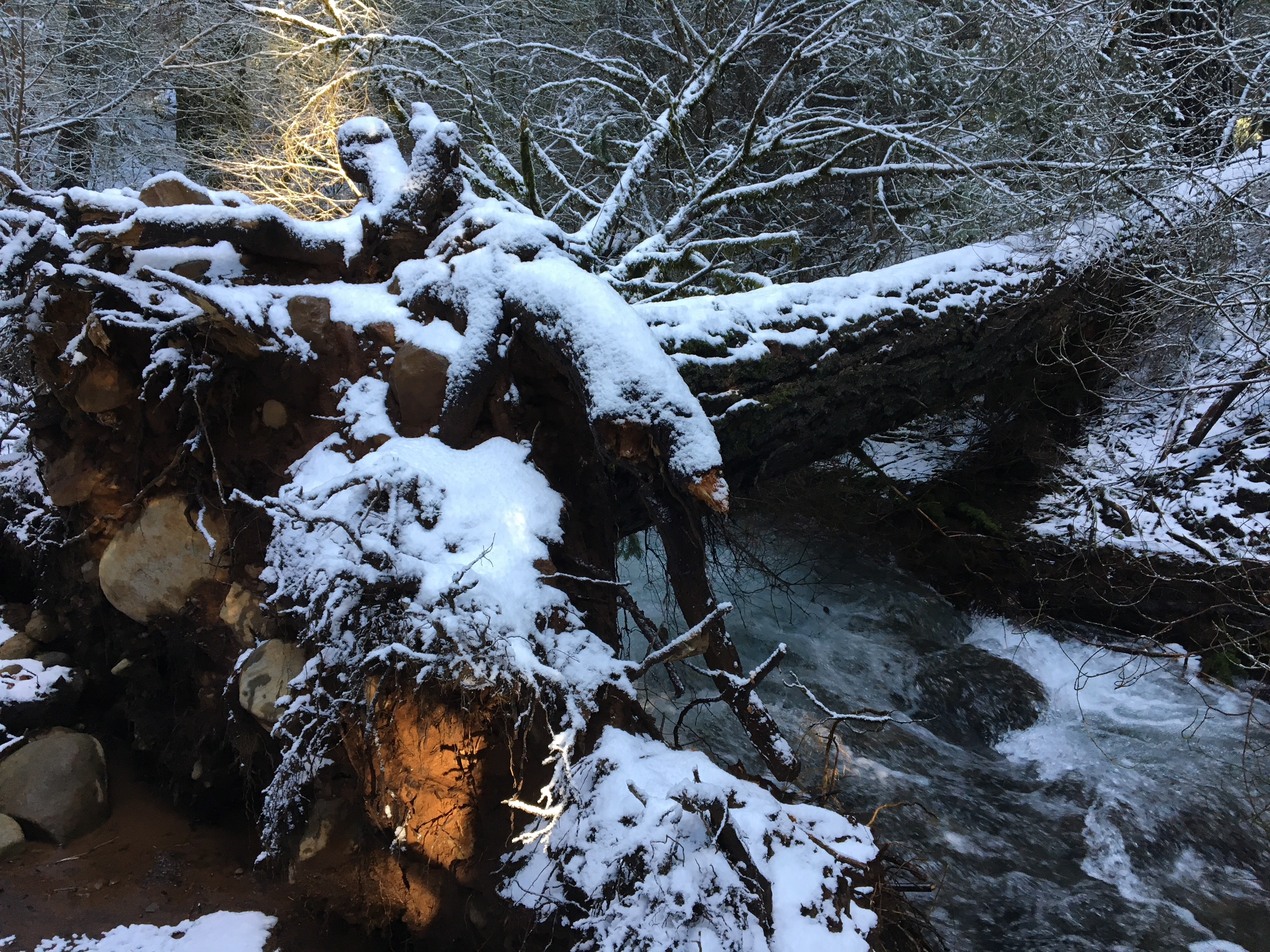
We stopped to inspect a fallen tree. It made a sturdy bridge over the creek and it’s roots were exposed in an unchanged unit, still holding rocks they had grown around.

“This makes me think of my inner work,” I said, ducking beneath a branch.

“What do you mean?” Kitten asked.

“Self-reflection can sometimes hurt. After a long period of unconsciousness or trauma, like a drought, the medicine of awareness can feel destructive — it’s painful to look on all aspects of myself — lessons can be hard, truth can hurt. Guilt, disappointment, shame, and anger surface. And when that happens, it feels like I’m being destroyed. Like my guts are being ripped out or my heart torn apart.”

Water cascaded down the creek bed over rocks and debris, navigating curves, eddies and pools.

“I think the commitment,” I continued, “is to give myself sustained compassion, like rain, so that which has been knocked over can become the fertile grounds for new life — or a bridge to enlightenment. To continually give myself compassionate attention and embrace myself instead of pushing myself away — that is the way.”

“I see. If you have the painful, seemingly-destructive insight and you don’t follow it up with compassion, it’ll catch on fire and consume you when someone starts an illegal fire,” Kitten said.

“Definitely.”

We crossed a wooden bridge before we completed the loop. Birds sang from the moss-covered trees, while a soft and steady drizzle, almost a mist, enveloped the forest.