The Lucky Ones

[First published in 2017 as “The Cows of Black Rock City,” this edition will appear along with many unpublished stories in a collection of shorts for Varanasi Sage — Due out in July!]

Twinkling lights strung around its frame, chain clicking in a dry loop, my bike created tracks on tracks in the dust, crossing tracks without pattern or reason.

In the dark of night, the high desert mirrors the sky; although the stars on the ground are colored, moving and spinning, dancing chaotically. In the dark expanse, we put on our lights and become technicolor shooting stars.

By week’s end, the thin layer of dust on my bike will gather to look as though it had been left forgotten in the recesses of a workman’s garage. Dust on my clothes, my skin and my hair, in my nose, ears and lungs. By week’s end, I, too, caked with dust, will look old and forgotten.

A herd of cows appears. Dim lights twinkle from their insides, differentiating them from the dust and darkness. Stationary, unafraid, wooden skeletons wrapped in translucent nylon. 

In the darkness of the playa, amongst dust and art, these are the lucky ones. Peaceful bovines, sacred cows, abundant goddesses of nourishment.  Their twinkling lights, the same as my own; viewing passing delights. Busses dressed like sheep and lighthouses, cars like genie lamps, golf cart abstract art, and bodies radically expressing themselves.

Our shared reality outside this city — the distortion of divine nature, the degradation of life by human command. Here they are not an exploitable object; a living, feeling being trapped in a pit of manure, in line for a violent death, never having eaten a blade of grass or stepped hoof in a meadow. I am a lucky one, in the darkness of the playa, amongst dust and art; not trapped in a war torn city, used as a human shield.

The sadness of contrast, a melancholy inspection, thoughts and emotions rising from the depths of another’s creation. Here in the dust — in the middle of nowhere — surrounded by darkness and lights.

69pAXiRXQS+FZoc0g2yLWw_thumb_2dd.jpg
Phuture Pasture by David Suckling for Burning Man 2017

Forest Song

[This story will appear in a collection of shorts for Varanasi Sage, due out July 1, 2019.]

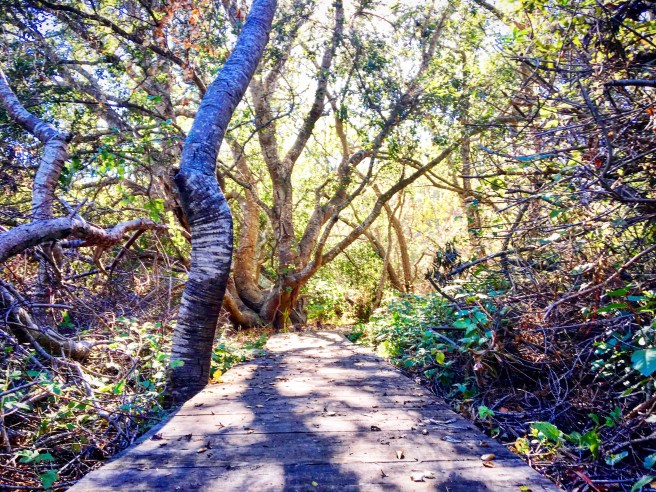
I opened the door, welcomed by early morning light peeking around clouds, caressing the world. Unseen doves proclaimed the day’s arrival in trilling coos. Oaks stretched in wild formations. Brown grasses stood defiantly against their drought deaths. The distant scent of a wood-burning stove — a reminder of recent wildfires that stopped at the next ridge. Deer tracks in the dust said I was not the only one who walked the trail.

They carried a flash, a remembering from my youth, making eye contact with a doe. She led me past trees, through ferns and ivy to her fawn, chestnut with white spots, nestled in the grass. Vulnerable. The doe watched as I knelt beside her baby, as I touched its tiny head, unaware of the danger to its fragile life. 

Through oak trees, lichen drooped long from their branches, the filtered sun created irregular, glowing shapes on the forest floor. Branches and leaves formed a tapestry of life, thick with energy, magnifying their essence and intensity. I was just one small organism in the network of life.  An enormous oak whose wide-spread branches twisted and turned, defied all patterns and rules. I approached the grand dame in awe of her divine, ancient presence, and when I moved under her furthest reach, the forest suddenly went silent.

A covey of quail (dressed in fancy spots, stripes and bobbling headpieces) whistled as they ran on speeding legs. A crinkling — Towhee kicking up leaves, flying in unison on purring wings when I approached. Acorn Woodpeckers squawked, perched on tree trunks — wearing tuxedos and red caps — drilling holes, stuffing them. Their gleeful chucking like happiness on the wind. I passed a giant oak, split at it’s lowest, thickest branch — down the middle. The top half on the ground, the trunk standing a jagged obelisk, rotted at the split.

Around a bend, a rhythmic cascade, almost like dropping water. I stopped to listen, but couldn’t make out the sound.

Slowly and quietly I walked, listening without seeing the source. At the crest, down the shaded hill, 5 or 6 deer chased each other, leaping between trees. They moved in s-curves, criss-crossing, creating figure eights with narrow hooves, playing like children in the forest. Nearer and nearer, they were so absorbed in their chase they didn’t notice me. Closer and closer, astonished by the sight, as close as I could get on the trail.

Overzealous, I stepped off the path and my human feet crunched leaves. Without showing signs of seeing me, they bounded away in perfect time through the meadow. At the edge of the forest, an antlered male turned back to look at me — knowing me, beckoning me on. 

On the other side of the meadow, the deer had left no trace.

A thick oak with a large horizontal branch, an arm reaching, pulled me off the trail. I hoisted myself up, stretched my legs and reclined back. Cradled in her arm, I gazed past the canopy to the sky. Rustling, fluttering, croaking, squeaking, laughing, whistling, chattering, calling. Each voice joined in one abundant song.

I could have lounged for hours, held by the tree and listening; yet, the forest did not sing for me. Symphonies without need for an audience. A true artist: creating for herself. 

“Show me the way,” I whispered. “How can I create like you?”

Close your eyes.

Moments passed, my ears opened to subtle layers of the song. Singers unashamed of their sound they received at birth. Each day a new score created without doubt or self-consciousness. Each voice accepted exactly as it was — knowing it had a welcomed part.

Unwrapping the Varanasi Sage

I haven’t even begun building the Varanasi Sage art installation and I’ve already hit a bump! Watch this video to see what happened — it’s all part of the excitement! I’m sure there will be many more bumps in the journey, so I’ve got to get used to it!

For more about the meaning behind this project, read Introducing: Varanasi Sage.


Introducing: Varanasi Sage!

I am thrilled to introduce my first art installation that I have been designing, registering, and creating for Burning Man 2019! Check it out!

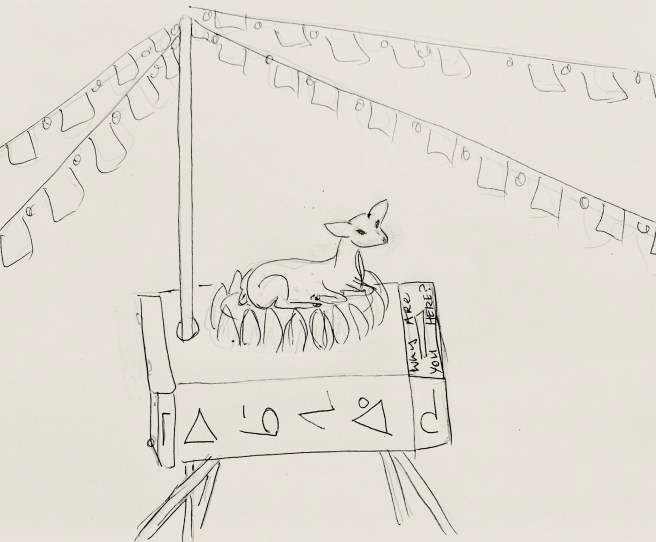
Custom-printed prayer flags create a pyramid around a fawn resting in a lotus flower, on a platform decorated with glyphs that convey a message: True wisdom belongs to the natural, non-human world. Each flag helps the participant dive deeper into the meaning of the piece, and one even has a guide to decode the glyphs. Lights illuminate the space and lights behind the lotus make the petals glow. A speaker within the platform plays sacred sounds. On the platform, a red button reads “Do Not Press.” A suggestion box below the fawn asks: “Why are you here?” A door in the back of the platform opens to reveal a zine stand, filled with zines written by me. These elements deepen communication and facilitates interaction with the curious.
A fawn does not belong in the desert, nor does it lay in lotus flowers, so it must be a magical, enlightened creature! And it’s smallness and vulnerability in a harsh environment make the participant feel compassion for the creature. Humans must choose not to destroy the natural, non-human world and instead revere it as the divine. These contradictions jar the participant, creating a sense of vulnerability, which encourage authenticity, tenderness, and the wisdom inherent compassion, harmony and gentleness.
In the spirit of this year’s theme, Varanasi Sage explores the reality that deep transformation can come from a place of peace. Even in the chaos of the playa, one can find peace. Varanasi Sage provides participants with a beautiful, peaceful place. People may feel overwhelmed or lost in deep playa — this is a refuge. It provides comfort and calm and shows that peace is always available.

via Varanasi Sage

fullsizeoutput_132a


Coming Soon: Glamsient, the Book!

During this winter season, I’m making the final push to complete my first book! I’m on track to have it finished in Spring.

In order to prepare the release, I’m taking time off from publishing work here. Check out photos from my current travels on Instagram http://www.instagram.com/glamsient

IMG_6404

Unmasking the Monuments

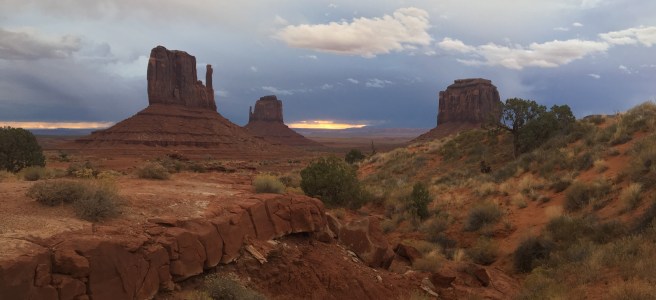
We drove in after dark. Large shadows, looming in the night like masked phantoms, lay in wait.

Half an hour before first light, wind shook the camper van. Rain urged us to stay under covers with tinny percussions. But we had come with one purpose: to witness dawn unmask the monuments.

I put on my warmest clothes with a sense of defeat and doubt. We wouldn’t have much of a sunrise in a storm.

When I stepped outside, as if on cue, the rain eased to a drizzle, merging the space between earth and sky, wrapping us in mist. Lightning flashed in the distance — dancing in bold streaks — thunder clapped to proclaim the illumination.

I sat patiently for the show. At first she was only a fleck below the clouds, but soon, a sliver of pinkish orange light at the horizon split the sky.

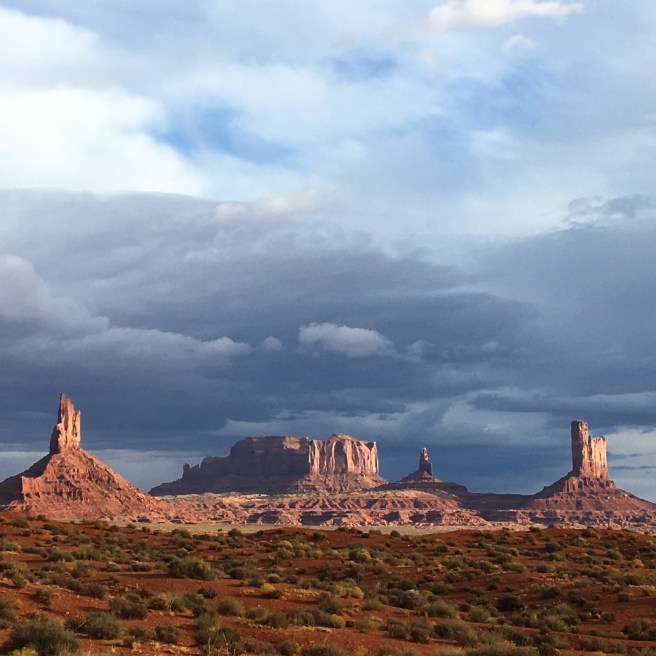
Black against the night sky, the monuments began to emerge, to take clearer shape, to reveal their red rock, to show they surround us near and far, to claim their land. Castles, cathedrals, ancient architecture shaped by the Artist’s hand, etched and chiseled into towers, walls, cliffs, and colorful layers.

When dawn captured the sky, we stepped through red sand in the direction of the three closest monuments, the only ones on the early morning trail. The smell of rain rose from the earth, but it was dry and quiet. Passing clouds, their softness, an ever-changing background, emphasized the stoic rocks.

Walking below, standing at their feet, staring up at their grandeur, I felt the knowing of the One far greater than I. Ancient energy, with the power to lift its own monuments and hold them in its hand as if to say, “This — is my Creation.”

Rain continued its pilgrimage to earth as we finished the trail. I looked to the monuments, a rainbow appeared momentarily, as if to say, “So are You.”

IMG_5607

Canyon Meditation

We chose not to look at the map and found what we believed was a path. As we walked, the forest seemed to hold us while birds sang its melody. We passed elk tracks preserved in dry mud and saw a tree that had been used as an antler scratching post. I wished I could walk without knowing our destination.

Upon hearing human voices speaking languages from all over the world, we knew we were close — and suddenly — the forest opened.

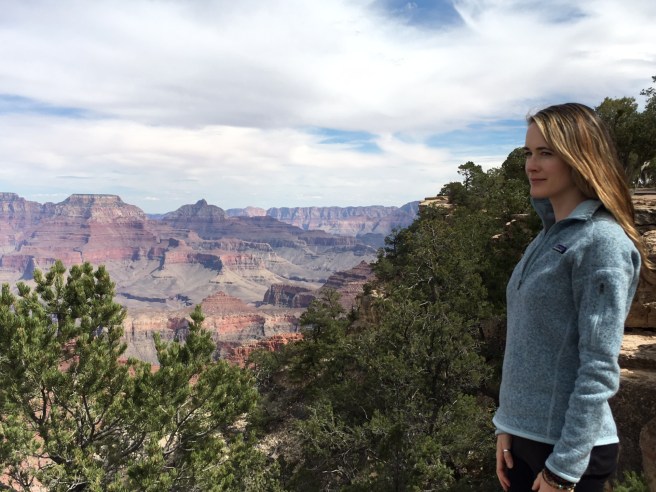
A magnetic pull from my heart led me to the canyon rim as though I were under enchantment. My body shook with adrenaline. Before me, a chasm ripped the earth and rocky, layered peaks formed colorful monuments, temples, pyramids, and fortresses. Spires and pillars rose from the ground like giants. Greater and larger than Stonehenge, than Chichen Itza, than man could ever be.

Nature’s chisel wielded by the Great Artist etched walls with shadowy crags and adornement. Creation coalescing into wonder from nearly two billion years of both violent and gradual evolution written in the rock. Lava and mud spreading and widening the canyon carved by wind and water, plateaus rising, glaciers melting, the continent crashing into volcanoes and making mountains. Erosion — pushing, pulling, forming megaliths and smiles that become wings of expanded freedom. A testament to my limited, human experience.

The river deepens the canyon as she moves to the sea — her former grandeur evidenced in decorated cliffs — she is now a mere trickle of what she must have been before dams and reservoirs closed her veins like tourniquets.

The Artist exhibits the freedom to transform, to shift — to evolve into beauty, into living inspiration.

Even with their loud voices, the other tourists don’t bother me. The vastness is large enough for us all. So large that I sense I can give all the heaviness of my heart to the canyon. All the pain of memories and attachments can release. And my heart will become expansive; my heart and the canyon will merge into one, magnetized like the continent and crashing into volcanoes. If I let it fall, it will tumble into the river and be swept away to the ocean. I can let it go — I can give it all to the One who is capable of transfiguration.

I hear the wind before I feel her. She comes up from the canyon depths and brushes my face. I feel the coolness of her touch. She is a whispering echo saying, “hush.”

Crows fly with feathers straight and light in the space between earth and sky. Above the canyon, below stars. Small, yet fearless. As we must be.

IMG_5645

Save Bear River

I drive down Dog Bar Road along narrow twists and turns. I pass green, rolling hills; Victorian farm houses with blossoming trees and horses out front; abandoned barns that are hauntingly romantic; and ponds that are full from recent rainstorms. 
In the distance, a group of female turkeys step out of the lush greenery and onto the road. I slow to a stop and see a male, with large plumage, chase after them. He passes behind daffodils and out of sight.
I arrive at the Bear River crossing and pull over. With my hands on the railing, I watch the water, knowing that 75% comes redirected from the Yuba. It’s hard to believe this fast-flowing river may soon become a reservoir if Nevada Irrigation District builds its proposed “Centennial Dam.” With two other dams on the Bear River, this is the last remaining stretch of free flowing water.
At the end of Dog Bar, I turn left for the Bear River Campground. 
People gather along the river panning for gold. I see young children, teens, parents, and older folks. The stormy winter unearthed far more gold than we saw during the drought, I’m told.
I walk the entire length of Bear River Campground, listening to the river’s soothing music. When I come to a patch of Miner’s Lettuce, I sit down and eat a few leaves. The river lulls my senses as it spill over rocks and laps against the shore. Native bees add their notes to the song, pausing when they alight on wildflower petals. The wind brushes against the river and caresses my face; it feels fresh, as if it has never been sullied by man’s emissions. I place both my hands to the ground. My heart fills with dread thinking this land will be entirely underwater if the dam is build.
When I reach the trailhead, I see a man collecting data next to a county truck.
“Mornin,” he says.
“Howdy.”
“You picked a good time to visit the campgrounds.”
“Because it’s empty?”
“That’s right. You been here in summer?”
“No, I just moved here recently. Is it a madhouse in summer?”
“Oh yes, lots of people camp here. It’s only $10 a night.”
“Wow! That’s the best deal in California.”
He laughs, “I wouldn’t doubt it. Where’d you live before you moved here?”
“My last home was in San Luis Obispo.”
“Ah. I went to Cachuma Dam a few years ago,” he says.
I look in his face and see the monstrous cement wall and dead zones lining the perimeter of the reservoir, the hallmarks of a dam. “It’d be a shame to see that here.”
“I’d hate to see that here,” he looks down at his spreadsheet.
“I’ll leave you to your work,” I say. “Have a good one.”
“You, too. Enjoy your walk.”
The trail follows the river closely at the base of a steep incline covered with ferns and wildflowers. Deer trails split off and lead to secluded nooks at the river’s edge. As a child, I would have played pretend in these nooks, imagining a time before modern development. I wonder if these are the locations where the indigenous Nisenan tribespeople continue their ceremonies with reverence to ancient traditions; I remember learning the Nisenan people in our area were stripped of their land and hunted like animals during the gold rush.
I pass beneath a flowering tree, petals flutter to the ground like a gesture of love. Cottonwoods sprout bright green foliage on every branch. 
Finding a large rock at the water’s edge, I listen to the river’s song and commune with the beauty around me. Soon, when the rain subsides, the river will return to a brilliant blue, all the trees will be green again, their leaves will flutter in the wind like tiny fans; the banks will recede below the tree line, and people will enter the river on kayaks and rafts finding refuge from their busy lives.
I think about the Nevada Irrigation District. They say the dam is a solution to climate change-driven water shortages, but don’t they know water evaporates rapidly off the top of a reservoir? Don’t they see that their other two dams on this river are never at full capacity?
I think about our Congressional Representative Doug LaMalfa. Nevada Irrigation District has requested he sell them our public land, the land I sit upon, so they can build the dam. He has already voted to pull back the EPA clean power plan, lift the moratorium on federal land coal leases, and roll back environmental regulations. I ask him regularly to share his stance on selling our land, the land I sit upon, but I have not heard back from him. I can only guess at his intentions.
I place my hand into the cold river, the snowmelt. It brushes through my fingers and against my palm. I savor the moment, knowing I may not have this opportunity next year.