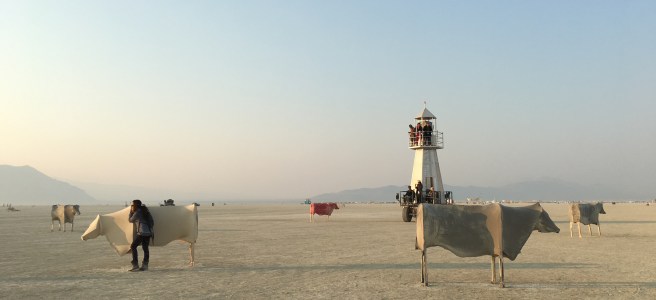
The Cows of Black Rock City

My bike, with twinkling lights strung around its frame and the chain clicking in a dry loop, glides along the dust, creating tracks on tracks, crossing tracks without pattern or reason. 

The high desert, in the dark of night, mirrors the midnight sky.  

Now, the thin layer of dust on my bike, by week’s end, will gather as though it hasn’t been ridden for decades, but instead, left old and forgotten, in the recesses of a workman’s garage. Dust on my clothes, my skin and my hair. I wear a scarf over my mouth and nose, but there must be — there has to be — dust in my lungs. By week’s end, I will also look old and forgotten.

Colored lights move and spin and dance chaotically. We become our lights in the dark expanse; nothing else to differentiate between us and the nothingness, we put on our lights and become technicolor shooting stars.

A herd of cows appears out of the dust and darkness, dim lights twinkle from their insides, the only thing differentiating them from the nothingness. I ride up to them. Stationary and unafraid, metal skeletons wrapped in translucent nylon.

Sadness wells in my heart.

Peaceful bovines, sacred cows. An object. Not a living, breathing, feeling creature. Yet these are the lucky ones, in the darkness of the playa, amongst the dust and the art; they are not trapped in a pit of manure, in line to die never having eaten a blade of grass or stepped foot in a meadow.

Their twinkling lights are the same as my own. 

Our shared reality — the degradation of life, the distortion of our divine nature. Yet I am one of the lucky ones, in the darkness of the playa, amongst the dust and the art; I am not trapped in a war torn city, used as a human shield.

I remember feeling this way last year — or was it the year before? The sadness of contrast, a melancholy inspection, sudden thoughts and emotions inspired by the depths of creation. Here in the dust — the critique of modern industry, modern society, modern greed — in the middle of nowhere, surrounded by darkness and lights.
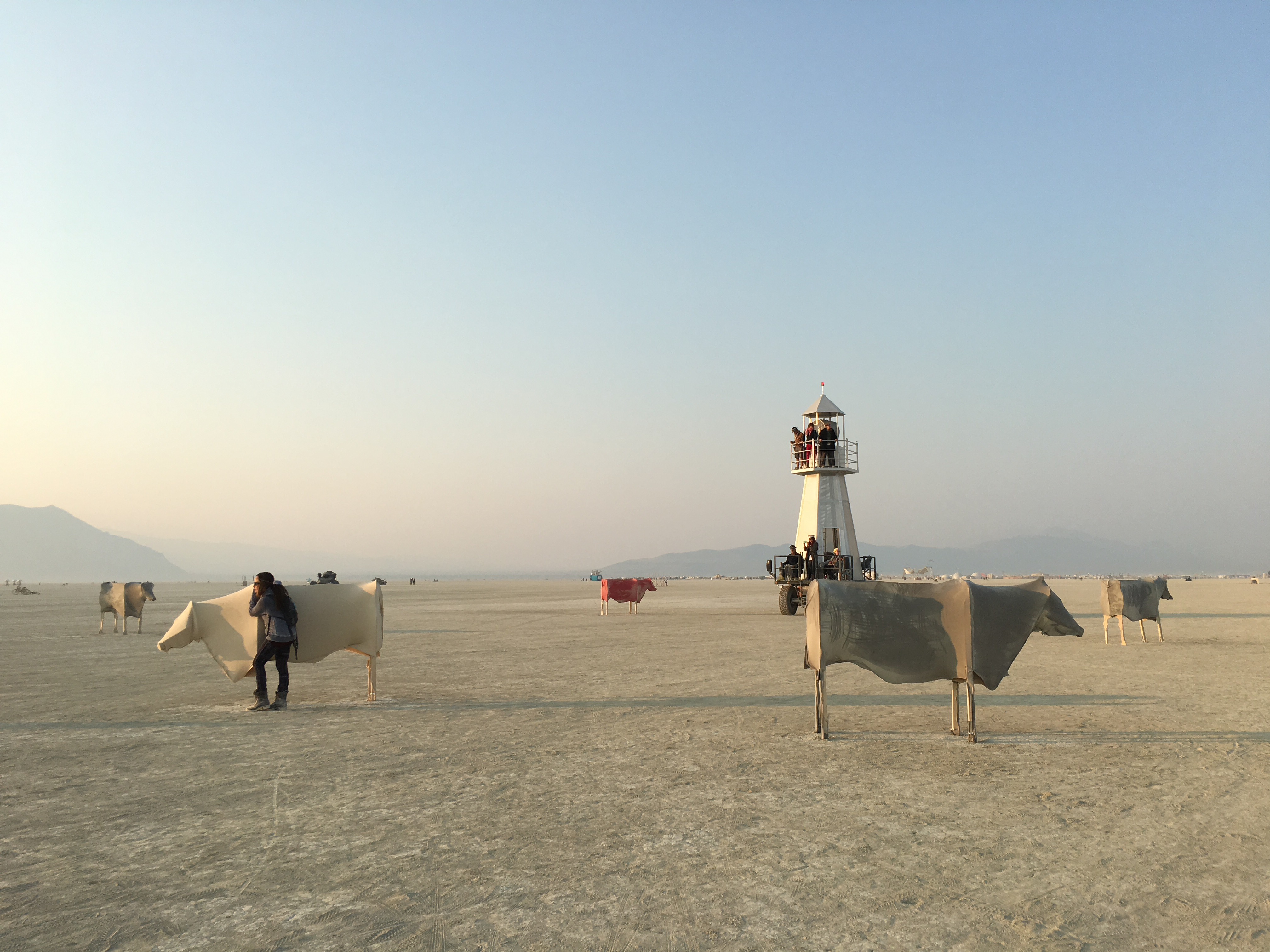
The Herd of Cows in the morning

Save Bear River

I drive down Dog Bar Road along narrow twists and turns. I pass green, rolling hills; Victorian farm houses with blossoming trees and horses out front; abandoned barns that are hauntingly romantic; and ponds that are full from recent rainstorms. 
In the distance, a group of female turkeys step out of the lush greenery and onto the road. I slow to a stop and see a male, with large plumage, chase after them. He passes behind daffodils and out of sight.
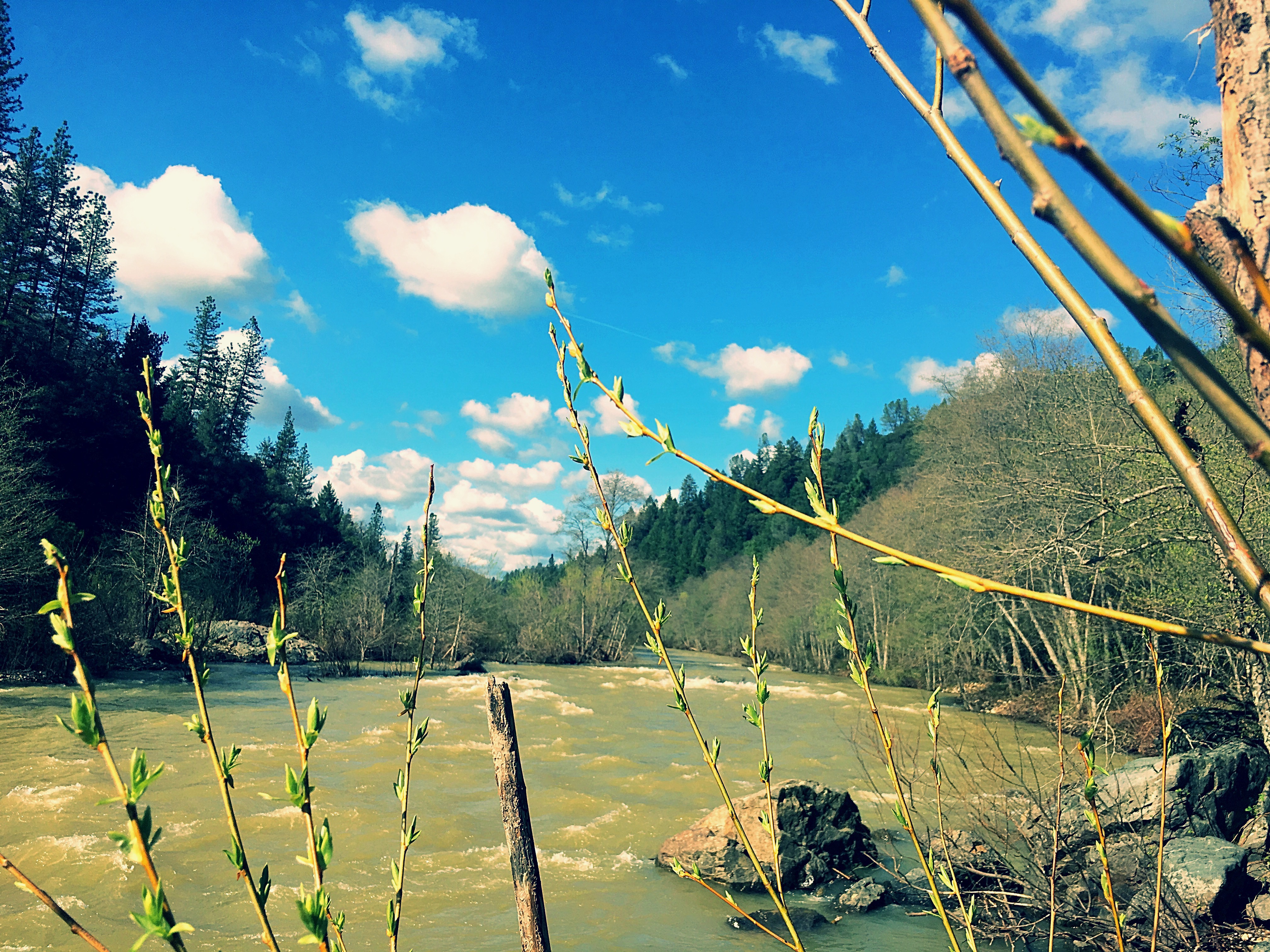
I arrive at the Bear River crossing and pull over. With my hands on the railing, I watch the water, knowing that 75% comes redirected from the Yuba. It’s hard to believe this fast-flowing river may soon become a reservoir if Nevada Irrigation District builds its proposed “Centennial Dam.” With two other dams on the Bear River, this is the last remaining stretch of free flowing water.
At the end of Dog Bar, I turn left for the Bear River Campground. 
People gather along the river panning for gold. I see young children, teens, parents, and older folks. The stormy winter unearthed far more gold than we saw during the drought, I’m told.
I walk the entire length of Bear River Campground, listening to the river’s soothing music. When I come to a patch of Miner’s Lettuce, I sit down and eat a few leaves. The river lulls my senses as it spill over rocks and laps against the shore. Native bees add their notes to the song, pausing when they alight on wildflower petals. The wind brushes against the river and caresses my face; it feels fresh, as if it has never been sullied by man’s emissions. I place both my hands to the ground. My heart fills with dread thinking this land will be entirely underwater if the dam is build.
When I reach the trailhead, I see a man collecting data next to a county truck.
“Mornin,” he says.
“Howdy.”
“You picked a good time to visit the campgrounds.”
“Because it’s empty?”
“That’s right. You been here in summer?”
“No, I just moved here recently. Is it a madhouse in summer?”
“Oh yes, lots of people camp here. It’s only $10 a night.”
“Wow! That’s the best deal in California.”
He laughs, “I wouldn’t doubt it. Where’d you live before you moved here?”
“My last home was in San Luis Obispo.”
“Ah. I went to Cachuma Dam a few years ago,” he says.
I look in his face and see the monstrous cement wall and dead zones lining the perimeter of the reservoir, the hallmarks of a dam. “It’d be a shame to see that here.”
“I’d hate to see that here,” he looks down at his spreadsheet.
“I’ll leave you to your work,” I say. “Have a good one.”
“You, too. Enjoy your walk.”
The trail follows the river closely at the base of a steep incline covered with ferns and wildflowers. Deer trails split off and lead to secluded nooks at the river’s edge. As a child, I would have played pretend in these nooks, imagining a time before modern development. I wonder if these are the locations where the indigenous Nisenan tribespeople continue their ceremonies with reverence to ancient traditions; I remember learning the Nisenan people in our area were stripped of their land and hunted like animals during the gold rush.
I pass beneath a flowering tree, petals flutter to the ground like a gesture of love. Cottonwoods sprout bright green foliage on every branch. 
Finding a large rock at the water’s edge, I listen to the river’s song and commune with the beauty around me. Soon, when the rain subsides, the river will return to a brilliant blue, all the trees will be green again, their leaves will flutter in the wind like tiny fans; the banks will recede below the tree line, and people will enter the river on kayaks and rafts finding refuge from their busy lives.
I think about the Nevada Irrigation District. They say the dam is a solution to climate change-driven water shortages, but don’t they know water evaporates rapidly off the top of a reservoir? Don’t they see that their other two dams on this river are never at full capacity?
I think about our Congressional Representative Doug LaMalfa. Nevada Irrigation District has requested he sell them our public land, the land I sit upon, so they can build the dam. He has already voted to pull back the EPA clean power plan, lift the moratorium on federal land coal leases, and roll back environmental regulations. I ask him regularly to share his stance on selling our land, the land I sit upon, but I have not heard back from him. I can only guess at his intentions.
I place my hand into the cold river, the snowmelt. It brushes through my fingers and against my palm. I savor the moment, knowing I may not have this opportunity next year.