A Holy Instinct – with Audio

Dark, yet hopeful, this piece explores a personal experience during this crisis as I navigate the new reality and try to understand the modern human condition. A departure from my usual focus on Nature’s beauty, this piece recognizes and investigates the shadow as a path to integration and healing. Click the play button to read along with me:

A Holy Instinct

In my studio apartment, I’m a hoarder purchasing yet another screen to chatter alongside the others in dissonant syncopation. They drown the sound of birds singing and dancing outside with news, privileged complaining, propaganda, memes, conspiracies, and — sometimes — photos of Nature or pets or kids. I scroll and scroll and scroll and place them on top of the microwave that runs without stopping its buzzing waves, on top of the other boxes full of half-read articles. Another hairdryer, another blender, another set of lights wrapped in plastic. Photos of mass-graves and refrigerator truck morgues and the unprotected people living in Mumbai slums and. Stack it with the others. Wires and cables dangle, arranging themselves into unkempt braids covering the hardwood floor, connecting and connecting, rows of nobs and buttons and circuit boards and. Push them against the walls, pile them on the furniture. Block the windows, block the trees, block the sun. Stack and stack from floor to ceiling until there are only slim pathways through boxes and bags and bins. 

Just one more thing  — just a petty thing — I crammed it into my studio apartment. And without warning, I turn the nobs on the stove, and let it seep. Racing through drawers, flinging rubber bands, nails, twist ties, plastic baggies, my fingers find the slim cardboard box and open it with joy at the sight of sticks with red heads. In one spark, fury burns the space too small for all it holds.

I would have burned myself with it, but somehow I escape. A holy instinct.

I gasp for breath, inhaling the putrid stench of my own burned hair.

Three weeks since I last turned on my car, and it greets me by saying it can’t go on without a fix. Armed with a disinfectant wipe and bank card, afraid of other hands, I encase my index finger to enter my pin. I swear I’m not a germ-freak. Or, at least, I wasn’t a month ago. But now I have people to protect. Even though I can barely breathe. I drape the wipe around the handle, lifting the nozzle into my car to fill it with dark, processed blood sucked from the Earth. As much as I love my Mother, I’m forced to tap Her veins. 

My car speeds north onto the concrete slabs divided by a wildlife-catcher. When they get there, in a panic, they try to run back. And maybe they make it, but we see their bodies destroyed — disfigured, ripped apart by humans wielding rubber and steel. Their flesh and blood won’t continue as life in another. It sits on top of the concrete to decay, unless it’s picked up like trash because it’s large enough to be a hazard.

Off the freeway, I drive past rows of vines still naked. The ground beneath them covered in grass.

As the road curves between oaks, under their wild branches, I unroll my window just an inch. Fresh air brushes the top of my head the way my mom used to stroke my hair. Turning west, my airways unclog. I take a deep breath, filling my lungs with green stretching, cascading peaks. Jet black heifers lazily dot the hills. Oak forests in the north, gorges carved below undulations. To the south, a golden crescent — miles long — met with white foam waves and the deep blue mystery. The east in my rearview mirror. And to the west, the winding road.

fullsizeoutput_184b
Photo by JPZ Image

Varanasi Sage NOW AVAILABLE on Amazon!

IT’S HERE!

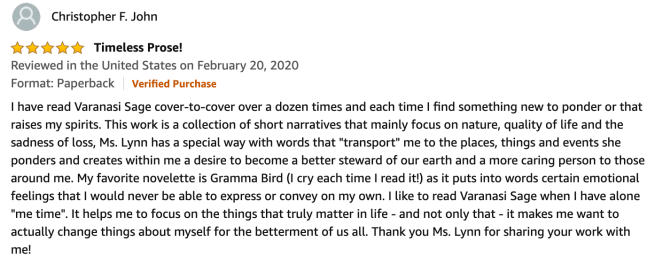
My debut collection, Varanasi Sage, is now available as an ebook and paperback on Amazon!

I am overjoyed to share this work with you! Years in the making, I put my heart onto the pages of this collection. I hope my heart touches yours as you read my words. I would love nothing more than for you to check it out. CLICK HERE!

Here are a few reviews I’ve gotten so far:

Screen Shot 2020-03-03 at 9.52.17 AM

Screen Shot 2020-03-03 at 9.52.48 AM

Screen Shot 2020-03-03 at 9.53.03 AM

If you’d like to read a few sample chapters from Varanasi Sage, click these links!

Awakening Depths

The Lucky Ones

Forest Song

During the process of writing, revising, and releasing this work, I encountered so much self-doubt and fear. Pushing through these emotions has been incredibly rewarding, and it still amazes me that I have a physical manifestation of my inner work.  I hope you will join me in celebrating this milestone!


Forest Song

[This story will appear in a collection of shorts for Varanasi Sage, due out July 1, 2019.]

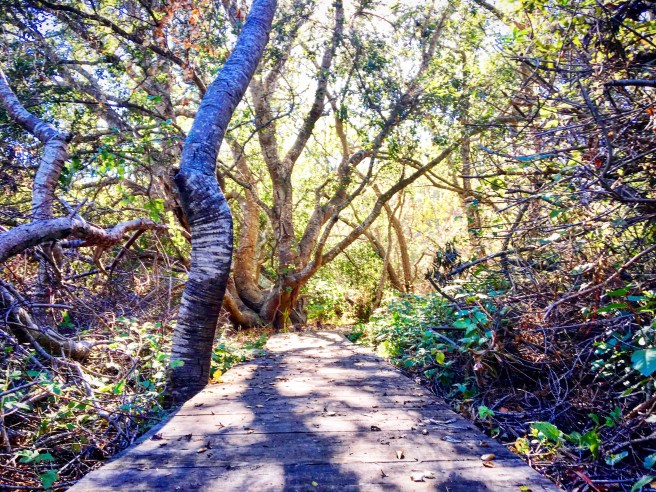
I opened the door, welcomed by early morning light peeking around clouds, caressing the world. Unseen doves proclaimed the day’s arrival in trilling coos. Oaks stretched in wild formations. Brown grasses stood defiantly against their drought deaths. The distant scent of a wood-burning stove — a reminder of recent wildfires that stopped at the next ridge. Deer tracks in the dust said I was not the only one who walked the trail.

They carried a flash, a remembering from my youth, making eye contact with a doe. She led me past trees, through ferns and ivy to her fawn, chestnut with white spots, nestled in the grass. Vulnerable. The doe watched as I knelt beside her baby, as I touched its tiny head, unaware of the danger to its fragile life. 

Through oak trees, lichen drooped long from their branches, the filtered sun created irregular, glowing shapes on the forest floor. Branches and leaves formed a tapestry of life, thick with energy, magnifying their essence and intensity. I was just one small organism in the network of life.  An enormous oak whose wide-spread branches twisted and turned, defied all patterns and rules. I approached the grand dame in awe of her divine, ancient presence, and when I moved under her furthest reach, the forest suddenly went silent.

A covey of quail (dressed in fancy spots, stripes and bobbling headpieces) whistled as they ran on speeding legs. A crinkling — Towhee kicking up leaves, flying in unison on purring wings when I approached. Acorn Woodpeckers squawked, perched on tree trunks — wearing tuxedos and red caps — drilling holes, stuffing them. Their gleeful chucking like happiness on the wind. I passed a giant oak, split at it’s lowest, thickest branch — down the middle. The top half on the ground, the trunk standing a jagged obelisk, rotted at the split.

Around a bend, a rhythmic cascade, almost like dropping water. I stopped to listen, but couldn’t make out the sound.

Slowly and quietly I walked, listening without seeing the source. At the crest, down the shaded hill, 5 or 6 deer chased each other, leaping between trees. They moved in s-curves, criss-crossing, creating figure eights with narrow hooves, playing like children in the forest. Nearer and nearer, they were so absorbed in their chase they didn’t notice me. Closer and closer, astonished by the sight, as close as I could get on the trail.

Overzealous, I stepped off the path and my human feet crunched leaves. Without showing signs of seeing me, they bounded away in perfect time through the meadow. At the edge of the forest, an antlered male turned back to look at me — knowing me, beckoning me on. 

On the other side of the meadow, the deer had left no trace.

A thick oak with a large horizontal branch, an arm reaching, pulled me off the trail. I hoisted myself up, stretched my legs and reclined back. Cradled in her arm, I gazed past the canopy to the sky. Rustling, fluttering, croaking, squeaking, laughing, whistling, chattering, calling. Each voice joined in one abundant song.

I could have lounged for hours, held by the tree and listening; yet, the forest did not sing for me. Symphonies without need for an audience. A true artist: creating for herself. 

“Show me the way,” I whispered. “How can I create like you?”

Close your eyes.

Moments passed, my ears opened to subtle layers of the song. Singers unashamed of their sound they received at birth. Each day a new score created without doubt or self-consciousness. Each voice accepted exactly as it was — knowing it had a welcomed part.

Coming Soon: Glamsient, the Book!

During this winter season, I’m making the final push to complete my first book! I’m on track to have it finished in Spring.

In order to prepare the release, I’m taking time off from publishing work here. Check out photos from my current travels on Instagram http://www.instagram.com/glamsient

IMG_6404

Sierra Hot Springs

The edge of a summer storm passed overhead breaking the monotony of blue sky. Patches of clouds cast temporary shade as they moved, releasing a misting drizzle, which fell upon us like a celestial blessing. Birds sang the glory of the day.

Stephanie and I relaxed in the large pool. She rested her head against the cement lip and closed her eyes; I faced away to look beyond the deck and view the Sierraville Valley.

People populated reclining chairs, others floated and bobbed in the pool. Stephanie and I were the only ones wearing bathing suits. 

Stephanie hadn’t spoken much since we left the silent dome and the hot pool it contained, but it didn’t bother me. I remembered my first time in the dome and the reverent silence that settled into my heart and mind as I slipped into a profoundly easy meditation facilitated by the heat of the tub, the arhythmic sound of water dripping into the two cold plunges, and the stained glass window — a woman resembling at once the Virgin Mary and Venus de Milo, pouring light into the waters through her outstretched hands. 

I looked to Stephanie; her face, perfectly serene, took on an ancient quality as if her soul had known this place years ago. 

Her visage made me want to rest my head against the cement lip, too, so I turned around. Just as I did, I saw a woman, floating on foam noodles — one under her shoulders, the other under her knees — as if she were in a chair. The woman’s eyes were closed, and like Stephanie, she hadn’t a care in the world. She could not see that her legs, spread in blissful comfort, moved towards the edge of the pool putting her naked groin on a direct trajectory for Stephanie’s face.

I poked Stephanie. She opened her eyes slowly until she realized a woman’s crotch was heading for her. 

With only a few giggles, Stephanie moved out of the way, and broke her silence: “want to check out the meadow pool you were telling me about?”

“Sure!”

We got our towels and walked onto the path. Pine trees filtered the sunlight into complex patterns on the ground.

“I love it here,” Stephanie said.

“Natural beauty and healing waters. What’s not to love?”

“Well,” she emphasized, “there is only so much hoochie coochie in my face that I can take.”

I laughed and then saw two porcelain tubs, just off the trail, nestled in the grass. They each had their own stream of hot water flowing into them from the ground. “Look at these, Steff! Here’s your solution!”

“We have to get in them,” she exclaimed. “How is this real?”

“Real magic,” I said.

We sat for a while, breathing in the novelty of relaxing in a bathtub on a mountainside, but we wanted to sit together and talk, so we continued our quest for the meadow pool. 

“I’m glad we sat in the secret tubs. The secret-not-secret tubs. They’re just right off the path, but they’re easy to miss,” I said.

“Everyone walks by, but not everyone sees,” Stephanie said. “I prefer that kind privacy, like the dome because nobody talks.”

“I was here one night and people were talking in there. I didn’t like that because it affected the depth of my meditation.”

Our feet crunched the path, adding a layer to the birds’ song.

“The big pool was a little extreme for me. I’ve never really been around that much nudity.”

“Oh, I didn’t know that.” 

“It was too much at once — naked people almost running into me with their parts. It happened twice. Once was a hoochie coochie and the other was titties.”

“Every time you close your eyes they come for ya, huh?” I joked.

“Seemed like it.”

We passed the white, Victorian Lodge built in 1870. Red poppies brightened the hillside.

“That hot pool, though,” Stephanie said. “It’s hard to explain what I felt. It was like pure energy. I felt a pulse — like a vibration.” 

“Because it’s so hot and the bottom is sand, I close my eyes and lose the feeling of having a body. It’s like my body becomes the water. Must be the closest thing to being in the womb.”

“It did feel like that! And that’s exactly how I felt when we were looking at the grass earlier. I had an out-of-body experience — a supreme oneness, like I was the wind.”

“Wow. Transcendental,” I looked to my left over the wide valley and the surrounding Sierra Nevada mountain range. “You’re so zen you don’t even need the dome.”

“A lady was crying in there.”

“I didn’t notice.”

“She was standing in one of the cold tubs with her face to the wall when we went in.”

“Oh, did she have her hand on the wall?”

“Yes. The dome felt like a place to…” 

“Open and release?”

“That’s how I felt. Completely safe. It was powerful. Every detail. The tiles, the wood, the stained glass. So natural and peaceful and somehow familiar.”

“I felt a release, too,” I said. “Before we walked in there I was angry about what was going on with work. I was thinking about it a lot.”

“I could tell you were trying not to, but you really were lost in thought.”

“But after going in the hot water and spending time in the dome, I feel like I released everything. Now I’m just kinda…dancing on the inside. Like I’m free.”

“Freedom is dancing on the inside. That could be your new motto,” she said as she looked at the trees who grew above us like guardians. “I like all the moss that’s growing.”

“I love mossy trees. And all the tall, lush grass,” I paused my step. “You know, earlier, when we were looking at the grass?”

“Yeah.”

“I was definitely lost in thought, thinking about that email. And you pointed to look out at the valley and the grass in the wind and there was a blue jay on a branch. That brought me back to the present moment and helped me let go.”

“That was it. ‘Come back. Come back,’ I was saying. I had that moment of oneness, but I knew how you were feeling, so I was like ‘hey, don’t forget to look around you and be here.’”

I breathed deeply, “next time I’m having a bad day I’m just going to come here.”

“Seriously. It’s so important to walk out. I feel the same in a lot of ways. You’re not alone.”

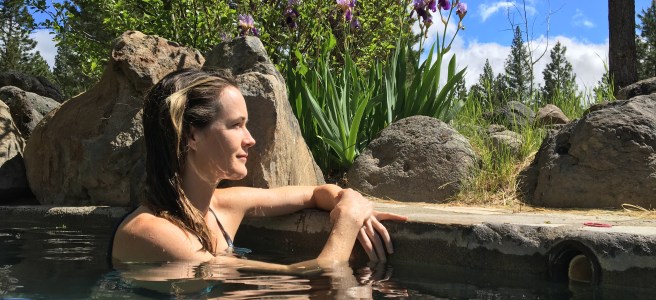
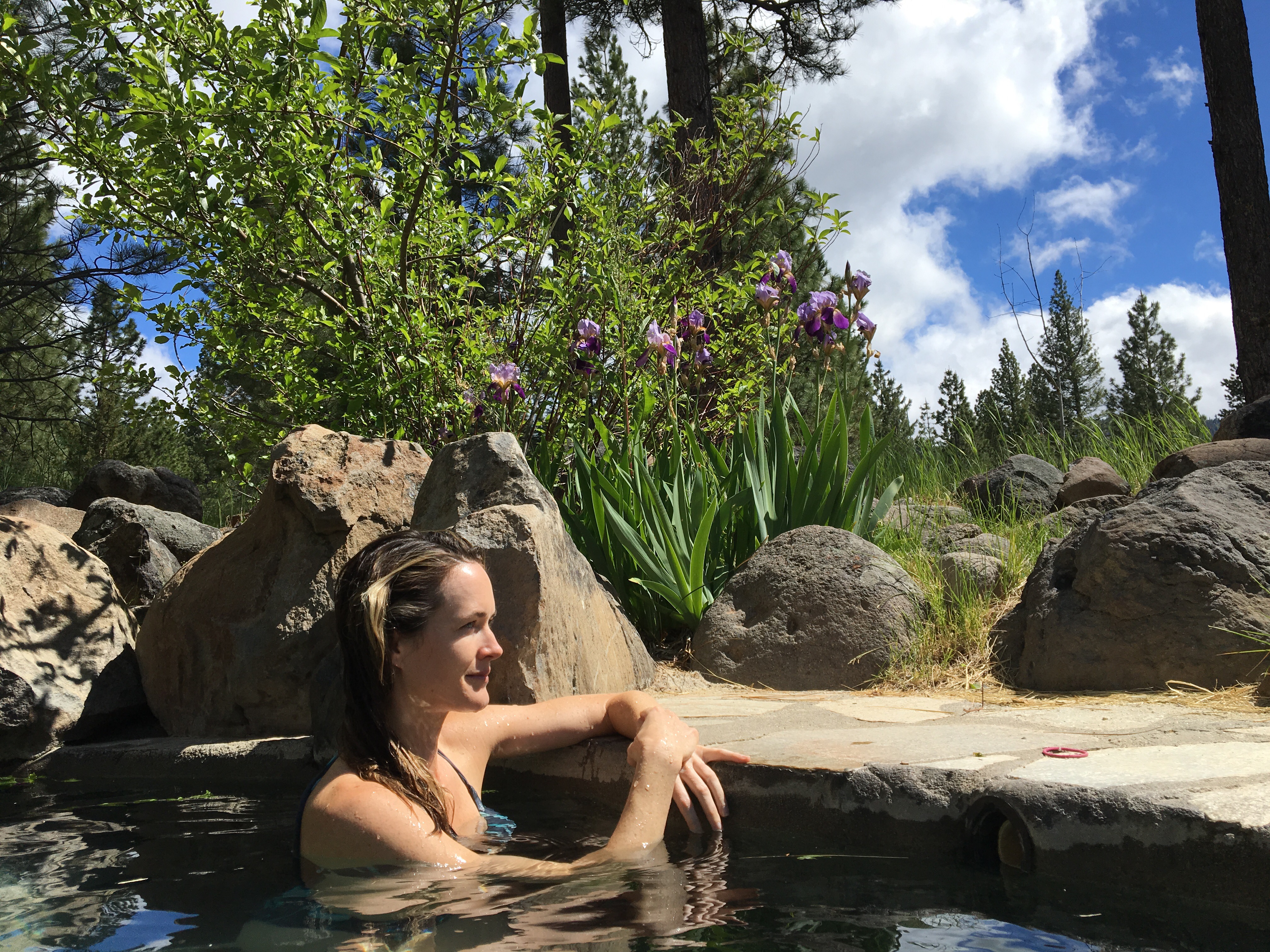
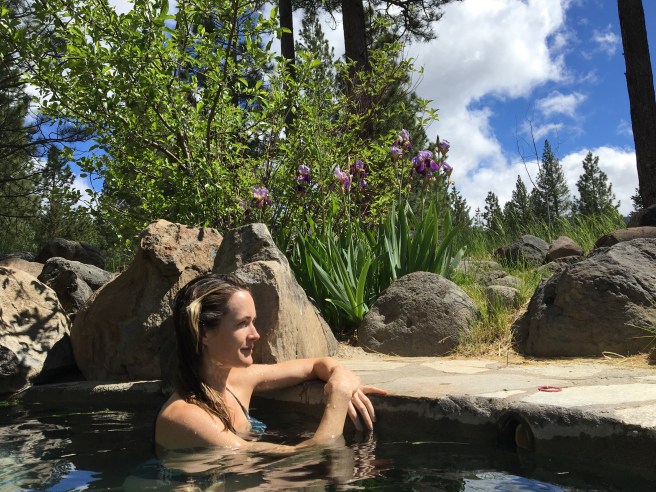
We approached the meadow pool and to our surprise, found we had the space to ourselves. A small tree grew behind boulders at the edge of the meadow. Purple irises bloomed in stately elegance. Flowers and leaves floated on the surface of the clear, blue water; we stepped in like queens. Our toes pressed into the soft, sandy floor.  

“I think I’m in the most beautiful place in the world,” Stephanie whispered.

“We’re in Faerlyland,” I said. “You know you’ve fully arrived in Faeryland when you come to the meadow pool and there’s mint and flowers floating in its waters.” 

“You described it like heaven when we were driving up here. And it really is.”

A wooden totem pole watched over the glistening water, speaking without words of the wildlife and civilization that lived in the valley before it was named Sierraville.  

“I love this aspen tree right here and the way the leaves flutter in the wind,” I said. “It reminds me of a wind chime my grandma had in her backyard. It was made out of thin, round, pearlescent shells. She had a lot of wind chimes, but I loved that one the most when I was a kid.”

“I know what you’re saying. Your grandma-angel is here. The Great Spirit is here.” 

I caressed the top of the water with my fingertips, creating swirling ripples. Birds sang from the trees in high tweets and whistles, forming the cadences and melodies of an unplanned symphony while clouds continued their slow and easy migration across the sky. 
 

I Come Back to Myself

Thoughts pour in; they swirl, forming a current, pulling more thoughts into the depths, growing tumultuous. They darken and become dangerous. I am caught, swept in by the undertow. 

It’s loud and I can’t escape. I try to distract myself with other people’s stories, but more words and information makes it worse. I resent the people on the other side of the screen.

I say to myself, “wherever you go, there you are,” but I start my car anyway.

Outside city limits, traffic thins until I am alone on the road. I slow my pace, enjoying the view: farmhouses, oak trees, cattails growing from wet earth. I crest over a bend to see a wide open sky and rolling hills. A lake rests between peaks. 

I arrive at the Buttermilk Bend trailhead. Signs announce Wildflower Tours at 11:00 am. It’s evening now, but I know I’m in the right place. I step onto the trail; the noise inside my head fades, replaced by the sound of the blue green river. 

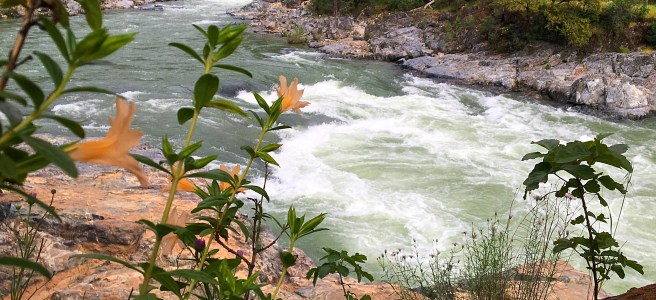
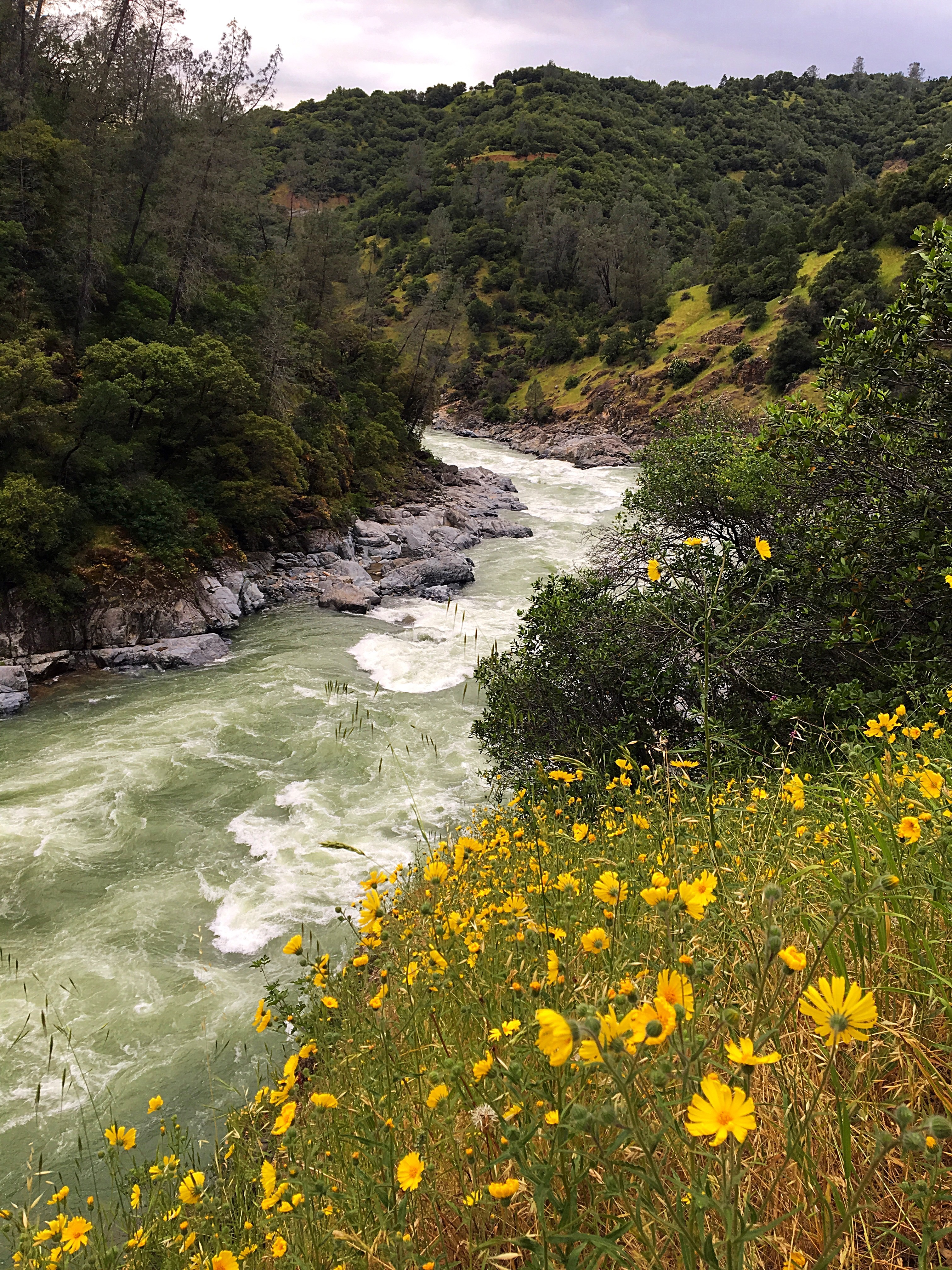
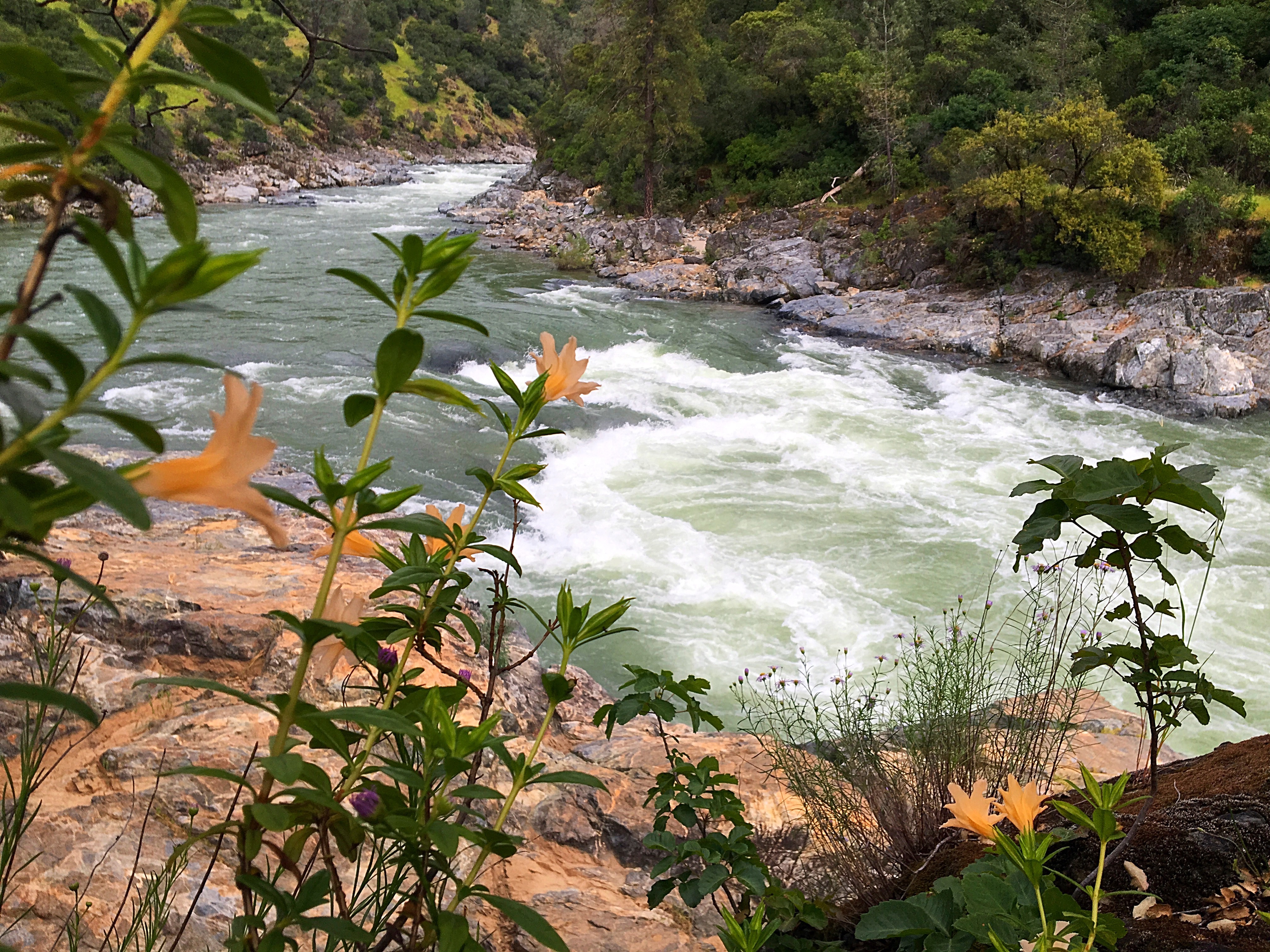
The Yuba rushes below me, through a valley she’s carved between foothills. I look into her. I see myself in her water; I am made of her, but she is greater than I. She is a force of life — mother to creation. She brings me back to myself, calling to her essence within my veins. I am not the dark and stormy waters of my mind; I am the observer of a free flowing river.

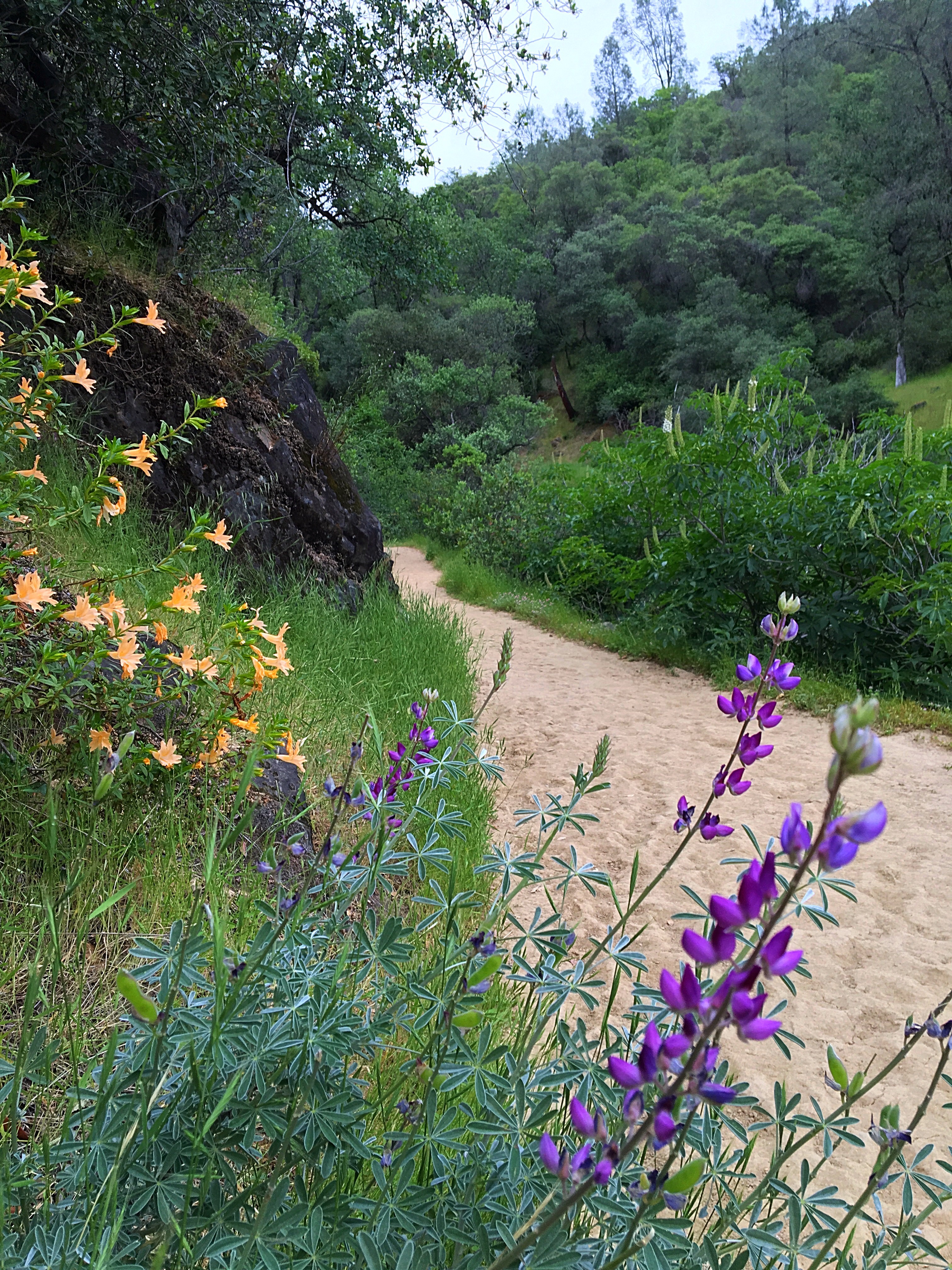
The trail follows the river’s path. We turn together. Curiosity ebbs and flows with the bends. Wildflowers line the path in blues, yellows, whites, purples, reds. They are compact, expansive, delicate, broad, intricate, simple, in boxes and in circles, fragrant and without scent. 

My plugged-in lifestyle, the one that makes my head loud, is like eating plastic information out of plastic bags; I scroll through photos that have been altered; I read inane comments; I watch videos of people pretending; I question every news article, every statement; the part of my life that is lived through squares plugged into outlets makes me forget my true nature. 

Wildflowers are a simple joy. When I see them, I feel a softening in my heart, a growing tenderness, an up-swelling of pleasant emotion.

The river sounds like the river primordial. It speaks the language of my soul. It washes my mind of the chaos and clutter I’ve accepted into it.  

Nothing to plug in, no buttons to push, nothing to sell or buy.

Amongst the wildflowers, next the river, I come back to myself — the pure, unaltered state of breathing and living.


Save Bear River

I drive down Dog Bar Road along narrow twists and turns. I pass green, rolling hills; Victorian farm houses with blossoming trees and horses out front; abandoned barns that are hauntingly romantic; and ponds that are full from recent rainstorms. 
In the distance, a group of female turkeys step out of the lush greenery and onto the road. I slow to a stop and see a male, with large plumage, chase after them. He passes behind daffodils and out of sight.
I arrive at the Bear River crossing and pull over. With my hands on the railing, I watch the water, knowing that 75% comes redirected from the Yuba. It’s hard to believe this fast-flowing river may soon become a reservoir if Nevada Irrigation District builds its proposed “Centennial Dam.” With two other dams on the Bear River, this is the last remaining stretch of free flowing water.
At the end of Dog Bar, I turn left for the Bear River Campground. 
People gather along the river panning for gold. I see young children, teens, parents, and older folks. The stormy winter unearthed far more gold than we saw during the drought, I’m told.
I walk the entire length of Bear River Campground, listening to the river’s soothing music. When I come to a patch of Miner’s Lettuce, I sit down and eat a few leaves. The river lulls my senses as it spill over rocks and laps against the shore. Native bees add their notes to the song, pausing when they alight on wildflower petals. The wind brushes against the river and caresses my face; it feels fresh, as if it has never been sullied by man’s emissions. I place both my hands to the ground. My heart fills with dread thinking this land will be entirely underwater if the dam is build.
When I reach the trailhead, I see a man collecting data next to a county truck.
“Mornin,” he says.
“Howdy.”
“You picked a good time to visit the campgrounds.”
“Because it’s empty?”
“That’s right. You been here in summer?”
“No, I just moved here recently. Is it a madhouse in summer?”
“Oh yes, lots of people camp here. It’s only $10 a night.”
“Wow! That’s the best deal in California.”
He laughs, “I wouldn’t doubt it. Where’d you live before you moved here?”
“My last home was in San Luis Obispo.”
“Ah. I went to Cachuma Dam a few years ago,” he says.
I look in his face and see the monstrous cement wall and dead zones lining the perimeter of the reservoir, the hallmarks of a dam. “It’d be a shame to see that here.”
“I’d hate to see that here,” he looks down at his spreadsheet.
“I’ll leave you to your work,” I say. “Have a good one.”
“You, too. Enjoy your walk.”
The trail follows the river closely at the base of a steep incline covered with ferns and wildflowers. Deer trails split off and lead to secluded nooks at the river’s edge. As a child, I would have played pretend in these nooks, imagining a time before modern development. I wonder if these are the locations where the indigenous Nisenan tribespeople continue their ceremonies with reverence to ancient traditions; I remember learning the Nisenan people in our area were stripped of their land and hunted like animals during the gold rush.
I pass beneath a flowering tree, petals flutter to the ground like a gesture of love. Cottonwoods sprout bright green foliage on every branch. 
Finding a large rock at the water’s edge, I listen to the river’s song and commune with the beauty around me. Soon, when the rain subsides, the river will return to a brilliant blue, all the trees will be green again, their leaves will flutter in the wind like tiny fans; the banks will recede below the tree line, and people will enter the river on kayaks and rafts finding refuge from their busy lives.
I think about the Nevada Irrigation District. They say the dam is a solution to climate change-driven water shortages, but don’t they know water evaporates rapidly off the top of a reservoir? Don’t they see that their other two dams on this river are never at full capacity?
I think about our Congressional Representative Doug LaMalfa. Nevada Irrigation District has requested he sell them our public land, the land I sit upon, so they can build the dam. He has already voted to pull back the EPA clean power plan, lift the moratorium on federal land coal leases, and roll back environmental regulations. I ask him regularly to share his stance on selling our land, the land I sit upon, but I have not heard back from him. I can only guess at his intentions.
I place my hand into the cold river, the snowmelt. It brushes through my fingers and against my palm. I savor the moment, knowing I may not have this opportunity next year.  

Drought Damage

I live at 2,500 feet on my aunt and uncle’s property and more often than not, snow in the forecast only brings disappointment; yet, one night a cold front descended, and at dawn, I awoke with the sun, and seeing a brilliant dusting on pine needles outside my window, I leapt from my bed and put on warm clothes. I luxuriated that morning, taking pictures of all the familiar sights that sparkled as if new.   
Through our greatest luck, my mom planned a visit that day. I called her and told her to come immediately: “The snow won’t stick for long,” I said.
Sure enough, by noon, the snow had melted from the trees and only amoeba-shaped patches remained on north-facing hills. 
“It’s too bad the snow’s gone,” I said to my mom after giving her a hug when she arrived.
“That’s ok, there was some on the drive up.”
“But you should have seen it,” I said. “Everything was at least 100 times more beautiful.”
“It’s beautiful enough,” she said, with her standard measured smile.
“Have you visited the snow this season?”
“No, you know I haven’t.”
“We should find some. I went on a hike through Rock Creek recently. There’s probably snow there. What do you think? Want to go?”
“Sure, but I don’t have snow shoes.”
“I have an extra pair.”
“OK. Do we need chains?”
“Probably, let’s buy some.”
“Have you ever put them on?”
“No, but it can’t be too hard.”
“Ok…” she looked at me skeptically.
We purchased chains and drove up the mountain. By the time we got to Nevada City, we saw snow on the ground. Highway 20 began a steep incline and my mom looked out the window at the snow, which thoroughly covered the ground and trees. 
“I know it’s cliche,” she said. “But this is a winter wonderland.”
We pulled off the highway and wrapped down narrow roads to the trailhead.
“The car is sliding!” my mom exclaimed as we drove down a steep stretch.
“Not that bad,” I said, completely unfazed.
“I hope we don’t get stuck on the way up,” she said.
“We won’t get stuck,” I wasn’t worried, having never driven in the snow. “We’re on an adventure, mom! A glamsient adventure.”
“Whatever that means,” she said.
“You would know if you read my blog,” I joked.
We pulled into the empty parking lot — the best kind at a trailhead.
“Look mom, yours are the only footsteps,” I called when she walked in front of me.
“Yes!” she made S-curves to revel in the novelty.
It amazed me to see her frolic. She is often serious and reserved, but in the snow she hopped and scampered. Effervescence infused her spirit. She patted snow together in her bare palms.
“Don’t throw it at me!” I said.
She threw it at a tree trunk and flashed a smile that I hadn’t seen since before my grandma got pneumonia and died.
“Can you tell there’s a lot of damage here?” I asked.
“Yes, but it’s all beautiful under the snow.”
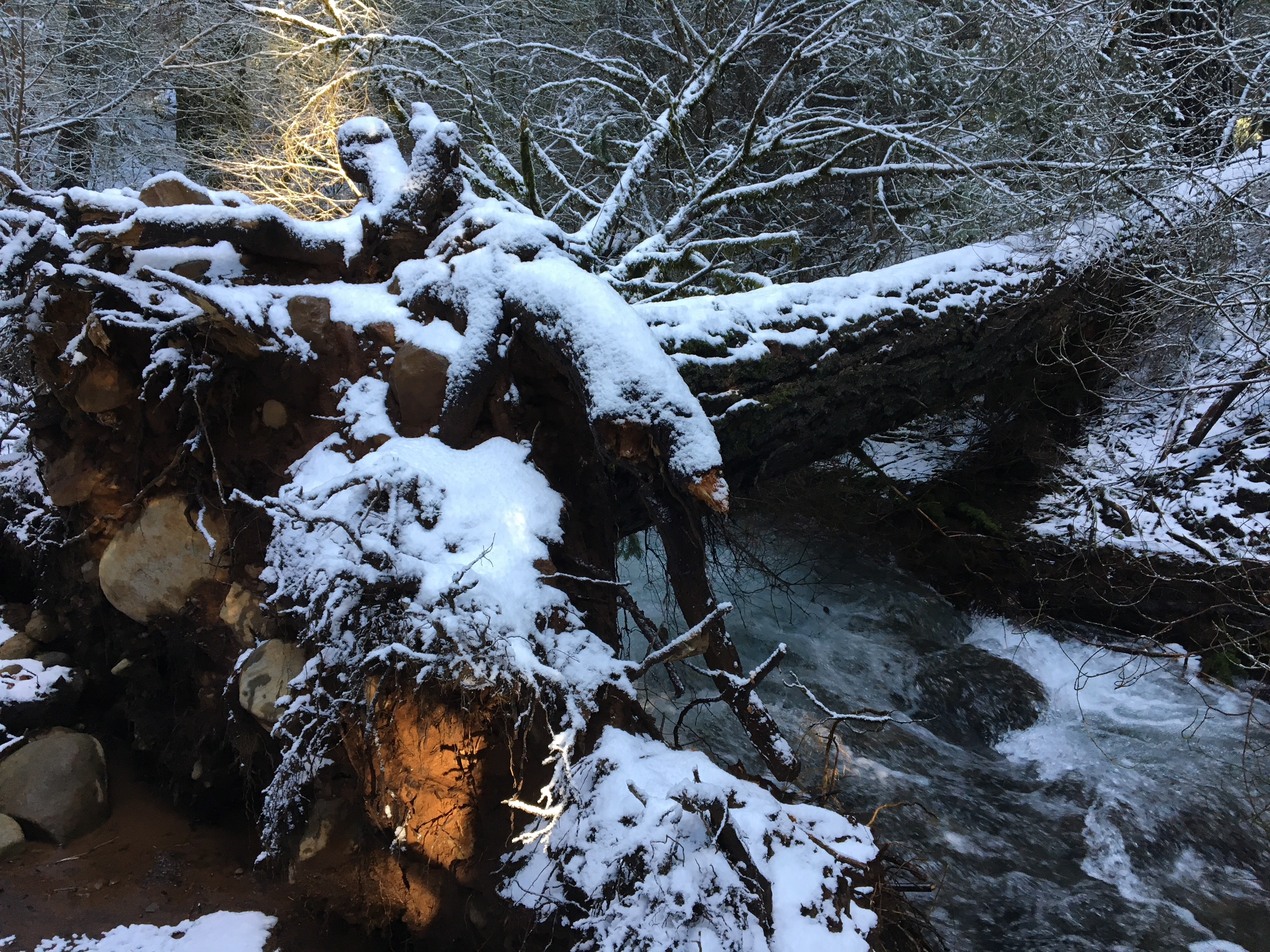
We came to a blockade — a large, fallen tree that stretched across the entire path.
“Should we turn back?” my mom wondered.
“I climbed over it the other day.”
When we got to the other side, she asked me, “is there snow on my head?”
“A little.” 
She went under a branch and shook it. “How about now?” she laughed.
I laughed along with her. She threw more snowballs at trees. We laughed when she missed her targets.
“Last time we were here, Kitten said the falling trees and branches are because of the drought.”
“Oh, yes. The forest service estimates that 1 in 3 trees in Californian forests have died from the drought.”
“Really?”
“I think it’s an underestimate,” she said. “We will see more damage. It takes years for the forests to return to good health.”
We walked along the creek, a new scenery with the snow, completely different than it had been in the rain. I even lost the trail in one section, although I didn’t tell my mom.
“The aquifers are mostly depleted in California,” my mom continued. “Since the 1930s, big agriculture since has run them dry.”
“That’s sad, mom.”
“Fresno has sunk some 20 or 30 feet because the aquifers below the city are empty.”
“I didn’t know that. Now I guess those aquifers are ruined.”
“It’s almost unimaginable how much humans have changed the earth.”
“Greed and ignorance,” I said.
At the end of our walk, we put chains on my car’s tires. It only took a dozen tries, and constant reference of the instructions, but we did it!
We climbed the hill at a low speed until we arrived at the steepest slope. My Mom gripped her seat while I stepped onto the gas and the car wobbled through slush. 
“Come on, little car!” My confidence bottomed out when I felt the car lose traction. I had no idea what I was doing and it was time to admit that to my mom.
But then — by some strange magic — the tires gripped and took us out of the churned up road. The car felt steady again, slowly progressing.
“We made it, Mom!” I said.
“Yeah,” she sighed, somewhat sarcastically as relief washed over her face.
The next morning, she wanted to leave early to avoid the San Francisco Bay Area traffic.
“You know how it gets,” she said.
“I just wish you could stay longer.”
“I noticed you have a few dead trees on the property,” she said.
“The pine trees?”
“Yes, the tops are brown. A sign of drought damage.”
“Do you remember the giant oak in the middle of the meadow last time you were here.”
She looked as if she were trying to recall her last visit.
“Doesn’t matter,” I said. “It fell last summer. Did I tell you that story?”
“I don’t think so.”
“One night, I was reading in my room and I heard Shadow making strange noises outside. I called his name a couple times out the window, but he kept going. So I went downstairs and opened the door to see what was going on and there’s Shadow on the fence, looking towards the meadow. I called his name and tried to get him to come in, but he just kept staring towards the meadow and making weird noises. I got kind of creeped out thinking maybe there was something or someone out there. 
“I went inside and when I was halfway up the stairs, I heard this loud, cracking sound and then an enormous thud, which shook the whole house! For a second, I couldn’t move. My heart was beating so fast. I had to check outside, but I couldn’t see that anything changed. It was so dark out and I didn’t want to go past the porch. 
“The next morning I went outside and, sure enough, the giant oak had split at it’s lowest branch — right down the middle. The top half of the tree was on the ground and the rest of the trunk remained standing like a jagged obelisk. Aunt Marika and Uncle Rick were shocked when I told them.”
“Another drought death.”
“I don’t know. It looked like there was a hole and some rotting where the tree split. It looked like insects had gotten in and then water went in the hole.”
“That’s the drought, for you. The tree becomes distressed when it’s not getting enough water, and bugs can burrow into it.”
“It’s natural defenses are down.”
“Exactly.” 
We finished our breakfast and I walked my mom to her car. We hugged and said goodbye, thank you for visiting, thank you for having me, come again soon. We waved as she pulled away.
I turned to the meadow and walked to the remaining chunks of the giant oak. Looking at the thick, moss-covered cylinders, I remembered the oak’s grand stature, a living connection to the past. Surely it had been alive before the United States became a country. Seeing it now, in only a few chunks and pieces, the majority hacked up and hauled away by neighbors for firewood, I remembered my young cousin’s reaction when she saw the tree had fallen. She grew up on the property and knew the oak — felt it’s presence — by the time she could walk.
I recalled her devastation. While my Aunt and Uncle surveyed the damage, my cousin climbed into the tree from the top where it rested on the ground, and walked through its branches towards its base; her face spoke of when her father set up a swing on its thickest branch, and the times she climbed it and found refuge in its branches like a secret hideaway. When she was ready, she found a place to sit, her back to me. She leaned against a branch, now vertical, pointing to the sky. She wrapped her arms around it; I approached her, and heard as the memories spilled softly from her eyes. 


Rock Creek Wisdom

I recently purchased Hank Meal’s, The River, a local’s guide to hiking trails surrounding the Yuba River. On a rainy afternoon, my friend, Kitten, and I got cabin fever; we opened Hank’s book and chose the Rock Creek Nature Trail (located in the Tahoe National Forest) as our tonic. Once the site of a lumber mill, Hank described this one-mile loop as an easy and accessible trail that meanders beneath 11 varieties of trees and alongside Rock Creek.

“Looks like we have the place to ourselves,” I beamed when we pulled into the empty parking lot.

The ground was completely saturated — water pooled around our every footstep. Light rain floated to earth, accompanied by large, sporadic drops falling from tree branches, tapping an intricate percussion on land and water. The creek rushed past us, beckoning us onwards.

“Look at all this debris,” Kitten said. “These recent storms have been brutal!” 

“The other day, I saw a group prayer going around Facebook asking for the storms to be gentle on the forests, and I don’t know how I feel about that.”

“Why?”

“California needs water. I’m not eager to pray the rain stops.”

A stream carved its way down the hillside and onto the path, turning the path into a waterway and making us walk along its edge. Branches, leaves, and pine needles littered the area, and the Rock Creek Trail felt less like a nature walk and more like a rugged adventure, like we were the first explorers. At one point, we had to climb over a large, fallen tree.

“All this damage is from the drought,” Kitten said. “Tree roots retract closer to the trunk and become less dense. And the branches die. So when a big storm hits, it uproots trees and branches fall.”

“Makes sense.”

“Now I bet this will be a tinderbox in summer — this and every other forest in California.”

“Let’s hope not! If we get enough rain, the dead stuff will get mushy and become fertile. With fewer trees and branches blocking out the sun, new life will grow. Regeneration is one of the most incredible aspects of nature, in my opinion. Didn’t the guidebook say this land was harvested for timber not long ago? I wonder what that looked like!”

“I hope we get the rain, too, of course. Shame if it burns. I’d rather see the land heal.”

“Did you know illegal campfires start a lot, if not most, of California’s forest fires? The drought makes everything dry, but it’s singular humans messing up on top of that.”

“Hitting Nature from both sides: the macro and the micro.” 

We passed what Hank described as a relaxing welcome bench, knocked out of the ground and thrown on its back.

“I’m ready for all humans to live in harmony with Nature.”

“Now that’s a good prayer.”

We stopped to inspect a fallen tree. It made a sturdy bridge over the creek and it’s roots were exposed in an unchanged unit, still holding rocks they had grown around.

“This makes me think of my inner work,” I said, ducking beneath a branch.

“What do you mean?” Kitten asked.

“Self-reflection can sometimes hurt. After a long period of unconsciousness or trauma, like a drought, the medicine of awareness can feel destructive — it’s painful to look on all aspects of myself — lessons can be hard, truth can hurt. Guilt, disappointment, shame, and anger surface. And when that happens, it feels like I’m being destroyed. Like my guts are being ripped out or my heart torn apart.”

Water cascaded down the creek bed over rocks and debris, navigating curves, eddies and pools.

“I think the commitment,” I continued, “is to give myself sustained compassion, like rain, so that which has been knocked over can become the fertile grounds for new life — or a bridge to enlightenment. To continually give myself compassionate attention and embrace myself instead of pushing myself away — that is the way.”

“I see. If you have the painful, seemingly-destructive insight and you don’t follow it up with compassion, it’ll catch on fire and consume you when someone starts an illegal fire,” Kitten said.

“Definitely.”

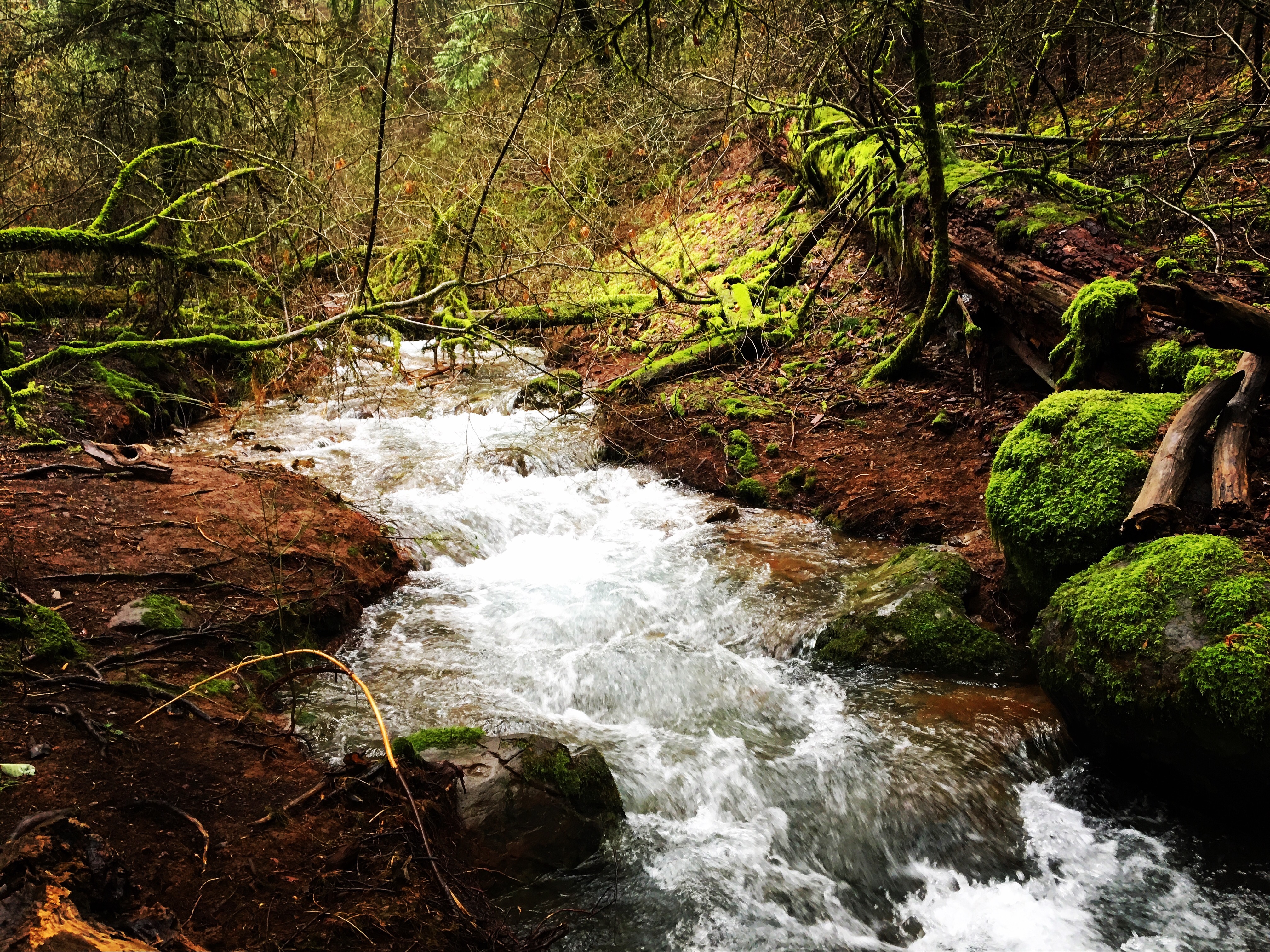
We crossed a wooden bridge before we completed the loop. Birds sang from the moss-covered trees, while a soft and steady drizzle, almost a mist, enveloped the forest. 

108 Sun Salutations

I started practicing yoga in my teens, and over the years, I have done my fair share of sun salutations. In my personal practice, I sometimes use a few to warm my body, but I don’t really enjoy them.  

So when I heard we were doing 108 sun salutations at the end of my first full day of Yoga Teacher Training, I rolled my eyes. Not only did we have to do 108, but we had to count them ourselves. ‘Great,’ I thought, ‘108 repetitions of repetitive movement.’ This was literally the opposite of the meditative, dynamic practice that I love.

Of course, I lost track within the first 15. And that irritated me to no end. What did it even matter to keep count at that point? I would never know how many I had done!

Then, somewhere around 30 (or maybe it was 35, who knows?), I couldn’t believe how many I still had to do. It seemed like this would take forever. And, oh man, it was so tedious!

By the time I got to 42, I wanted to go home. I wanted to stop the incessant ups and downs, roll up my mat, and leave. I felt far from my comfortable home where I could do whatever practice felt right.

Around 50, only half-way, I decided the whole training was a waste of time and I should just quit! Teacher training was a stupid mistake. 

Then — somewhere close to 70 — I realized I was nearly finished. It was hard and annoying, but it was almost over. A rush of gratitude and appreciation washed through me.

Hitting 80 brought a feeling of accomplishment, which grew with every round I completed thereafter.

At 90, I chose to savor the remaining salutations. I was so close, and I wanted to enjoy those last rounds.

Number 100 arrived and I knew the struggle was worth it. I had done so much.

I finally reached 108, and thought maybe I should do a couple more just in case I had undercounted. They weren’t so bad; it wasn’t so hard.

Resting in child’s pose after completion, I asked myself why I fought against the practice. My resistance made me suffer far more than the actual sun salutations. 

My life flashed before me and I saw all my daily annoyances, the times I was impatient, the times I wanted to quit or fast-forward. I thought of when I wished my life away — stuck in traffic, pining for summer, waiting at the DMV, sick in bed. I saw my struggles and I saw the end of my life. Would I still wish my time away at the end or would I wish I could have savored even the most frustrating moments? What would my life look like if I appreciated all the moments instead of resisting them?

We finished class and I got in my car, feeling a new space in my being, like my mind had opened and my heart softened. 

A text from my cousin Derek came through: “Can you drive me home tomorrow? I have to leave my car in town at the shop.”

“Of course,” I wrote back without hesitation. “If you can be in town at 6 when I finish training that would be perfect.”

“For sure,” he replied.

That night I could barely sleep even though I was exhausted. The 108 salutes energized me. I tossed and turned feeling the uncomfortable combination of wired and tired.

My alarm sounded early the next morning. I rolled out of bed and into the shower. My eyes were puffy, and I knew coffee wouldn’t be enough. At least we would start teacher training that morning with an asana class — that would wake me up.   

Nine hours of training later, it was dark out, and I was ready to go home and relax with a glass of wine. I drove to my cousin’s mechanic, and got a message from him on the way: “Running late there in 10.”

I parked out front. 10 minutes, not so bad, but 10 minutes passed quickly, and soon came 15. I was bored and annoyed. Where was he? I was helping him. He should be on time.

After 20 minutes, I was pissed! Obviously, he didn’t have any respect for my time or energy! How could he be so rude as to keep me waiting when I was doing him a favor?

I sat there fuming. I mentally prepared to let him have it as soon as he got there. I figured out all the things I would say to make him feel guilty and bad about himself for making me wait. He was selfish and I would make sure he knew it!

That is — until I remembered the 108 sun salutations from the night before. This was my lesson. Getting angry and resisting my present moment was ruining my present moment. Waiting wasn’t the problem, it was my mindset. 

I thought about the miracle that Derek and I both have these physical forms on earth, wouldn’t it be better to appreciate the time we get to spend together? A guilt-trip tirade would make us both miserable. He was late — no big deal. Nobody was hurting, except for me with my self-inflicted suffering. Being angry wouldn’t make him arrive sooner.

I decided to relax and clear my mind.

Not long thereafter, headlights shone around the corner and Derek pulled up. We rolled down our windows.

“Sorry I’m late,” he said, sheepishly.

“I appreciate your apology and I’m glad you’re here now,” I said, without a note of hostility. “You want to park in this spot?”

“Yeah, that would be great.”

We moved like Tetris pieces.

“Thanks, cuz,” he said, getting into my car.

“You’re welcome.”

“Can I take you to dinner?”

“Sure. I’d love that.”

During our meal, we laughed at stupid jokes and spoke of our futures. I even told him about my newfound love for sun salutations.