I Come Back to Myself

Thoughts pour in; they swirl, forming a current, pulling more thoughts into the depths, growing tumultuous. They darken and become dangerous. I am caught, swept in by the undertow. 

It’s loud and I can’t escape. I try to distract myself with other people’s stories, but more words and information makes it worse. I resent the people on the other side of the screen.

I say to myself, “wherever you go, there you are,” but I start my car anyway.

Outside city limits, traffic thins until I am alone on the road. I slow my pace, enjoying the view: farmhouses, oak trees, cattails growing from wet earth. I crest over a bend to see a wide open sky and rolling hills. A lake rests between peaks. 

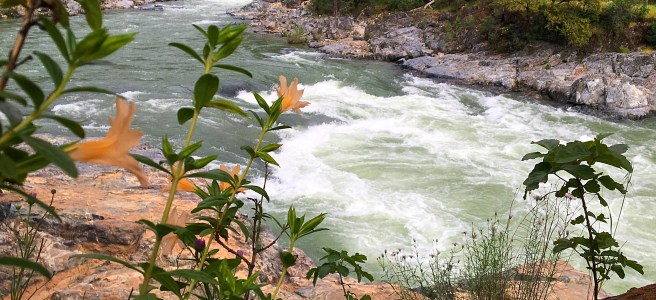
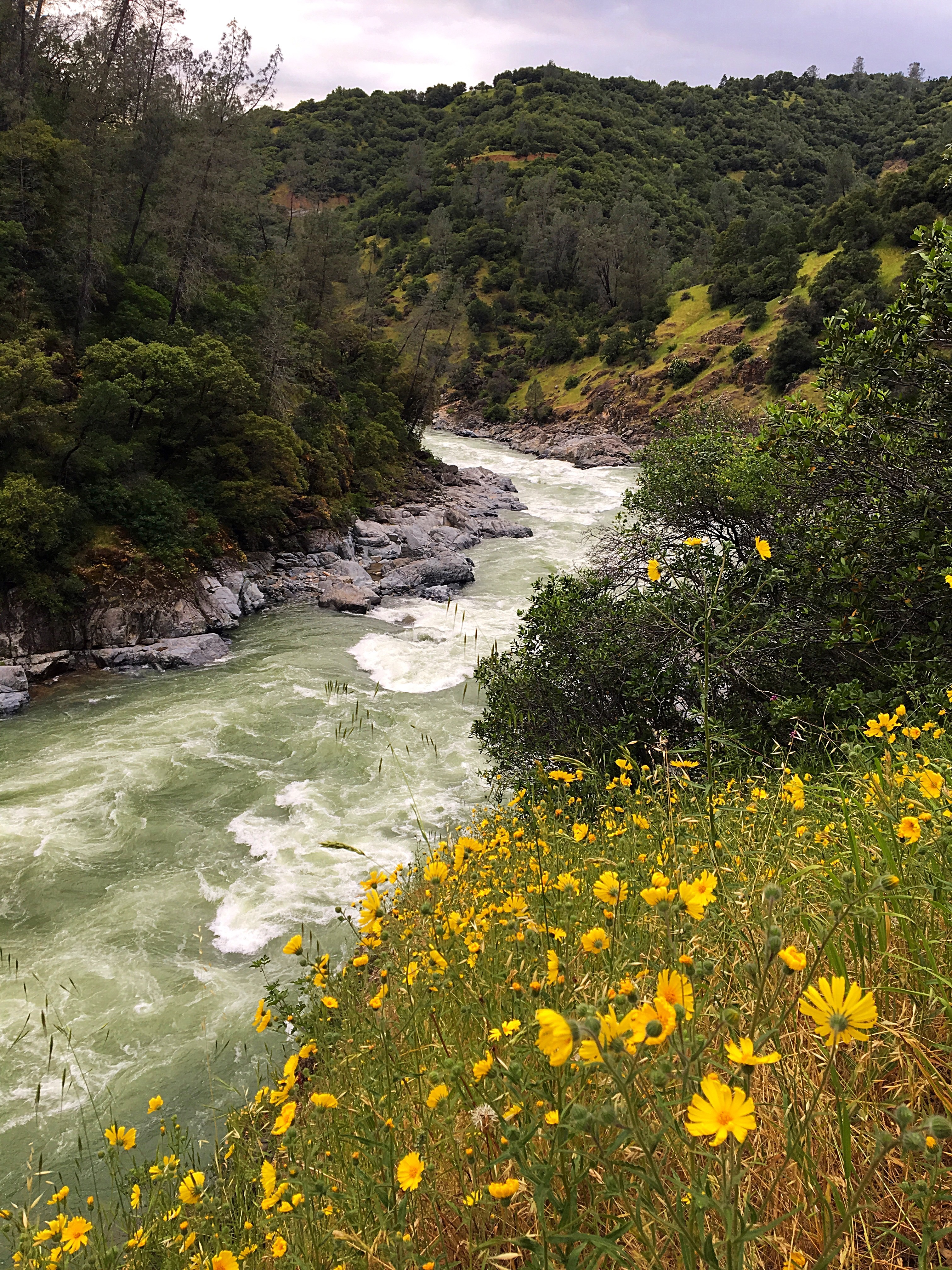
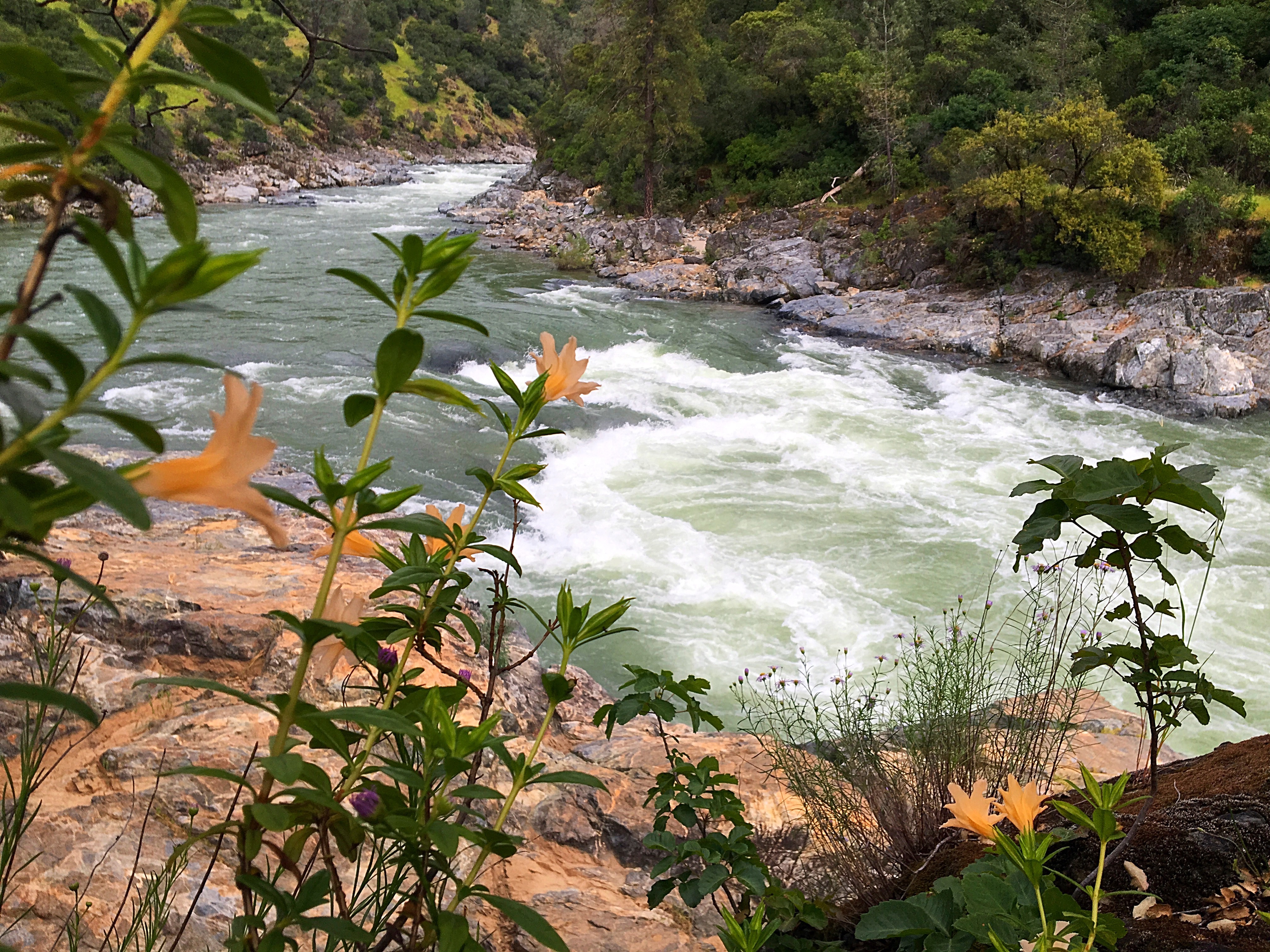
I arrive at the Buttermilk Bend trailhead. Signs announce Wildflower Tours at 11:00 am. It’s evening now, but I know I’m in the right place. I step onto the trail; the noise inside my head fades, replaced by the sound of the blue green river. 

The Yuba rushes below me, through a valley she’s carved between foothills. I look into her. I see myself in her water; I am made of her, but she is greater than I. She is a force of life — mother to creation. She brings me back to myself, calling to her essence within my veins. I am not the dark and stormy waters of my mind; I am the observer of a free flowing river.

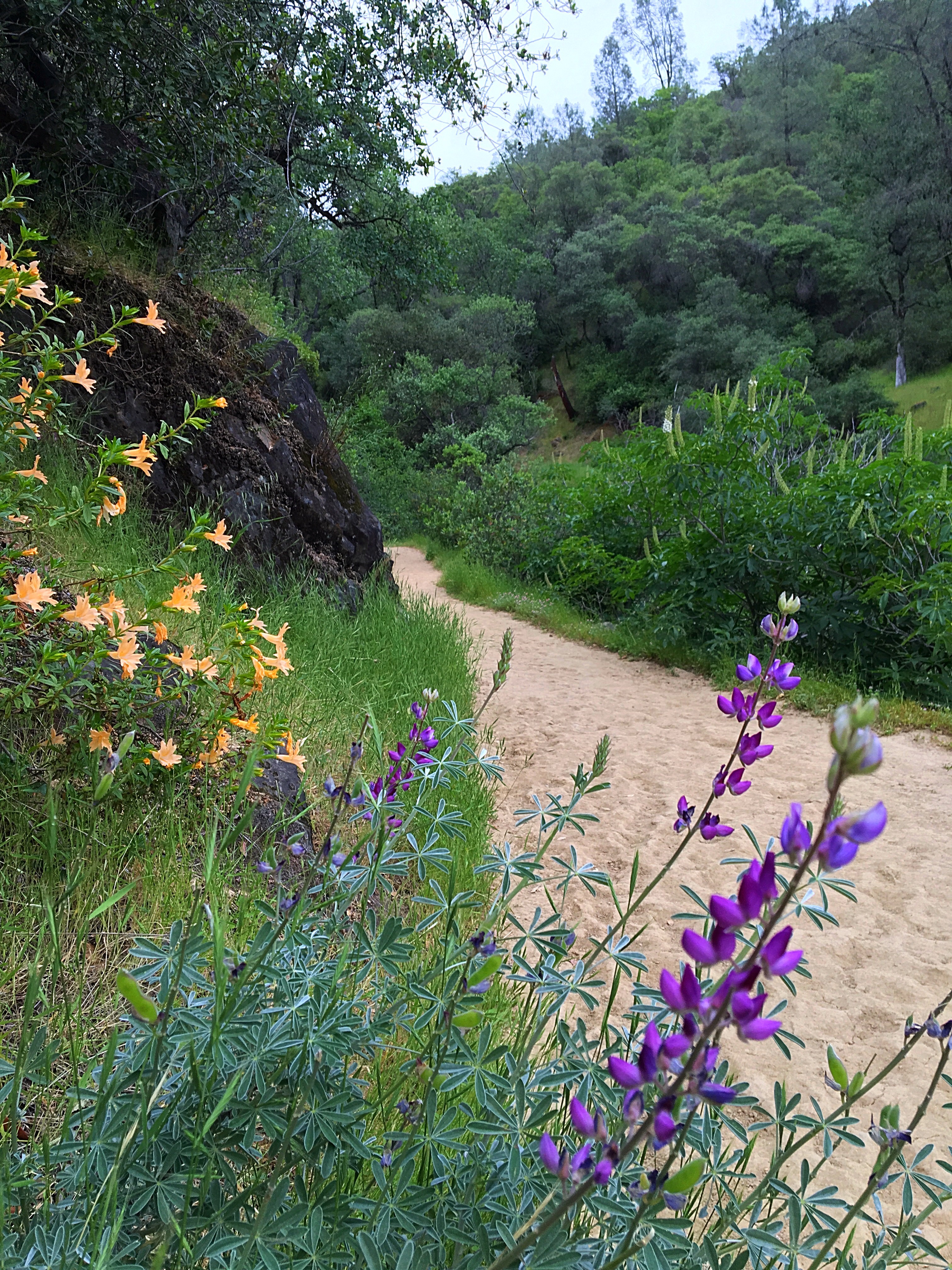
The trail follows the river’s path. We turn together. Curiosity ebbs and flows with the bends. Wildflowers line the path in blues, yellows, whites, purples, reds. They are compact, expansive, delicate, broad, intricate, simple, in boxes and in circles, fragrant and without scent. 

My plugged-in lifestyle, the one that makes my head loud, is like eating plastic information out of plastic bags; I scroll through photos that have been altered; I read inane comments; I watch videos of people pretending; I question every news article, every statement; the part of my life that is lived through squares plugged into outlets makes me forget my true nature. 

Wildflowers are a simple joy. When I see them, I feel a softening in my heart, a growing tenderness, an up-swelling of pleasant emotion.

The river sounds like the river primordial. It speaks the language of my soul. It washes my mind of the chaos and clutter I’ve accepted into it.  

Nothing to plug in, no buttons to push, nothing to sell or buy.

Amongst the wildflowers, next the river, I come back to myself — the pure, unaltered state of breathing and living.


The Broken Pot

The night before I left town, I needed to clean my house. I hate returning to a mess because it doesn’t feel restful, and the last thing I want when I get home is to feel like I have chores to do. 

Luckily, my house is fairly-tiny, and doesn’t take long to clean. I started with bathroom and then the kitchen, finishing with the floors. Everything was complete when I vacuumed my tiny living room. Except I quickly dusted my piano, realizing it was overdue, and repositioned the plants upon it.  

Satisfied with my clean home, I took a break to eat snacks before my next chore: packing. Both of my cats were downstairs with me. Sterling, a big, fat, fluffy cat laid next to the front door, which I had opened to bring in fresh air. A thin, transparent, gold curtain in the doorway kept the bugs out. My older, dominant cat, Shadow, sauntered past me towards the door. Like an arrogant king, he paused to look down at Sterling, who did not make eye contact.

Shadow sat just beyond the gold, transparent curtain and faced himself directly at Sterling. Only the thin veil separated the two, extra-large males. I barely noticed Shadow’s confrontational posture until Sterling was growling. He carried on for a few moments before I looked up from my phone and asked “what’s going on here?” 

As soon as I spoke, Sterling moved quickly and low to the ground. He stopped at the door behind me, which led to his cozy, safe space. He pawed at the door, trying to pry it open. 

I crouched next to him, inadvertently blocking him into a corner. “It’s ok,” I said. “You don’t have to leave. I’m not angry.” I pet him, but did not open the door. 

He breathed quickly, his agitation intensifying. He cowered beneath my touch. “Hey, it’s ok,” I placed my hand on his belly and gave him a rub. His eyes widened, his pupils dilated. “What’s up with you?” 

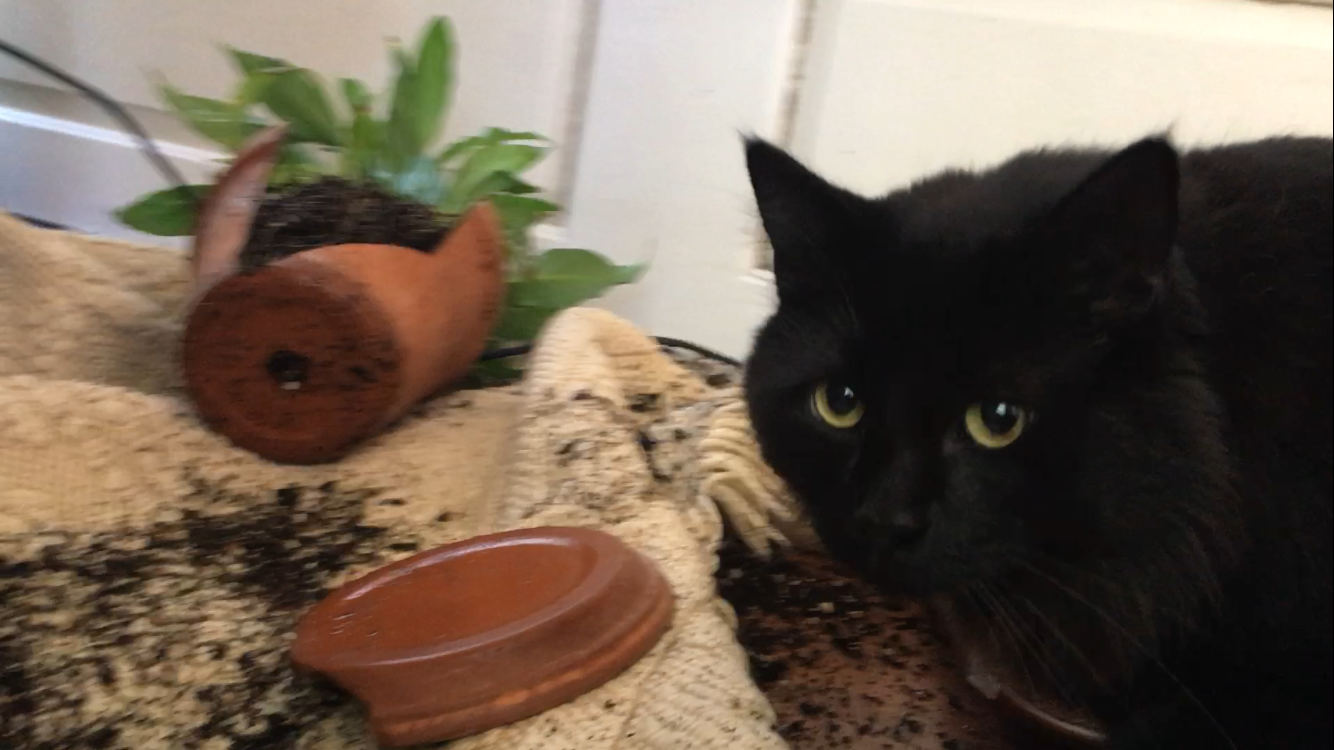
I heard the floor creak. I turned, surprised to see Shadow right behind me. I reacted with a slight jolt. Sterling clamored to his feet, scratching at the floor with his claws. He bolted to the piano as fast as his fat body could take him. He leapt with fear, not looking where he was going, and found himself face-to-face with one of the potted plants.

I watched as his claw caught the lip of the saucer beneath the pot. “Oh Shit!” I exclaimed as Sterling fell backwards and the pot banged deep bass notes, echoing my expletive, before crashing to the ground, breaking and flinging dirt across the floor.

For a split second, looking at the broken pot and the brand-new mess, I had to make a choice. 

I chose to be OK with what just happened. I chose to accept it, even though I had just finished cleaning the house and still had to pack and get organized; even though it didn’t feel OK, I chose to accept it with an understanding that it was OK.

I looked at the broken pot and the dirt on the floor. I looked at the little pile of dirt on the piano keys, the shards of pottery on top of the mound. I looked at the rug I inherited from my Grandmother, scrunched up where Sterling launched off it. In a way, the scene was aesthetically pleasing. Everything was beautifully chaotic, organically placed; it was an artistic expression of gravity and physics that no human could possibly recreate.

I kneeled beside the plant and stroked its narrow leaves — for at least a year it needed repotting, it had grown large and looked cramped. There also hadn’t been enough soil in the pot, but the plant was healthy and so the task never made it onto my to-do list. “Now’s your time,” I said. 

I picked up the plant and the shards of pottery; I shook out the rug and cleaned off the piano. I moved with acceptance — maybe even contentment — and did not feel one twinge of irritation, resentment or anger.

With the plant repotted and the room clean again, I sat back and considered my reaction. Not too long ago, I may have cursed the sky for giving me wacko cats and grumbled as I fixed everything. Where did this deep sense of equanimity come from?

It could only be my yoga practice. I began yoga teacher training at the beginning of the year and have been learning the principles, philosophy and energetics of yoga. According to yoga, personality is a process, and we can evolve to a higher ideal. Left to itself, the mind repeats in cycles, yet with the power of our will we can retrain the mind and reshape ourselves. In this instance, I was not the woman who would curse the sky and get red in the face; I was the woman who picked up the pieces with a calm, knowing smile.

I recalled my teacher, Kelly Golden’s words at the end of every class, “the real practice of yoga begins when you step off the mat and into the world.”

Yoga teaches that discernment is the pinnacle of our spiritual practice. Everyday we make choices and the true practice of yoga helps us choose what is highest and best. In this instance, my practice allowed me to choose acceptance and peace. 


Rock Creek Wisdom

I recently purchased Hank Meal’s, The River, a local’s guide to hiking trails surrounding the Yuba River. On a rainy afternoon, my friend, Kitten, and I got cabin fever; we opened Hank’s book and chose the Rock Creek Nature Trail (located in the Tahoe National Forest) as our tonic. Once the site of a lumber mill, Hank described this one-mile loop as an easy and accessible trail that meanders beneath 11 varieties of trees and alongside Rock Creek.

“Looks like we have the place to ourselves,” I beamed when we pulled into the empty parking lot.

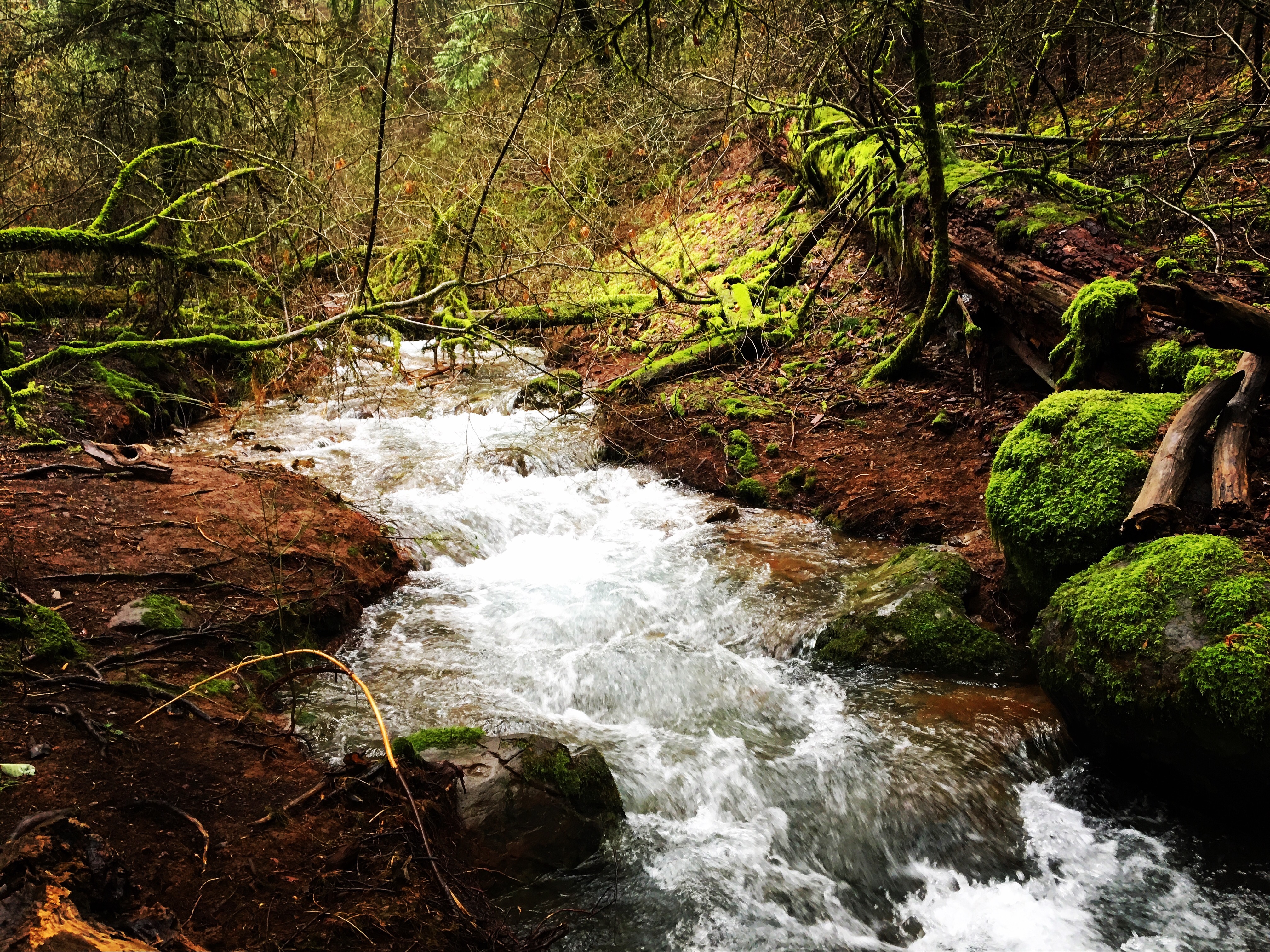
The ground was completely saturated — water pooled around our every footstep. Light rain floated to earth, accompanied by large, sporadic drops falling from tree branches, tapping an intricate percussion on land and water. The creek rushed past us, beckoning us onwards.

“Look at all this debris,” Kitten said. “These recent storms have been brutal!” 

“The other day, I saw a group prayer going around Facebook asking for the storms to be gentle on the forests, and I don’t know how I feel about that.”

“Why?”

“California needs water. I’m not eager to pray the rain stops.”

A stream carved its way down the hillside and onto the path, turning the path into a waterway and making us walk along its edge. Branches, leaves, and pine needles littered the area, and the Rock Creek Trail felt less like a nature walk and more like a rugged adventure, like we were the first explorers. At one point, we had to climb over a large, fallen tree.

“All this damage is from the drought,” Kitten said. “Tree roots retract closer to the trunk and become less dense. And the branches die. So when a big storm hits, it uproots trees and branches fall.”

“Makes sense.”

“Now I bet this will be a tinderbox in summer — this and every other forest in California.”

“Let’s hope not! If we get enough rain, the dead stuff will get mushy and become fertile. With fewer trees and branches blocking out the sun, new life will grow. Regeneration is one of the most incredible aspects of nature, in my opinion. Didn’t the guidebook say this land was harvested for timber not long ago? I wonder what that looked like!”

“I hope we get the rain, too, of course. Shame if it burns. I’d rather see the land heal.”

“Did you know illegal campfires start a lot, if not most, of California’s forest fires? The drought makes everything dry, but it’s singular humans messing up on top of that.”

“Hitting Nature from both sides: the macro and the micro.” 

We passed what Hank described as a relaxing welcome bench, knocked out of the ground and thrown on its back.

“I’m ready for all humans to live in harmony with Nature.”

“Now that’s a good prayer.”

We stopped to inspect a fallen tree. It made a sturdy bridge over the creek and it’s roots were exposed in an unchanged unit, still holding rocks they had grown around.

“This makes me think of my inner work,” I said, ducking beneath a branch.

“What do you mean?” Kitten asked.

“Self-reflection can sometimes hurt. After a long period of unconsciousness or trauma, like a drought, the medicine of awareness can feel destructive — it’s painful to look on all aspects of myself — lessons can be hard, truth can hurt. Guilt, disappointment, shame, and anger surface. And when that happens, it feels like I’m being destroyed. Like my guts are being ripped out or my heart torn apart.”

Water cascaded down the creek bed over rocks and debris, navigating curves, eddies and pools.

“I think the commitment,” I continued, “is to give myself sustained compassion, like rain, so that which has been knocked over can become the fertile grounds for new life — or a bridge to enlightenment. To continually give myself compassionate attention and embrace myself instead of pushing myself away — that is the way.”

“I see. If you have the painful, seemingly-destructive insight and you don’t follow it up with compassion, it’ll catch on fire and consume you when someone starts an illegal fire,” Kitten said.

“Definitely.”

We crossed a wooden bridge before we completed the loop. Birds sang from the moss-covered trees, while a soft and steady drizzle, almost a mist, enveloped the forest. 

108 Sun Salutations

I started practicing yoga in my teens, and over the years, I have done my fair share of sun salutations. In my personal practice, I sometimes use a few to warm my body, but I don’t really enjoy them.  

So when I heard we were doing 108 sun salutations at the end of my first full day of Yoga Teacher Training, I rolled my eyes. Not only did we have to do 108, but we had to count them ourselves. ‘Great,’ I thought, ‘108 repetitions of repetitive movement.’ This was literally the opposite of the meditative, dynamic practice that I love.

Of course, I lost track within the first 15. And that irritated me to no end. What did it even matter to keep count at that point? I would never know how many I had done!

Then, somewhere around 30 (or maybe it was 35, who knows?), I couldn’t believe how many I still had to do. It seemed like this would take forever. And, oh man, it was so tedious!

By the time I got to 42, I wanted to go home. I wanted to stop the incessant ups and downs, roll up my mat, and leave. I felt far from my comfortable home where I could do whatever practice felt right.

Around 50, only half-way, I decided the whole training was a waste of time and I should just quit! Teacher training was a stupid mistake. 

Then — somewhere close to 70 — I realized I was nearly finished. It was hard and annoying, but it was almost over. A rush of gratitude and appreciation washed through me.

Hitting 80 brought a feeling of accomplishment, which grew with every round I completed thereafter.

At 90, I chose to savor the remaining salutations. I was so close, and I wanted to enjoy those last rounds.

Number 100 arrived and I knew the struggle was worth it. I had done so much.

I finally reached 108, and thought maybe I should do a couple more just in case I had undercounted. They weren’t so bad; it wasn’t so hard.

Resting in child’s pose after completion, I asked myself why I fought against the practice. My resistance made me suffer far more than the actual sun salutations. 

My life flashed before me and I saw all my daily annoyances, the times I was impatient, the times I wanted to quit or fast-forward. I thought of when I wished my life away — stuck in traffic, pining for summer, waiting at the DMV, sick in bed. I saw my struggles and I saw the end of my life. Would I still wish my time away at the end or would I wish I could have savored even the most frustrating moments? What would my life look like if I appreciated all the moments instead of resisting them?

We finished class and I got in my car, feeling a new space in my being, like my mind had opened and my heart softened. 

A text from my cousin Derek came through: “Can you drive me home tomorrow? I have to leave my car in town at the shop.”

“Of course,” I wrote back without hesitation. “If you can be in town at 6 when I finish training that would be perfect.”

“For sure,” he replied.

That night I could barely sleep even though I was exhausted. The 108 salutes energized me. I tossed and turned feeling the uncomfortable combination of wired and tired.

My alarm sounded early the next morning. I rolled out of bed and into the shower. My eyes were puffy, and I knew coffee wouldn’t be enough. At least we would start teacher training that morning with an asana class — that would wake me up.   

Nine hours of training later, it was dark out, and I was ready to go home and relax with a glass of wine. I drove to my cousin’s mechanic, and got a message from him on the way: “Running late there in 10.”

I parked out front. 10 minutes, not so bad, but 10 minutes passed quickly, and soon came 15. I was bored and annoyed. Where was he? I was helping him. He should be on time.

After 20 minutes, I was pissed! Obviously, he didn’t have any respect for my time or energy! How could he be so rude as to keep me waiting when I was doing him a favor?

I sat there fuming. I mentally prepared to let him have it as soon as he got there. I figured out all the things I would say to make him feel guilty and bad about himself for making me wait. He was selfish and I would make sure he knew it!

That is — until I remembered the 108 sun salutations from the night before. This was my lesson. Getting angry and resisting my present moment was ruining my present moment. Waiting wasn’t the problem, it was my mindset. 

I thought about the miracle that Derek and I both have these physical forms on earth, wouldn’t it be better to appreciate the time we get to spend together? A guilt-trip tirade would make us both miserable. He was late — no big deal. Nobody was hurting, except for me with my self-inflicted suffering. Being angry wouldn’t make him arrive sooner.

I decided to relax and clear my mind.

Not long thereafter, headlights shone around the corner and Derek pulled up. We rolled down our windows.

“Sorry I’m late,” he said, sheepishly.

“I appreciate your apology and I’m glad you’re here now,” I said, without a note of hostility. “You want to park in this spot?”

“Yeah, that would be great.”

We moved like Tetris pieces.

“Thanks, cuz,” he said, getting into my car.

“You’re welcome.”

“Can I take you to dinner?”

“Sure. I’d love that.”

During our meal, we laughed at stupid jokes and spoke of our futures. I even told him about my newfound love for sun salutations.




Snowflakes

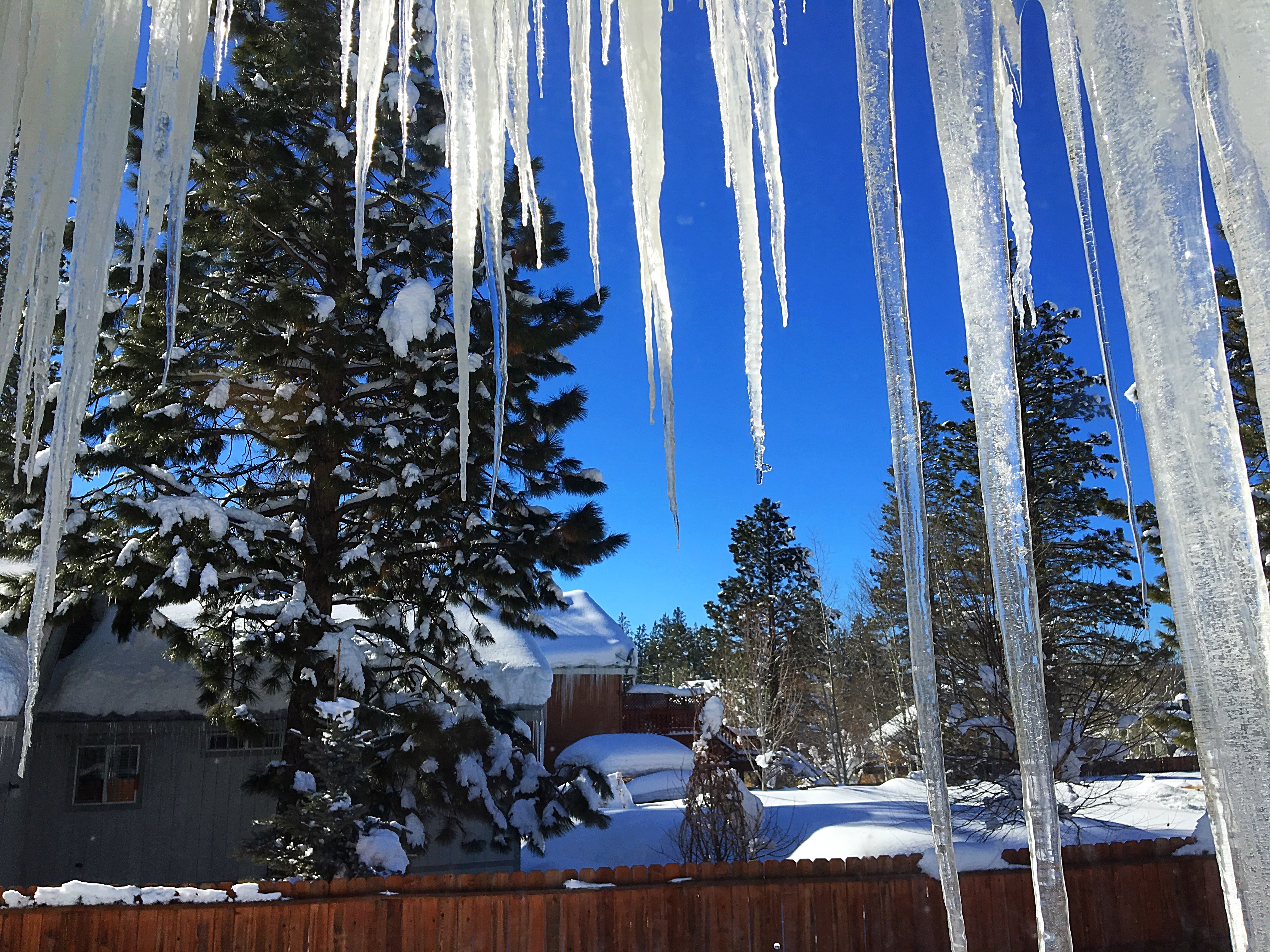
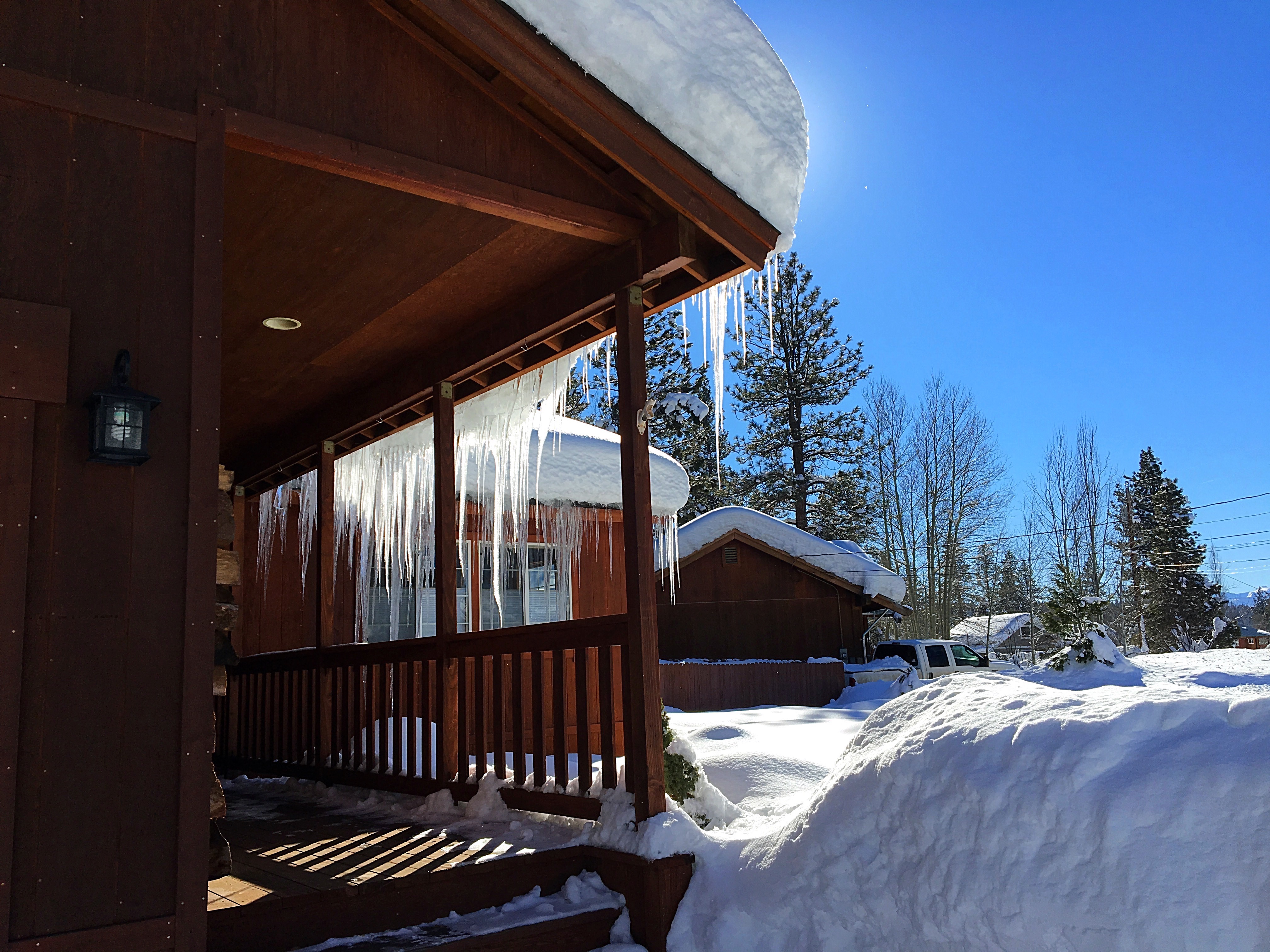
Decorated and adorned — the mundane made profound — neighborhood houses become gingerbread with thick, clean frosting on the roofs. No longer differentiable between old or new, run-down or well-kept, each dwelling takes on an air of elegance. Icicles hang from awnings like stalactites. An enchanted child appears behind my eyes. 

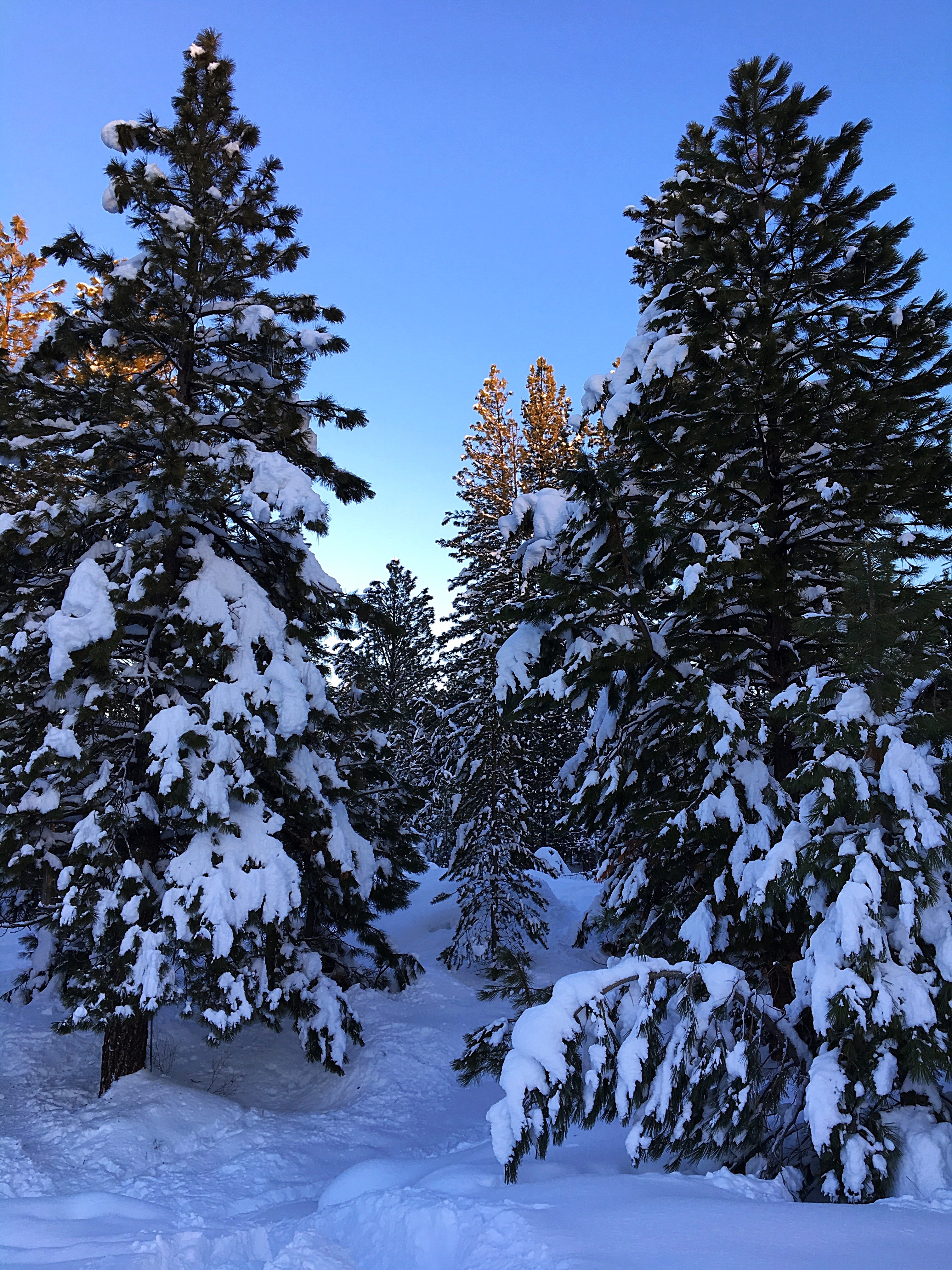
We make tall footprints on what we think is the path. Away from the homes, a reservoir sits still and frosted. Creeks shimmer, cutting through the meadow, frozen in place, lightly dusted; large rocks and boulders, capped white, create bright mounds in the dark river. Cottonwoods, having lost their leaves, look dead beside the Pines, which pop their green heads out of the snow.  

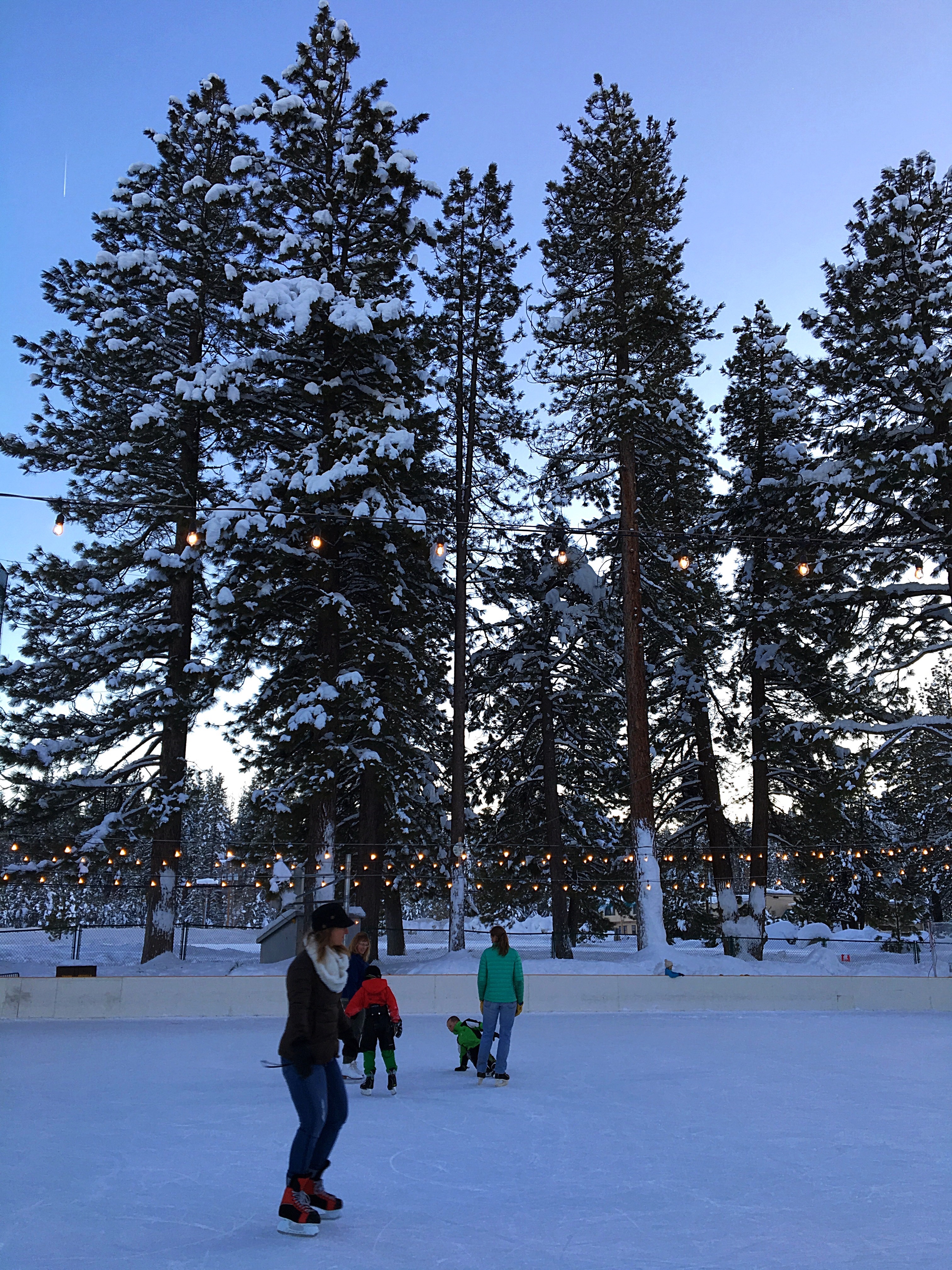
In town, we pass the ice rink. Cafe lights and ballroom waltz music from the early 1900s creates a sense of nostalgia for a time we never knew.

We drive off-road. Tree branches droop with heavy snow and drop the weight in puffs that cascade to the blanketed ground. We stop on a ridge and step out of my cousin’s Jeep. The landscape surrounds us in sacred silence created by the deep snow, sparkling as if rhinestones fell in the storm.

“Almost takes my breath,” I’m entranced by the mountains and valleys before us.

“I saw the best snowflake the other day,” Derek tells me in his ski bum drawl. “I was standing on my front porch and it was one of those big fluffy ones. I watched it float down and land on the railing. It was so perfectly geometrical and intricate and it just stayed there. I wanted to pick it up and show my roommates, but obviously that’s not gonna happen.”

“Such an incredible paradox, isn’t it? One snowflake is so fragile, yet put together –” I reach to the landscape.

“There’s been a bunch of avalanches this season. Kinda crazy. Just last year we were complaining about another snowless winter.”

“Did you know that people are using ‘snowflake’ as an insult these days?” I ask.

Derek laughs, “what? No. That’s lame.”

“I agree. I found out about it on Twitter. Apparently it’s to insult someone who is fragile and thinks they are unique — a bleeding-heart or triggered person who gets trophies for participating. That’s the context, I suppose. It started with conservatives using it against liberals, but now liberals have embraced the term against conservatives. Reminds me of the Sneetches from Dr. Seuss. Do you remember those creatures with stars on their bellies?”

“Yeah, totally. You just can’t insult someone by calling them a snowflake, though. It’s magical. Literally everything is more beautiful in the snow. And if it’s too outta hand, houses get crushed. Even if it does melt, it becomes water and enters the water cycle. It doesn’t go away. Being called a snowflake just isn’t and insult.”

“I don’t get it either. Part of nature as humans is to feel — it’s what gives us our humanity. And for people to mock that side of ourselves, it’ll turn people into unfeeling monsters.”

“Damn. That’s true.”

“Seriously. Having an open, compassionate, sensitive heart requires courage and strength in a world with so much pain and suffering.” 

“And evil.”

“It’s a strange time, Derek.”

“A strange time, indeed.”

We slip into silence, admiring the changing sky. Delicate pink, purple and indigo hues reflect in the white mountainside like a painting. Stillness and peace reside between our voices. 


The Forest’s Song

I step outside. The sun peeks around clouds to caress the world and welcome me. Unseen doves proclaim the beauty around us. 
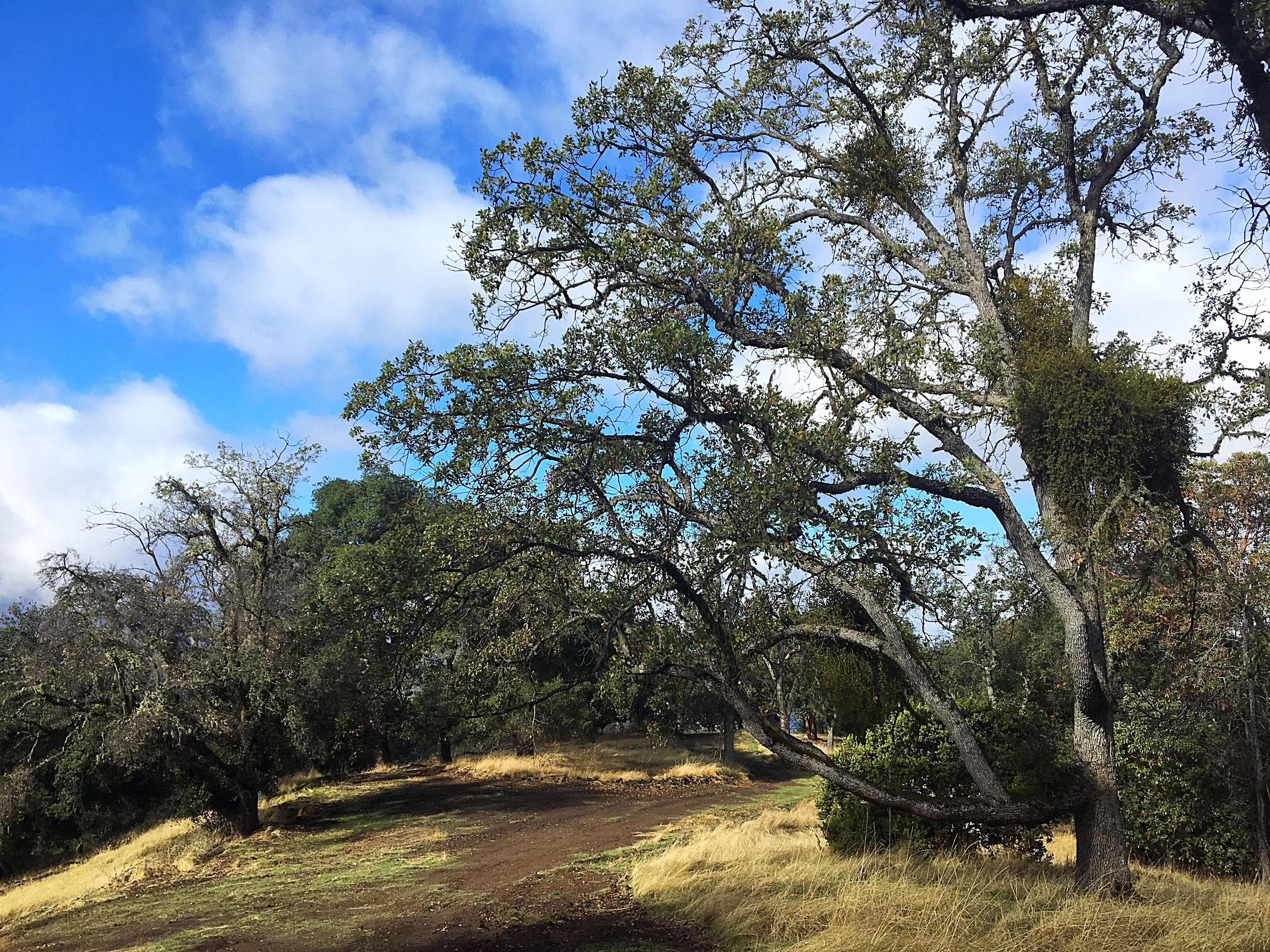
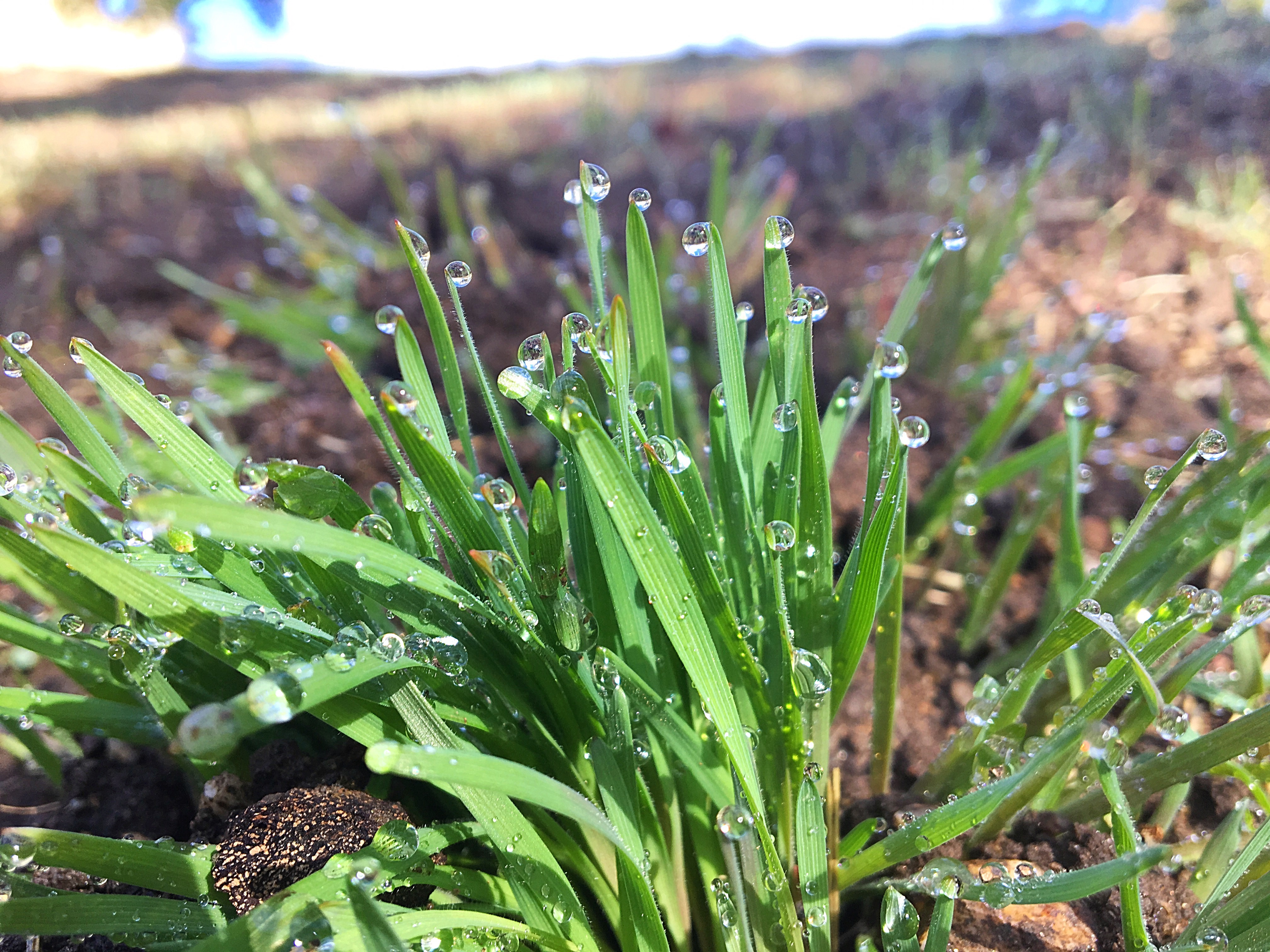
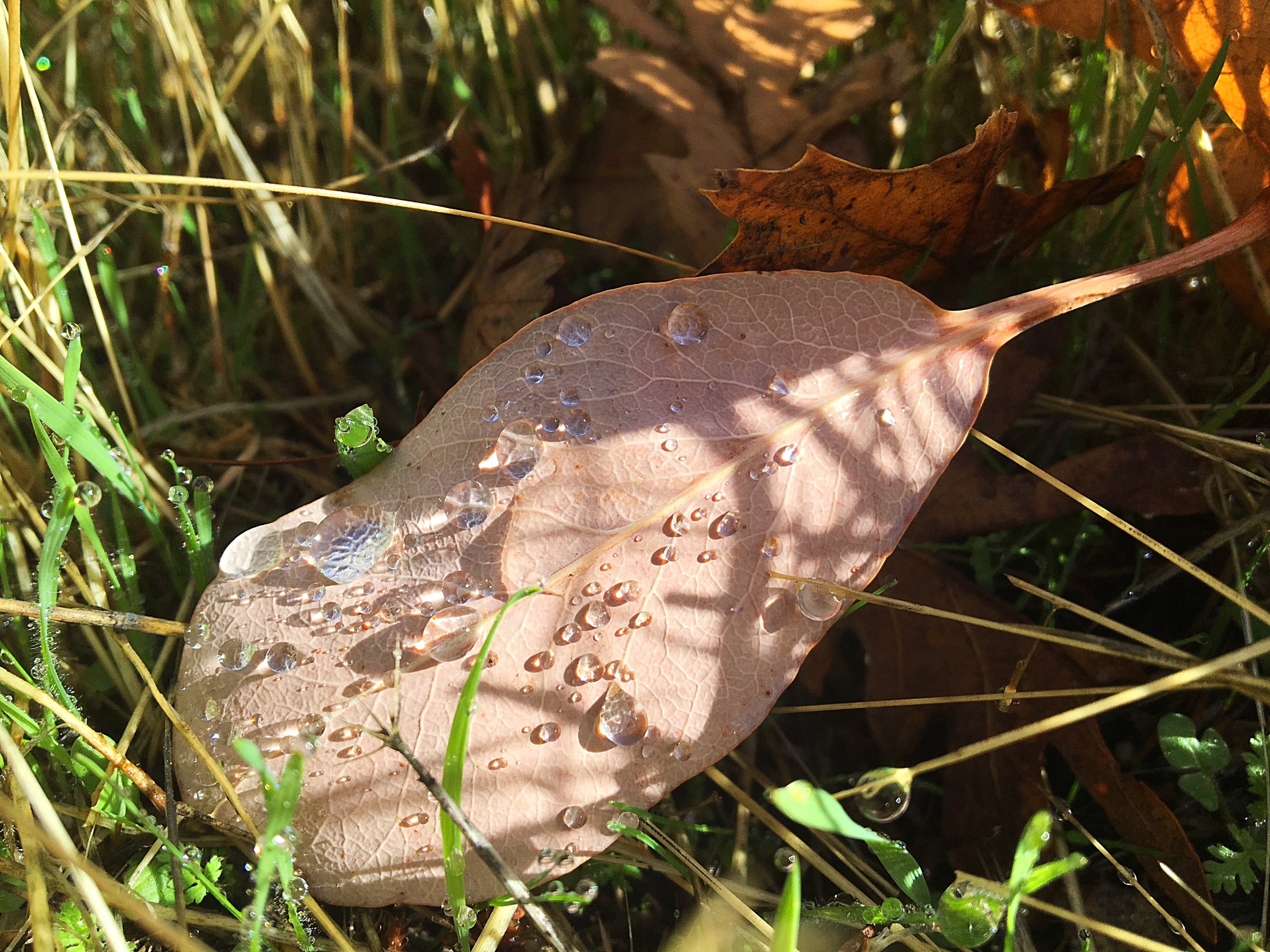
Dew rests on the earth; oaks stretch in wild formations. Brown leaves blanket the ground and young grasses grow amongst those that had died in summer. Moisture adorns foliage with drops that sparkle and glitter in the sun. Deer tracks tell me I am not the only one who walks this trail. 
I take a deep breath; crisp, clean air fills my lungs. The distant scent of Linney’s wood-burning stove reminds me that only a few months ago a wildfire raged in these mountains.
I come to a clearing and see a flock of quail, each dressed with its own fancy spots, stripes and bobbling headpiece. They whistle as they run away on speedy legs.
I hear a crinkling sound and see California Towhee kicking up leaves to forage beneath them. As soon as I’m close, they fly away in perfect unison, their wings purring through the air.
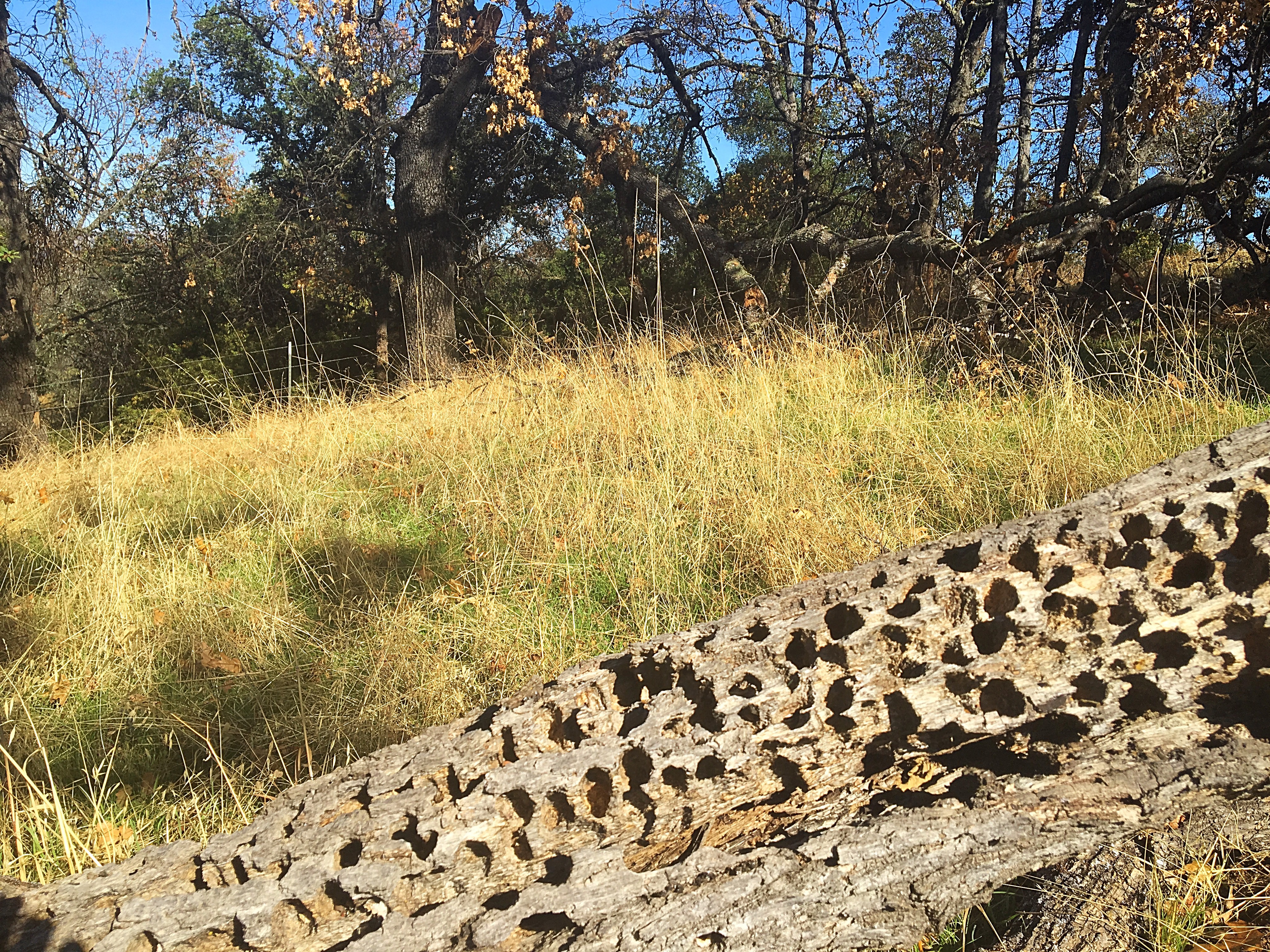
Acorn Woodpeckers squawk and chuckle while they perch on tree trunks, wearing tuxedos and red caps, drilling holes and stuffing them with acorns. Their happy, gleeful chucking brings a smile to my face. They must be telling jokes to make work more fun. 
Off the trail, a thick oak branch grows horizontally from its trunk. Seeing that it’s dry and free of insects, I hoist myself onto it, stretch out my legs and recline back. The tree holds me like I am lying in its arm. 
Gazing into the canopy and up to the sky, I hear birds all around me. They rustle in leaves, they fly with fluttering wings. They sing, chirp, laugh, and coo. Each voice joins in one abundant song: the song of the forest.
I could lounge for hours on the tree branch listening, yet I know the forest does not sing for me. The forest needs no outside audience for its symphonies. It is a true and great artist: creating for creation’s sake, creating for itself. 
If the forest is the ultimate artist, how do I compare? What happens when I am the only one who reads my writing? 
I know the answer; I have felt it often. When I am my only audience, I get discouraged. I blame my voice — I call it awkward and uninteresting. My dream appears hopeless. My feelings keep me from putting words on the page.
The oak holds me like a mother. 
“Show me the way,” I whisper. “How can I create like you?”
“Close your eyes,” she says.
I obey. 
Minutes pass and I begin noticing subtle layers of the song. A hawk calls from high. A frog croaks in the distance. A crow caws. 
The forest tells me there’s room for every voice and contributors are never ashamed of their sound — it is the one they received at birth. They need not be melodic, gentle or harmonic to join the orchestra; they need only to be themselves. The song’s beauty is in its rich and vibrant variety. Each day it creates a new score without one thought of who will listen. The forest creates by design — without doubt or self-consciousness. 
Opening my eyes, I look into the tree with new understanding and say, “I will add my voice to the forest’s song.”

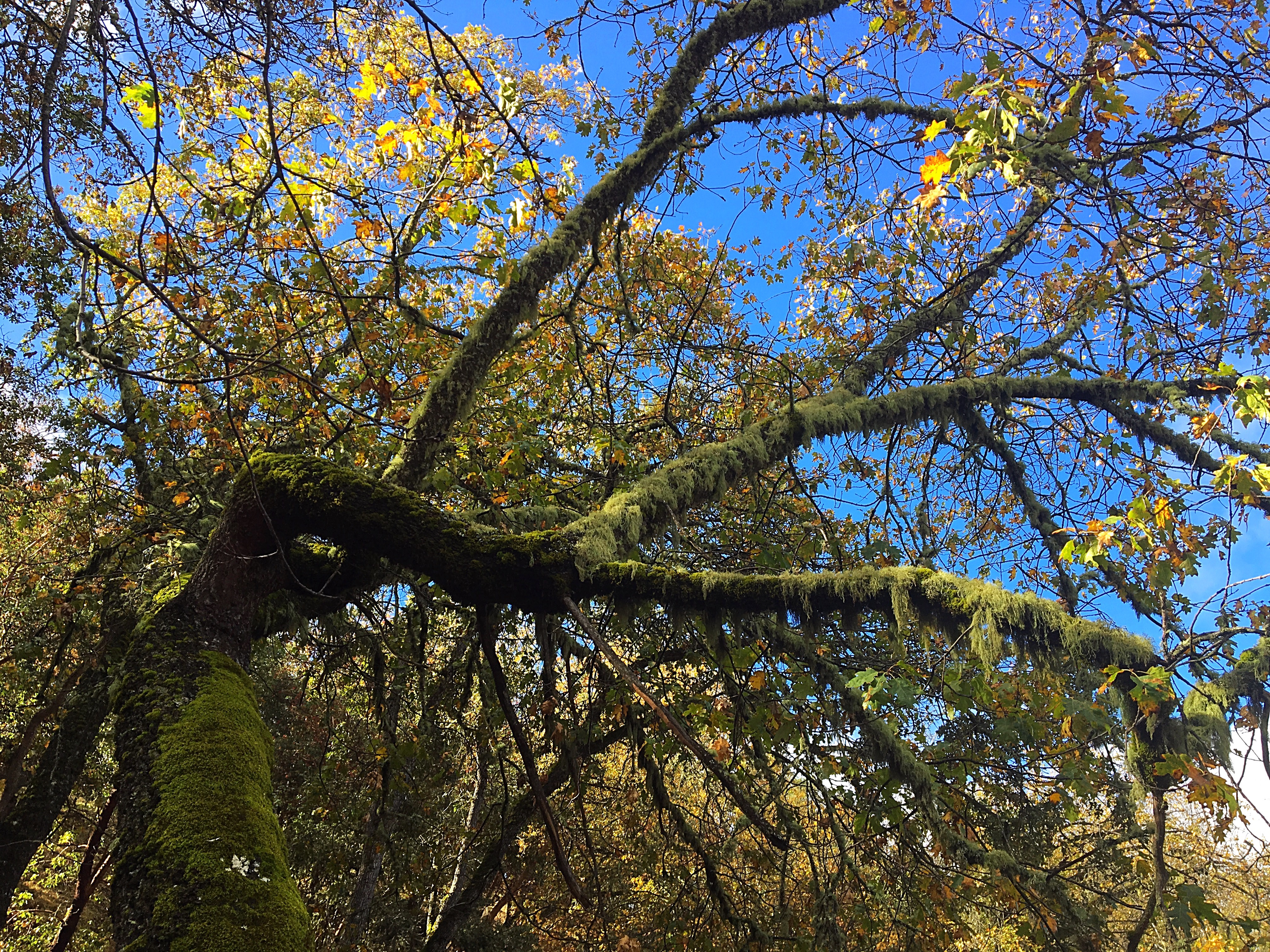
On the right, the tree who held me like a mother


Empty holes drilled by Acorn Woodpeckers

Burning Intentions

At this very moment, I’m on the road heading northeast to Black Rock City, Nevada for the art and music festival Burning Man. Far more than just a party, last year (my first time), I learned the truth of the saying “the playa delivers.” I got everything I wanted and even more of what I needed for my transformative path. Now, sitting in the front seat of a cargo van — packed full with supplies and costumes — I know the most important part of my preparation has been setting my intentions.
Putting intentions into words and sharing them with others seems to strengthen and solidify them. And so, I would like to share my Burning Man 2016 intentions with you:

  • To have deep, meaningful interactions with friends and strangers; to speak into peoples’ lives with wisdom and love.
  • To see the divine Light shining from the eyes of those around me; to feel divine peace and love; to feel the oneness of my divine nature.
  • To see beyond and let go of my self-limiting beliefs; to access new levels of consciousness; to step into my authentic truth.

When I emerge from the dust, I will have stories to share and I will let you know what became of my intentions.
Below is a video shot by Evan Halleck capturing a group hug from last year. I appear at about 50 seconds, wearing a white jacket and holding the hand of a very dear friend of mine.

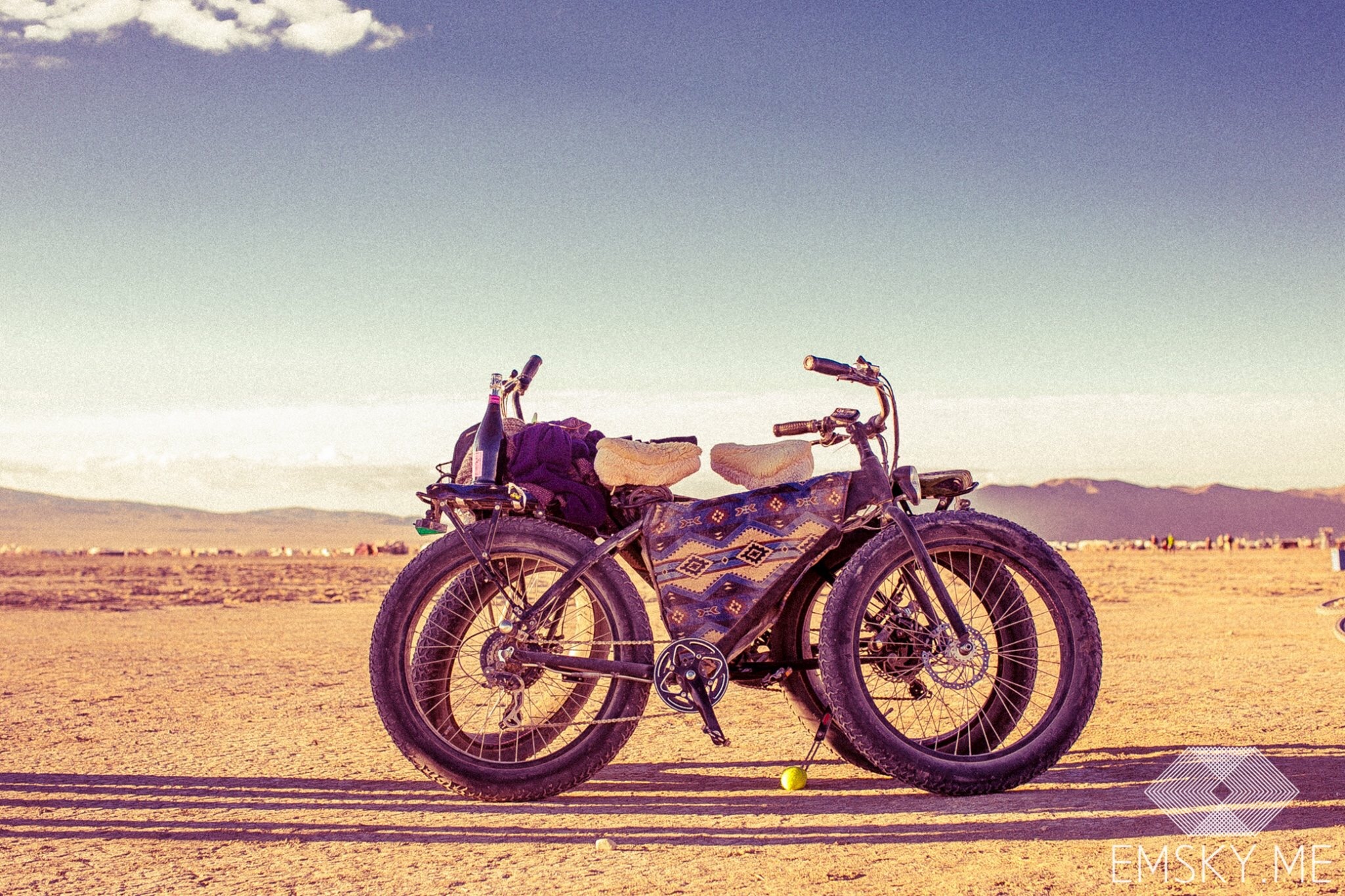
Bikes on the Playa 2015; photo by Louise Lodigensky emsky.me

Pinnacles National Park: California’s Well-Kept Secret

Keeping my vow, the day I left work, I headed straight to Pinnacles National Park. Luckily for me, a glamsient friend had the day off and agreed to join me. We started at the visitor center on the east entrance where I saw a sign announcing the arrival of a California Condor.”A new baby! How exciting,” I said to the ranger behind the counter.
“Yes, a girl. We are thrilled,” she said. “It’s from the only nest in the park!”
“Do you have any camping available for tonight?” I asked. Knowing that many California parks fill up months in advance during summer, I braced myself for her answer.
“Oh yes, there’s plenty.” She handed me a map of the campground. “Pick out an empty space, come back and let us know which one you want.”
We drove towards the back of the campground — it was virtually empty! With so much availability, we found exactly what we wanted: a site surrounded by trees and bushes to give us privacy and shade.
High Peaks Trail via Bear Gulch Cave
For our first hike, we chose the High Peaks Trail by way of Bear Gulch Cave. My glamsient friend informed me this is the most popular trail in the park.
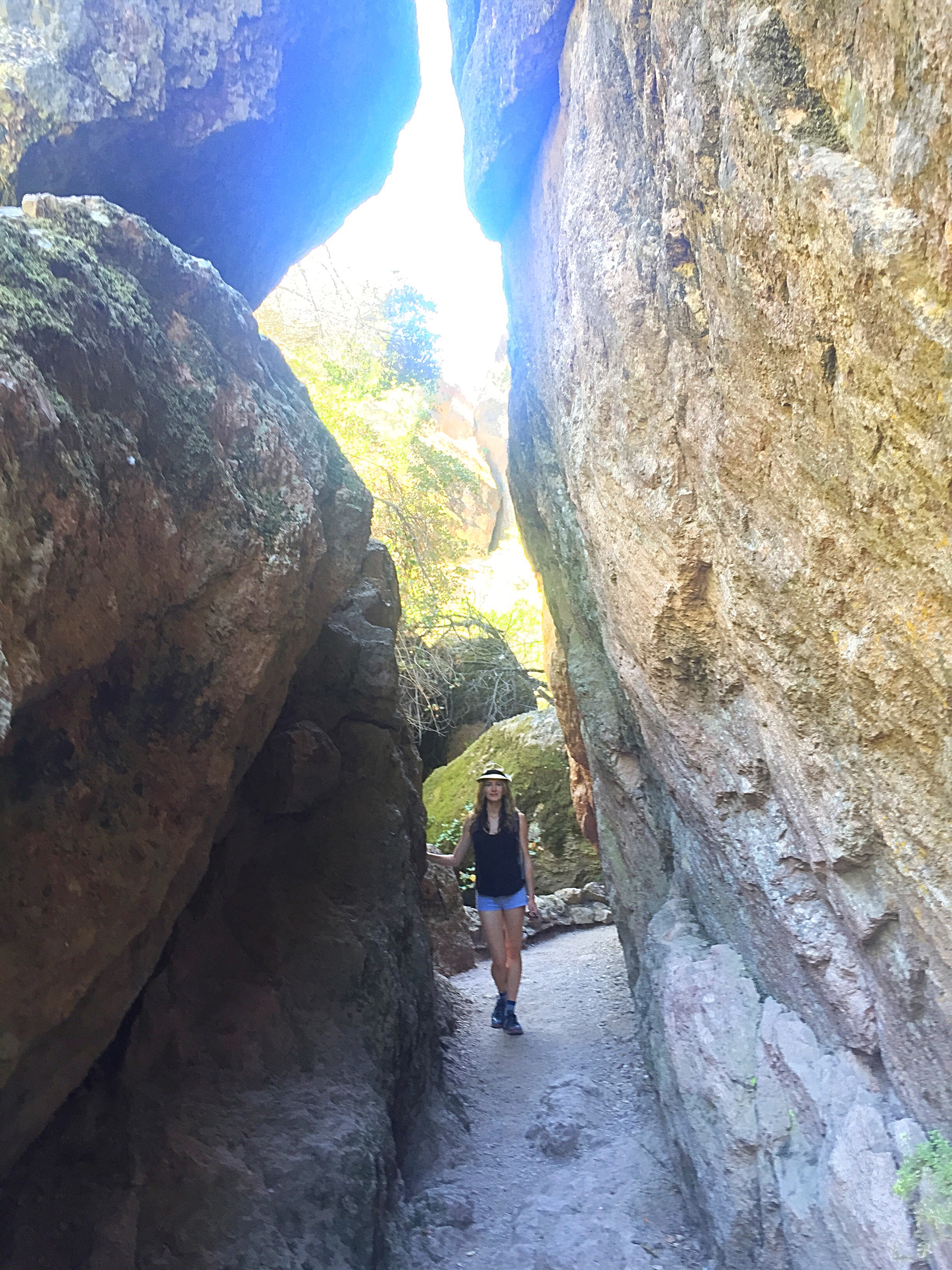
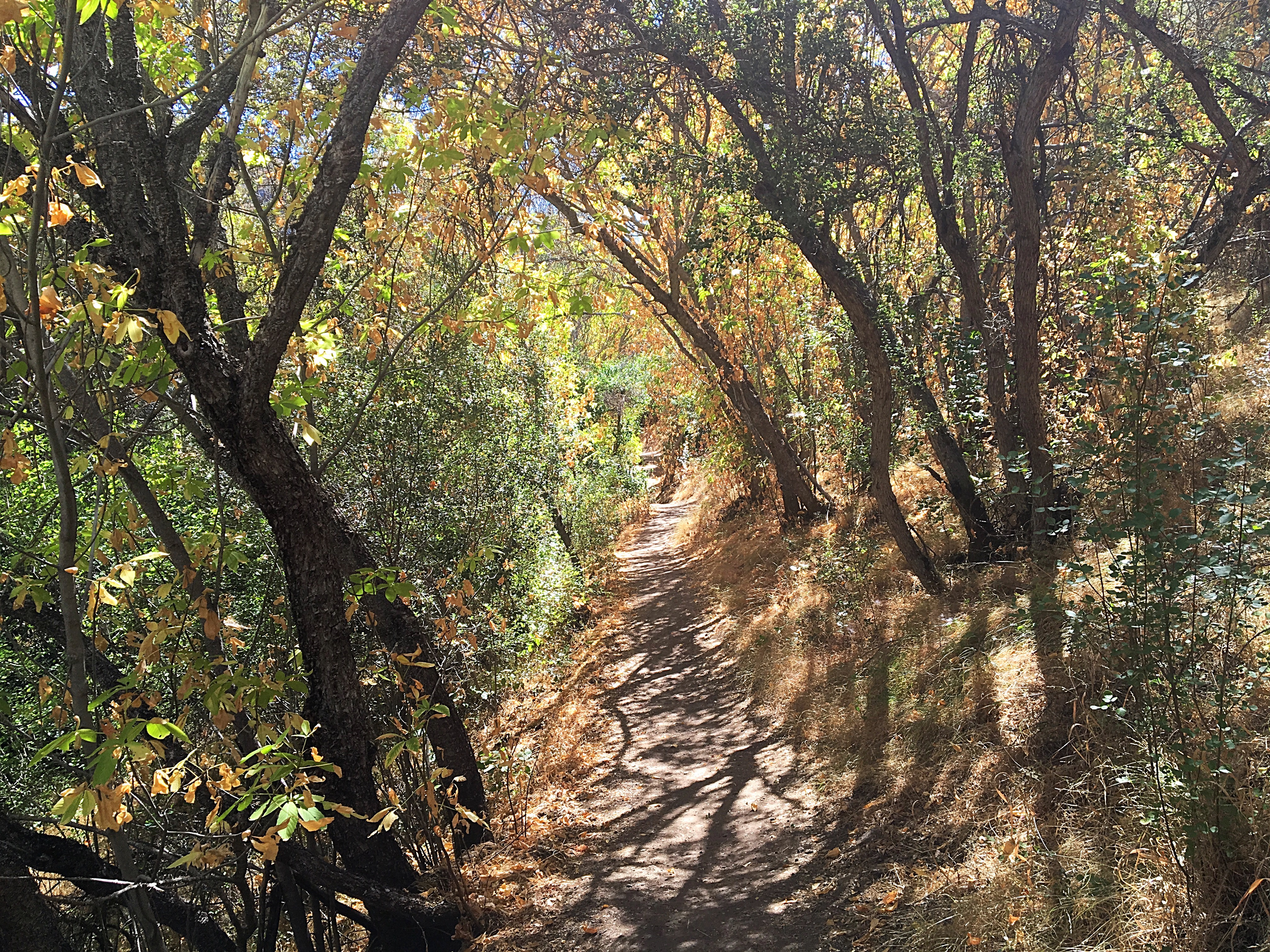
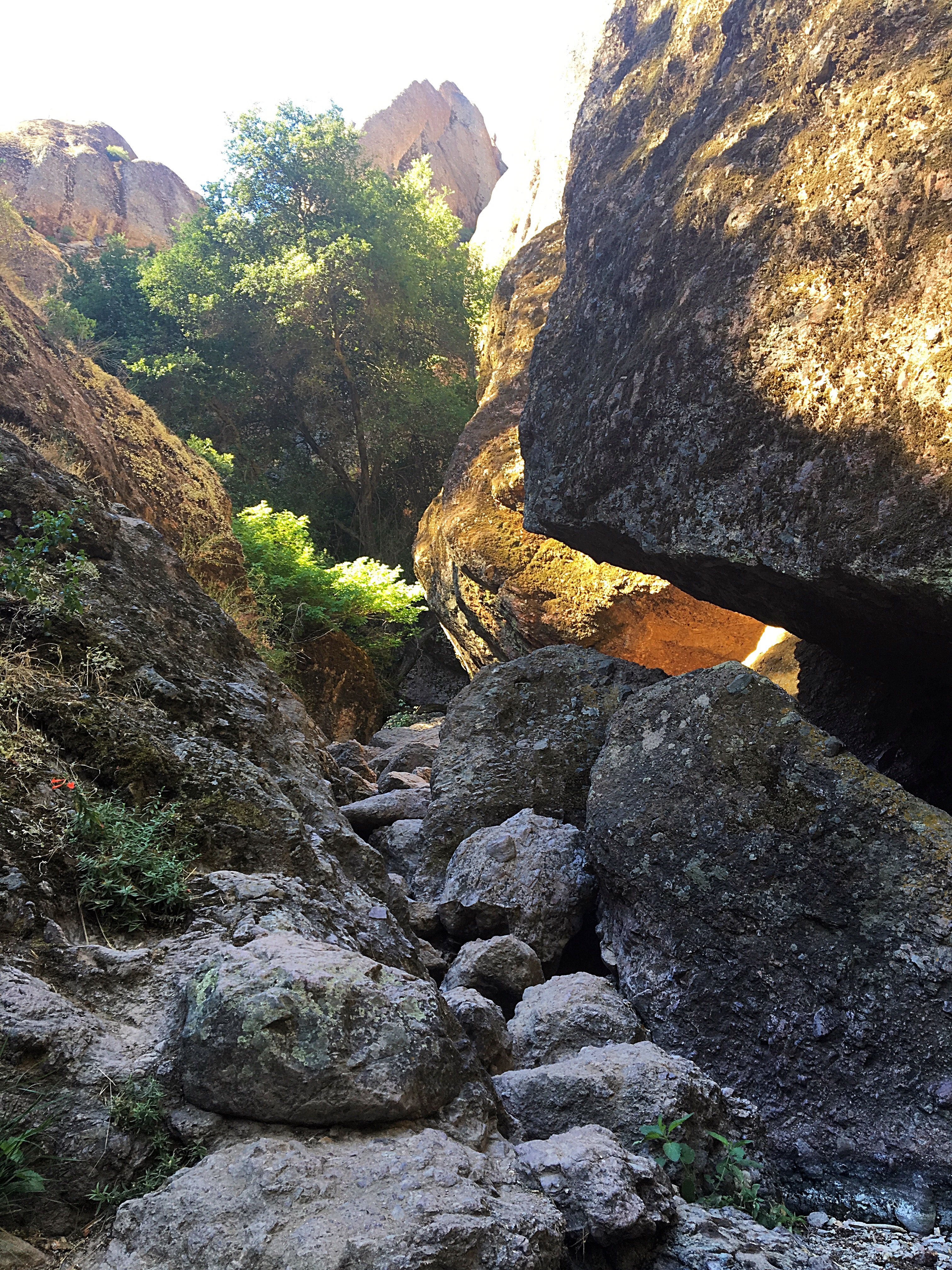
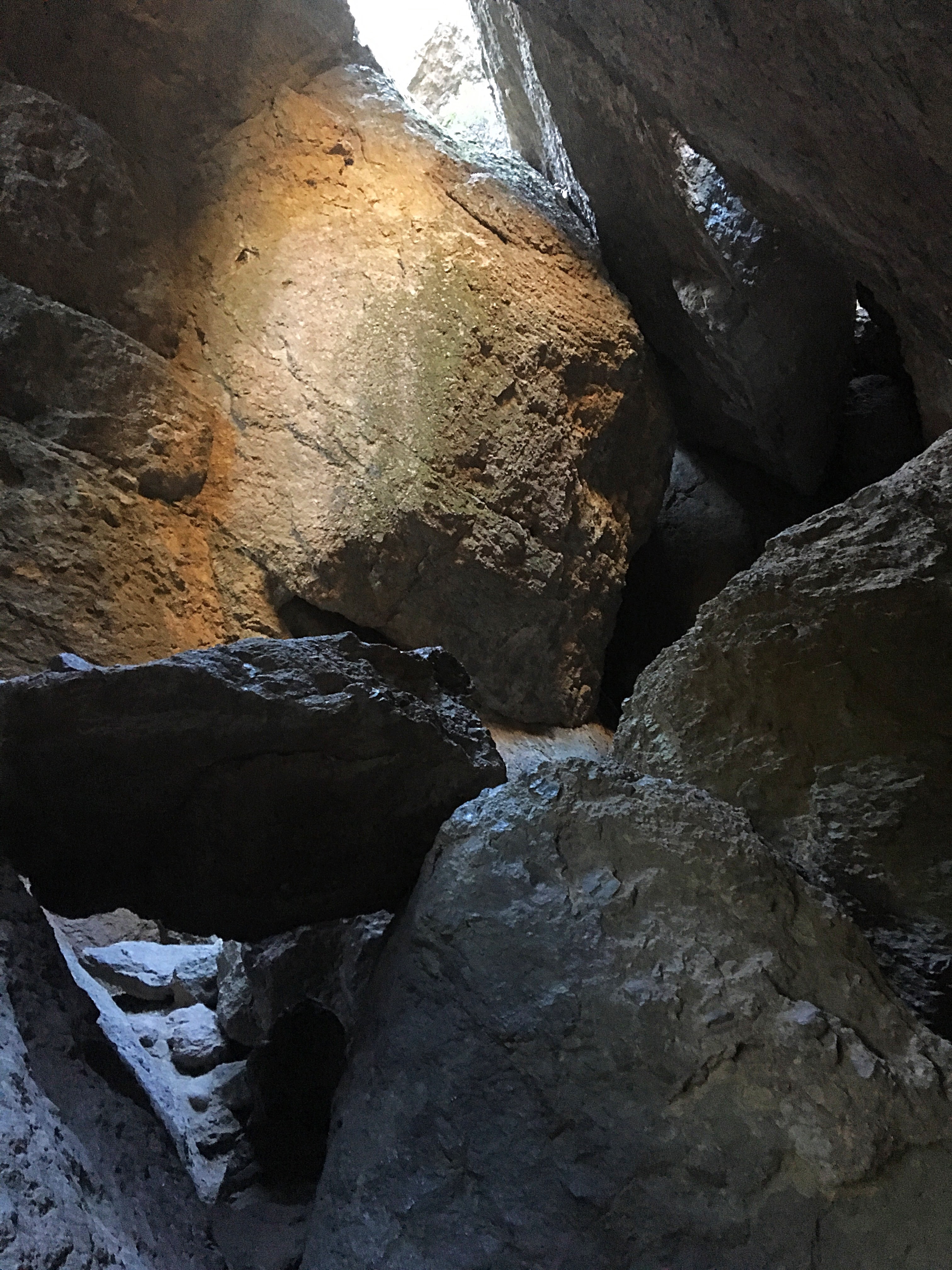
The first section guided us to Bear Gulch Cave, a rare talus cave thought to be formed in the ice age. The canopy of trees made this hike gentle and pleasant even in the middle of the afternoon. Created by large boulders that had fallen and wedged into narrow canyons, the cave was easy to navigate — sunlight made its way into the cave through open spaces to illuminate the path. We walked over bridges and up stairs created in the 1930s; part of the way, we had to crouch to pass underneath boulders.
“Wouldn’t want to be here during an earthquake,” my friend remarked. “The San Andreas fault is pretty close.”
For a popular destination at the park, the cave was by no means crowded; we saw only a few groups of people.
Leaving the cave, the trail led us to a small reservoir; that’s where the strenuous climb began to the High Peaks. Without the tree cover, under the blazing sun, every step moved me further uphill and every step told me that I am out of shape! I quickly realized this section of the trail would be much more enjoyable in cooler weather — either early morning in summer or a cooler time of year altogether!
(That being said, we saw many groups with children. They seemed fine. Hot, but fine.)
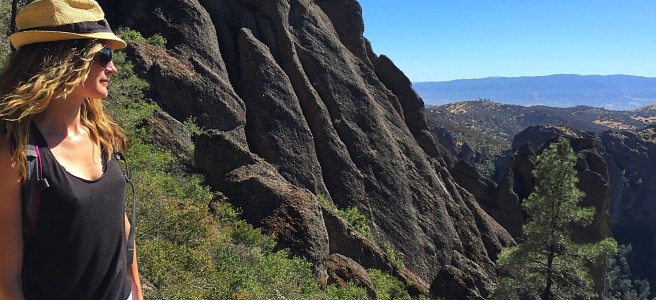
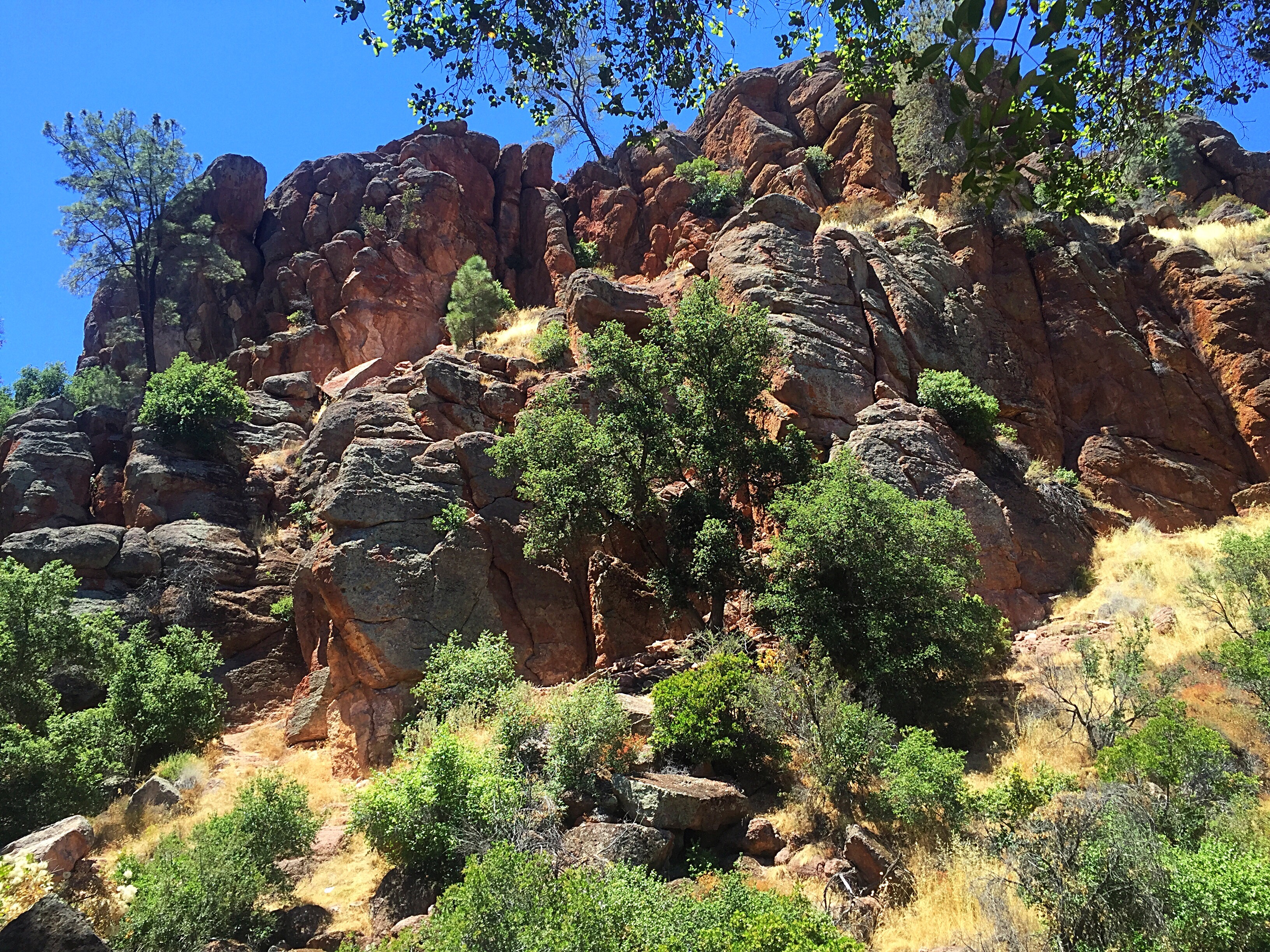
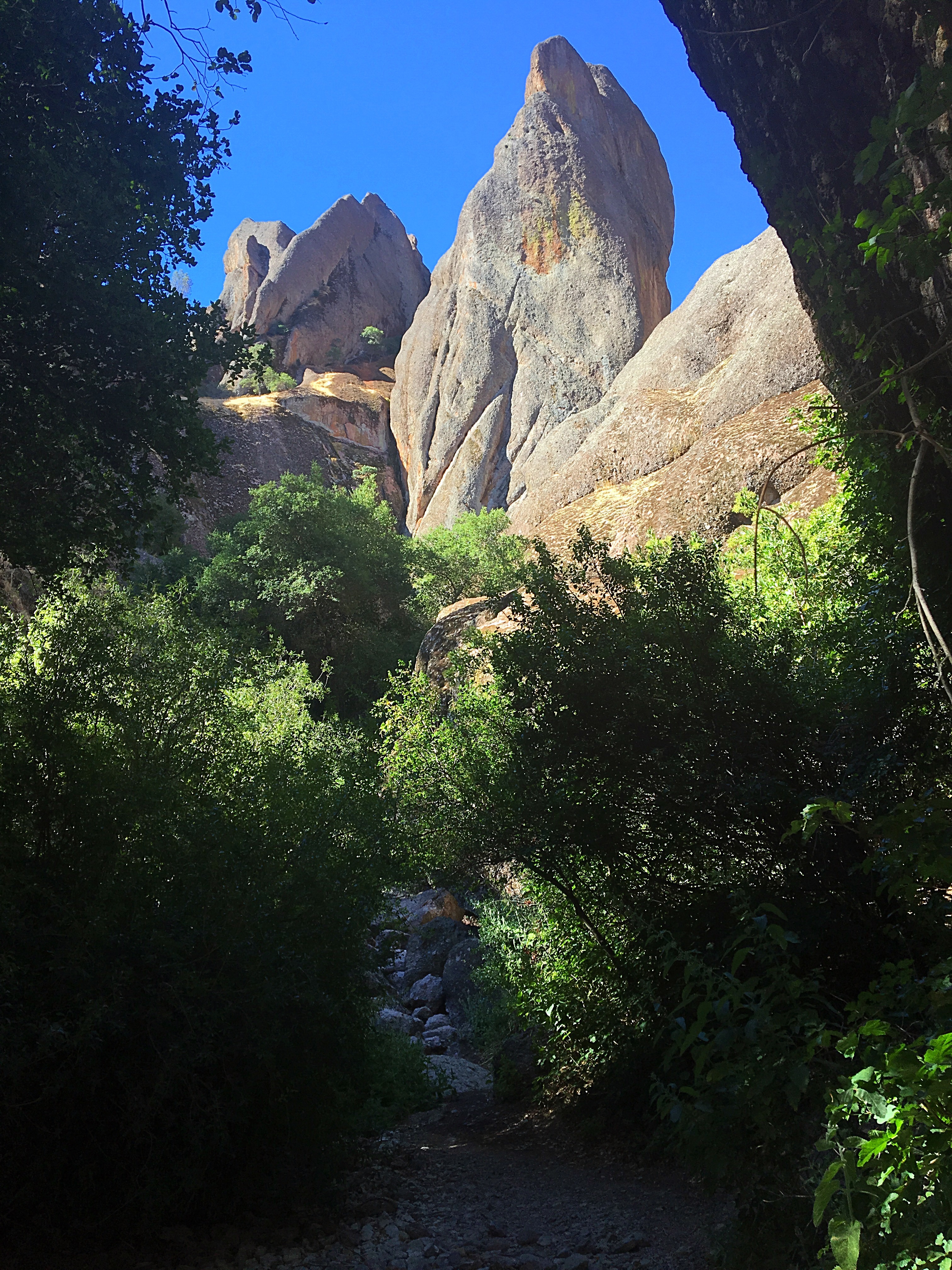
Ultimately, our effort paid off — the trail took us to an incredible peak revealing far reaching vistas of valleys, rock formations and mountain ranges to the east and west. The High Peaks trail showcases prehistoric rock formations; volcanic activity created these rocks 23 million years ago and erosion formed them into what we see today. It surprised me to learn seismic activity moved the solid, massive boulders over 195 miles northwest from the time of their creation.
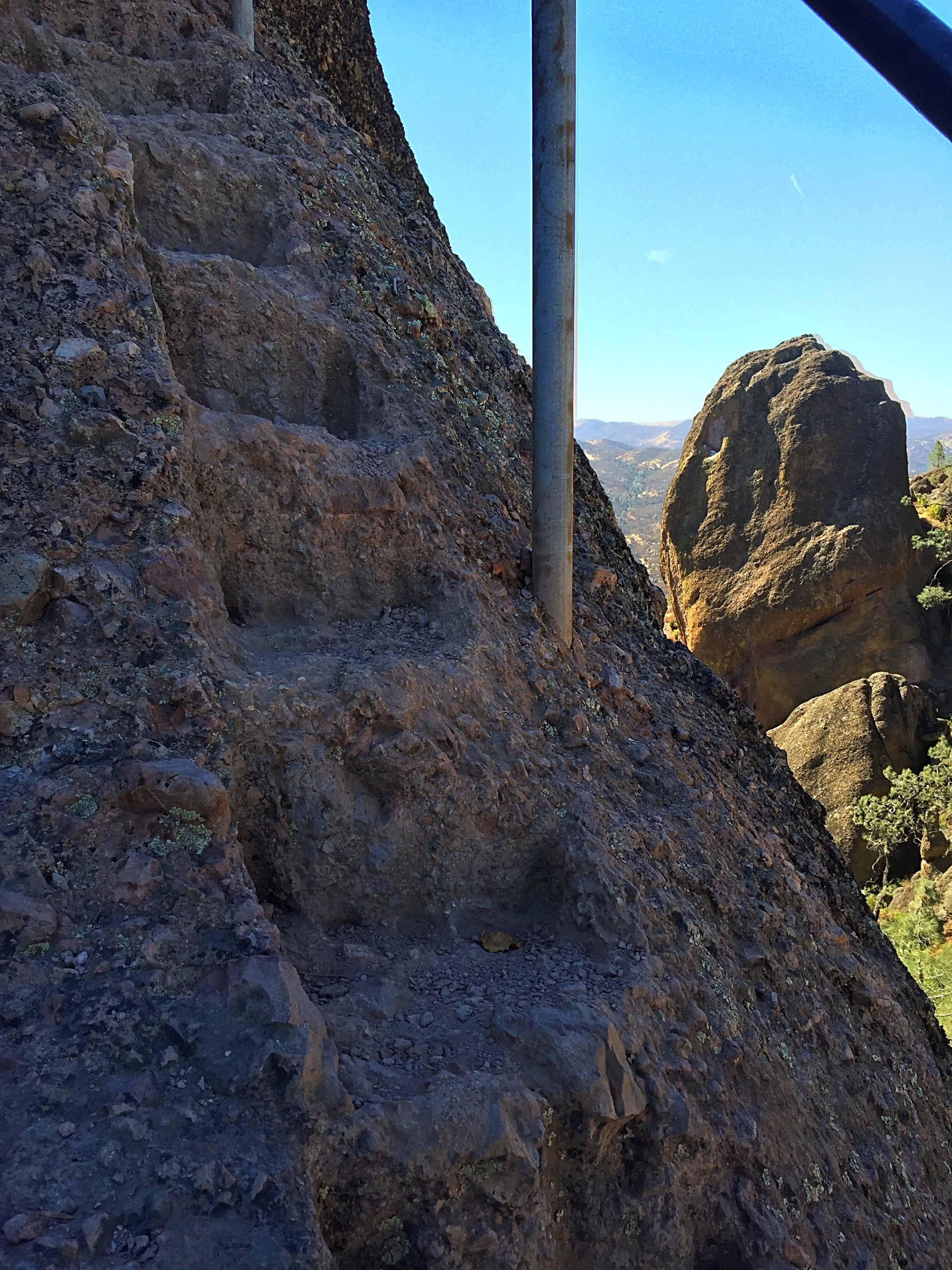
At the crux, we walked up and over boulders that created a long ridge — in many places, the trail was carved by dynamite into footholds and steps. We stopped to catch our breath, but lost it when a Condor flew overhead! One of only 36 wild in the park, we knew we were in the right place at the right time.
Shortly after we made our descent, we saw a couple on the trail.
“Is the peak much farther?” The young man asked. He sat in shade created by chaparral, his face was red and dripping with sweat. “We are thinking of going back.”
“You’re so close,” I told him. “Keep going.”
“It’s worth it,” my friend said. “The views and everything — you don’t want to turn back.”
“And there’s a cave on the other side,” I said.
Halfway down, we found a spot to rest and wait for the full moon. Despite my aching feet and jelly knees, seeing the moon — large and pink — rise over the mountains at sunset was a glory to behold.
It was dark when we returned to camp for dinner. Eating that night, I noticed a sense of vitality within me. My blood pumped through my veins, fresh air emboldened my lungs and my muscles felt active and alive!
Balconies Trail
The next morning, my fellow glamsient left early for work. Part of me wanted to head home, but I quickly recognized that desire as my old habit of rushing to the destination. The Balconies Cave enticed me and, remembering to slow down and savor the journey, I chose to stay in the park.
Driving to the trailhead I saw quail, turkeys, and a doe with her fawn. The parking lot was empty apart from my car, and only the sound of birds accompanied me onto the path.
Meandering through trees, the Balconies trail is mostly flat — a perfect companion to yesterday’s strenuous hike. Yellow swallowtail butterflies greeted me as if to say I had made the right choice. I breathed deeply, enjoying the time to myself.
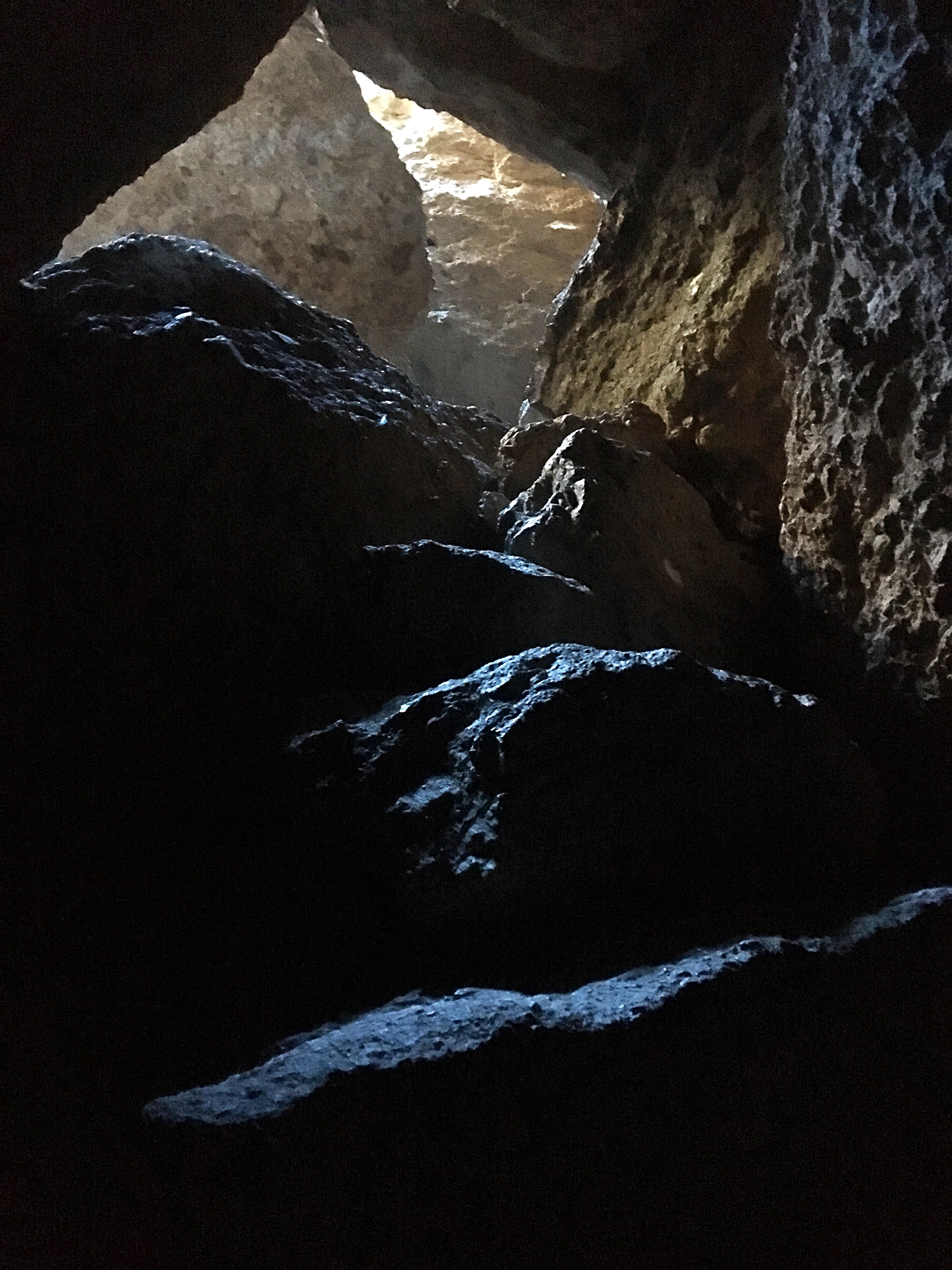
When I came to the entrance of the talus cave, I saw a large, metal gate. “Flashlights Required,” a sign read. Having seen a similar warning at the trailhead I had my headlamp — and thank goodness for that! The cave was pitch black; only little white painted arrows marked the trail.
Cool and dark, the deep quietude of the cave penetrated my being. I was completely alone, and instead of steadily moving through to the other side, I sat and turned off my headlamp. Surrounded by rock, my small, vulnerable body felt soft and humble, but I was not afraid. I felt held and supported. I seemed to dissolve, as if I were part of the rock, the air, the empty space. In perfect stillness, I tuned to the deepest part of me — connected and endless.
When I was ready, I moved forward through the cave. As soon as the first rays of sun beckoned me out I wanted to go back into the dark, cool, quiet chamber. It had given me a thrill unlike any other.
Hiking the next section of the trail — a moderate stretch with views of rock formations jutting out of the earth like balconies — my mind returned to my experience in the cave. Wholly grounding, yet also uplifting, I longed to return to the cave and the feeling of oneness.

Rock Formations
Small and humble
A shady, gentle, empty stretch of trail
Footholds in the trail
Rocky trail
Rock formations over the trail
Entering the cave
Exiting the cave
Taking in the view from the high peaks


Zion Transformation

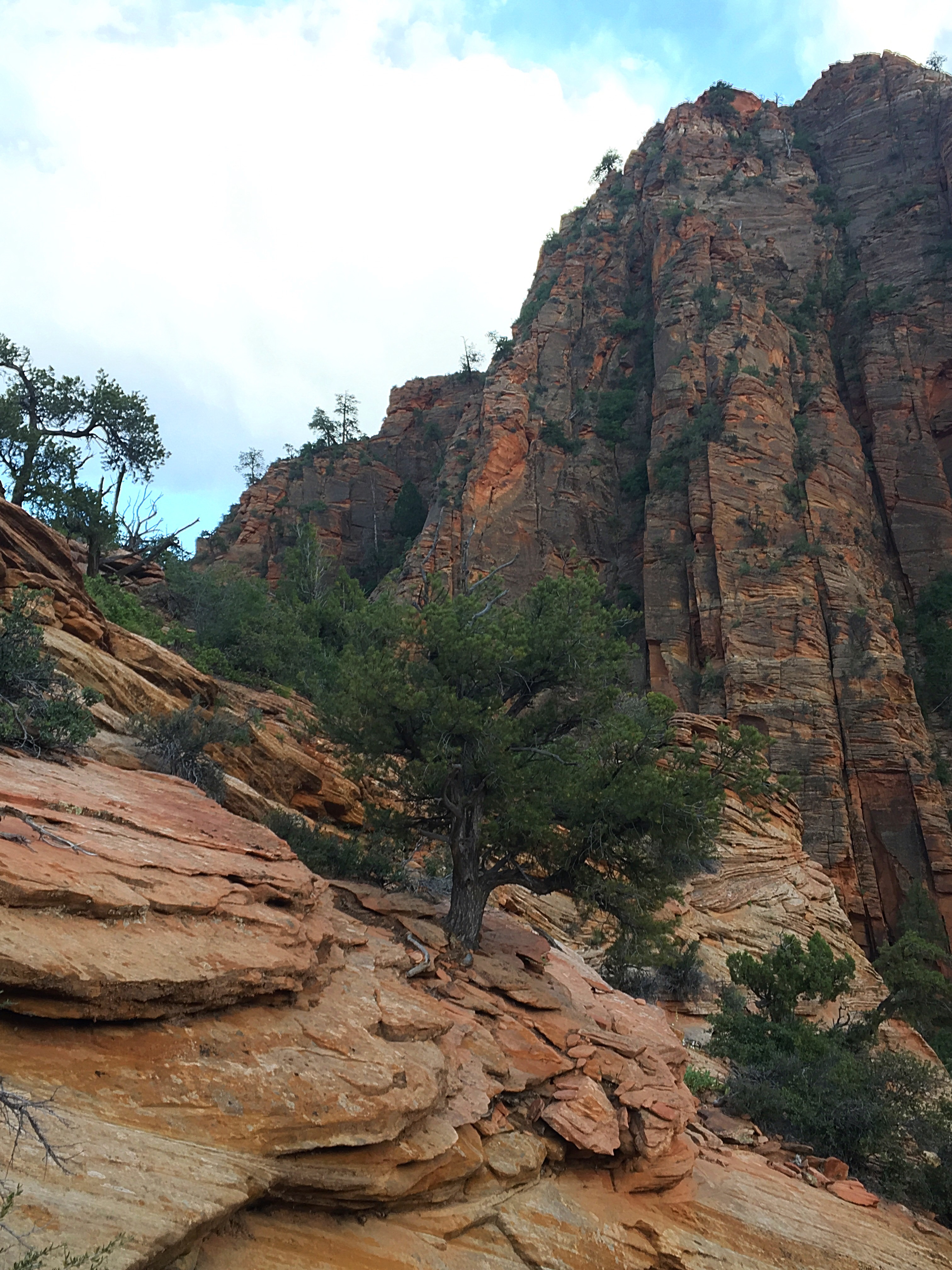
Alone at 6:00 am, watching the sunrise over rock formations, climbing natural staircases, feeling smooth buttresses with the palm of my hand, I come to sit on the top of a earth-made spier — I feel like the uppermost piece of a cairn. I sit patiently, open to a message from the landscape.

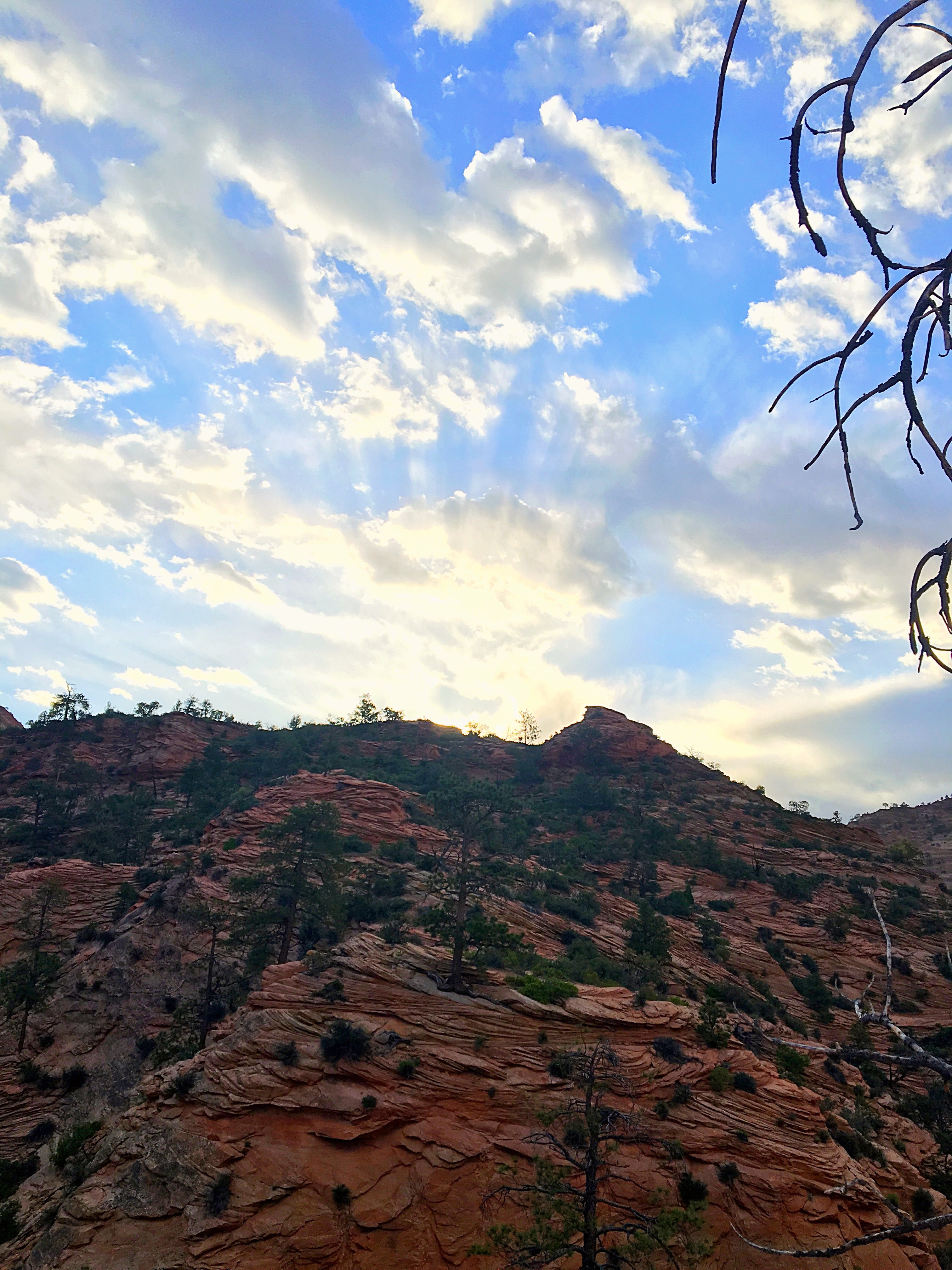
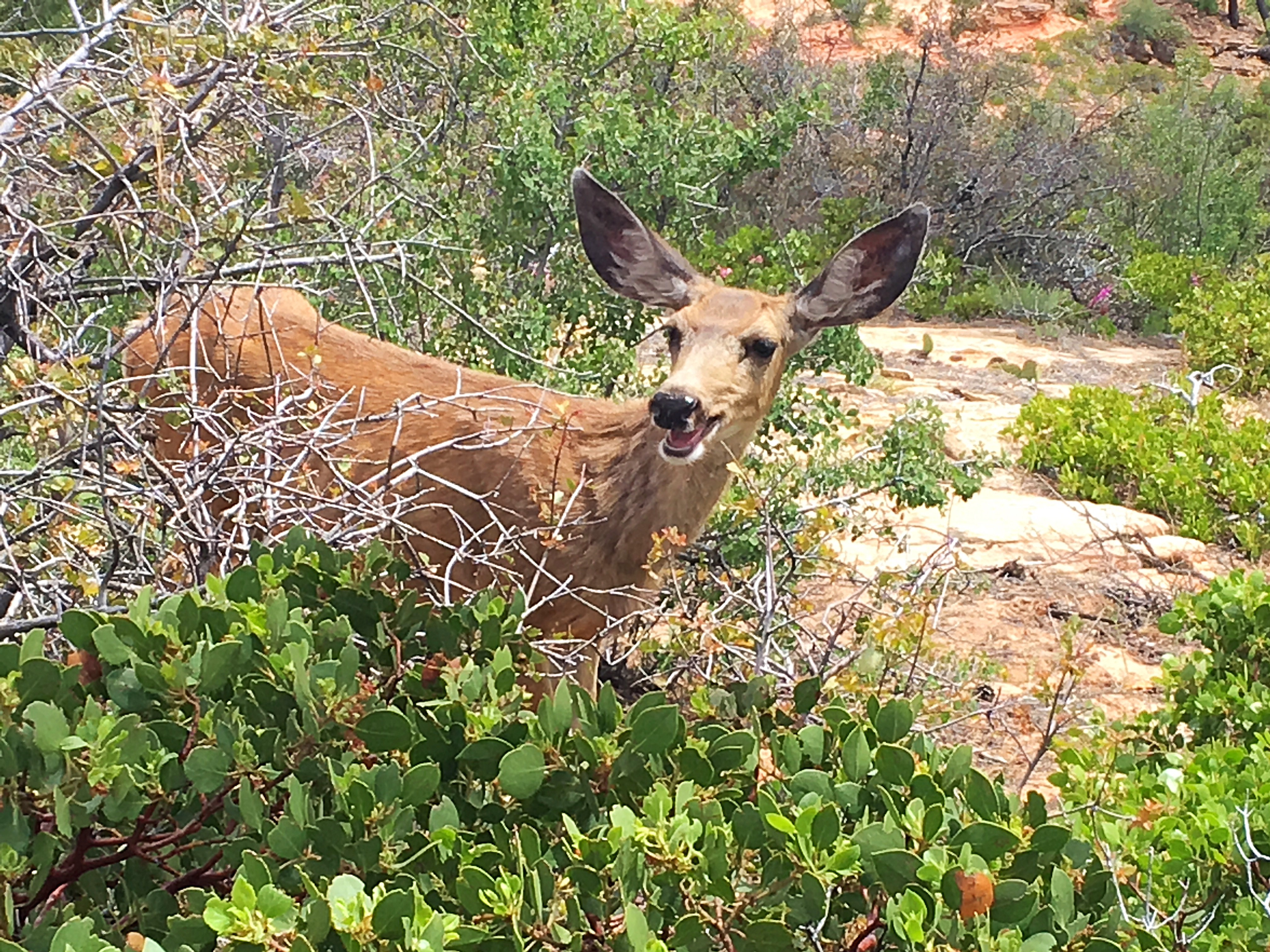
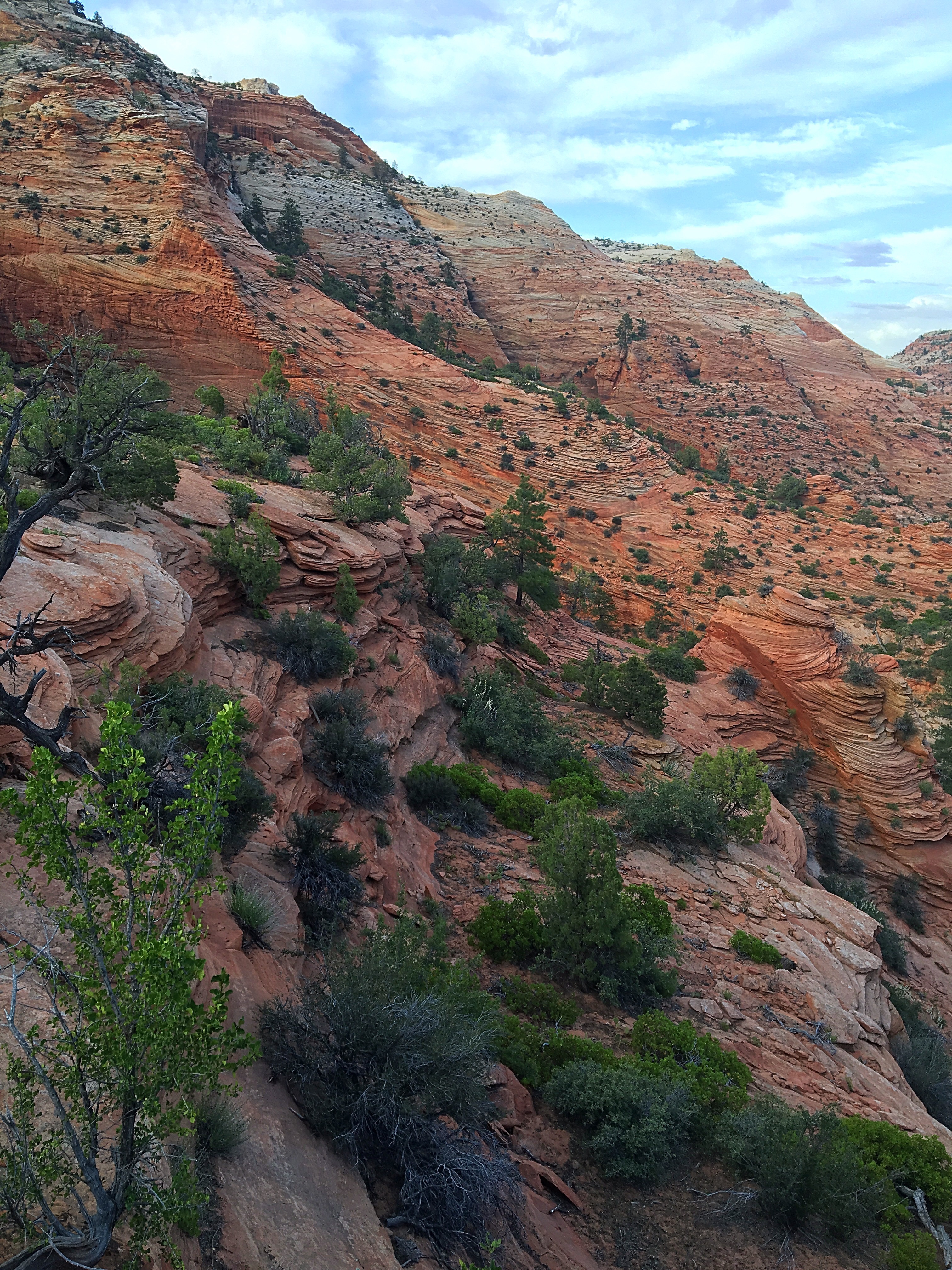
A sparrow flies in circles around me. Scat below my feet tell me deer enjoyed this view not long ago. I recalled the joy I felt seeing the hot and thirsty doe near Angel’s Landing the day before, and my surprise to see her at high altitude. A tree grows from a crack in the rock behind me — most of the trees and plants I see here seem to force their way through hard, impossible places. The sun’s rays pass by clouds, creating beams of majestic light that illuminate the red, yellow and orange striped rocks around me. Only birdsong breaks the silence of the dawning day.

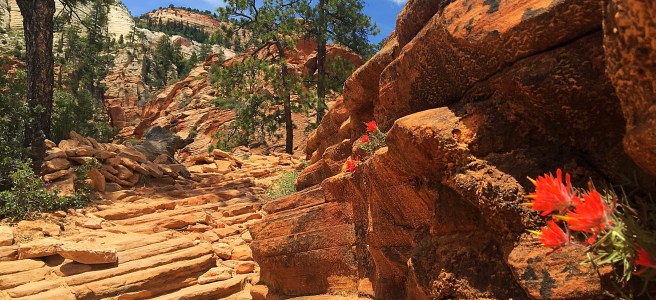
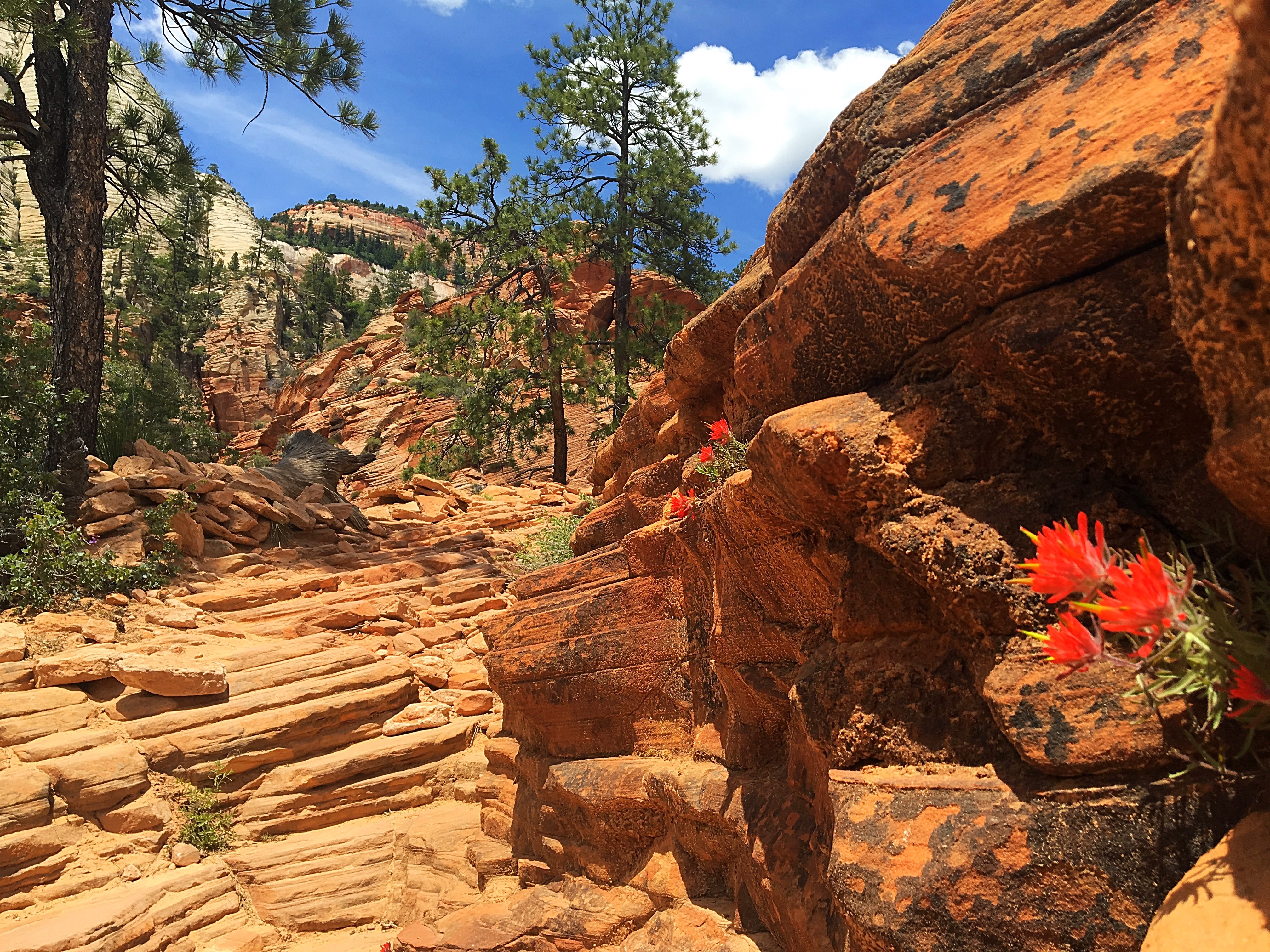
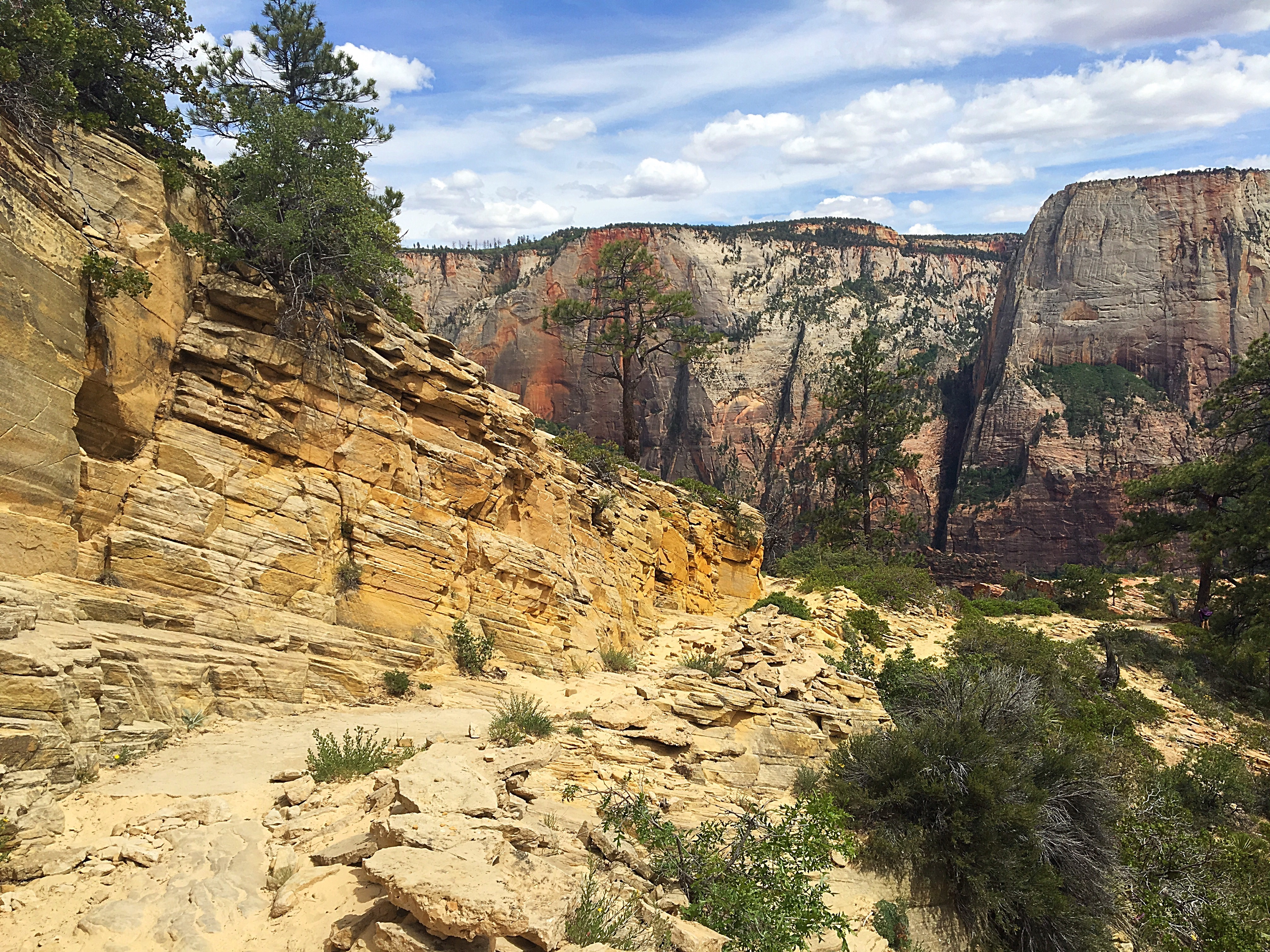
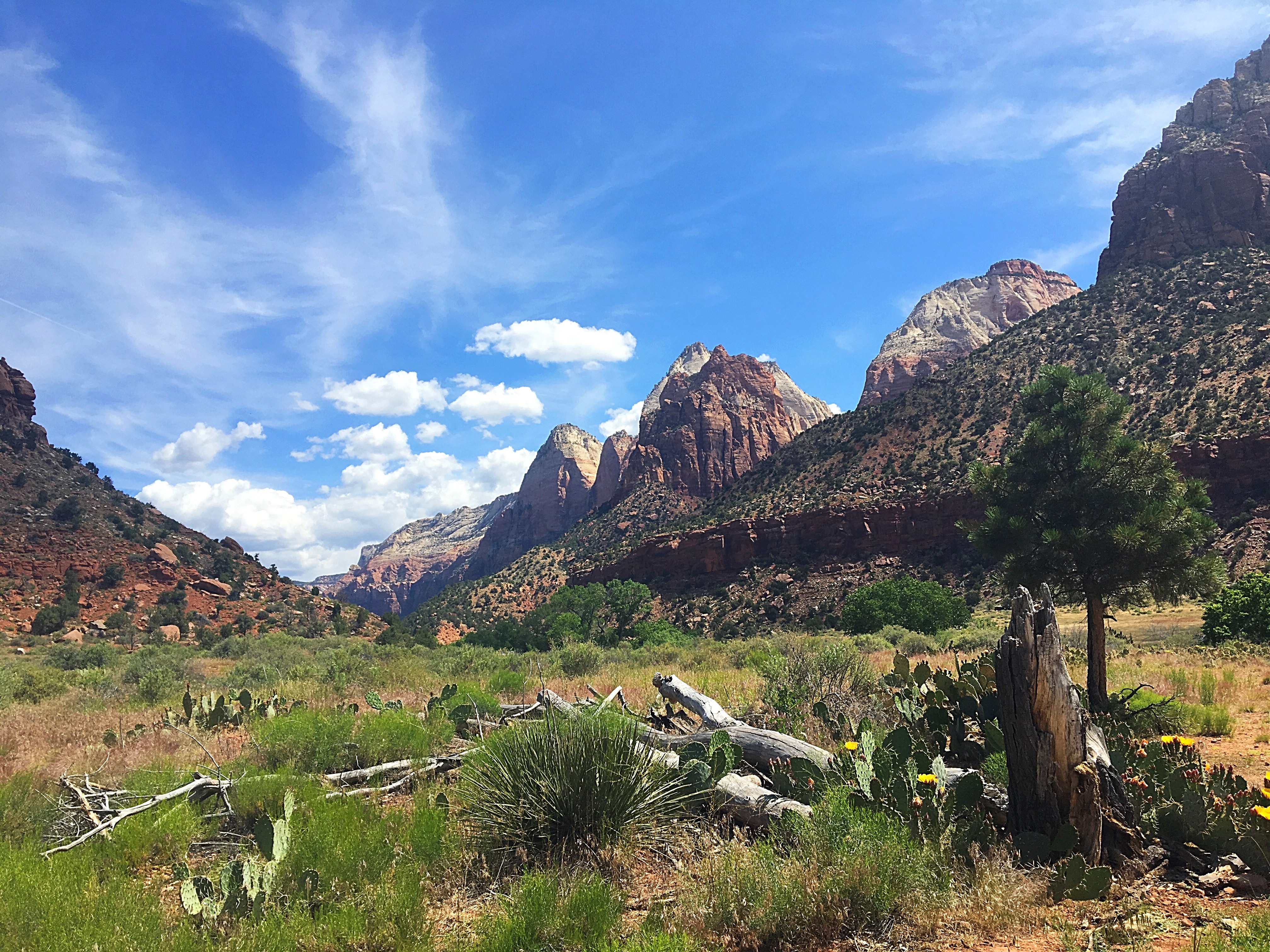
I look upon the earth before me. It is almost impossible to believe, sitting on a rock perch, that 275 million years ago this region was a flat sea basin. But it’s true: The iconic Zion landscape in Utah is the result of millions of years and five geological processes: sedimentation, lithification, uplift, erosion and volcanic activity. I look upon a working transformation — geological processes that continue today.

The resulting transformation is an unparalleled beauty that speaks to the soul of an unseen power. Several times while hiking I had to sit and pause in stillness and quietude to fathom the power of the rivers and the earth’s movements that created the structures and forced the earth towards the sky in vast towers and points.

I wondered, would the flat basin give home to the many plants and animals I had seen? Would the flat basin draw tens of thousands of visitors in a day with its grandeur? Could it provide the same inspiration to artists, have the power to pierce your heart, and take away your breath?

The spirit of Zion revealed itself to me with insight into myself.

I am a creature of change. I actively pursue transformation of my consciousness to become a more radiant reflection of human possibility — an instrument of equanimity, love and peace. I long to be transformed, to allow the processes within and without mold me and sculpt me into the shapes that I am destined to become.

The work of authentic transformation is ongoing and multifaceted: Zion is still changing. The rocks tell me to be humble, relax into the processes, accept and surrender to the unseen power. Growing pains must not be resisted or feared, but rather, seen as an effect of personal evolution. Life provides limitless opportunities for inner refinement; being present to reflect my true nature requires a Zion-like patience.

Sunrise; Zion National Park
Doe near Angel’s Landing
Orange Rocks
Yellow rocks
Once a flat sea basin
A tenacious tree
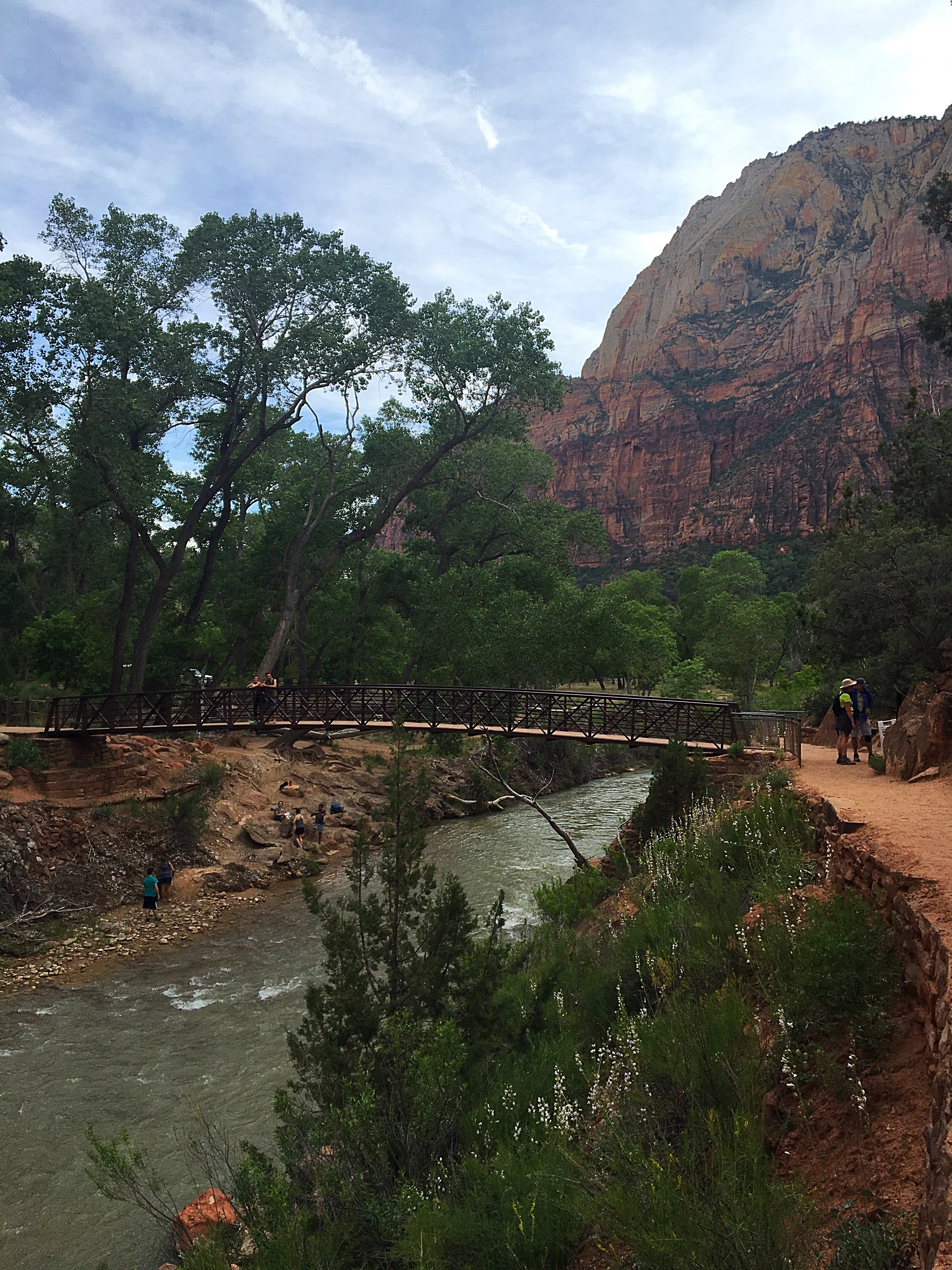
Virgin River; a major force in Zion’s transformation
Trees growing out of striped rock
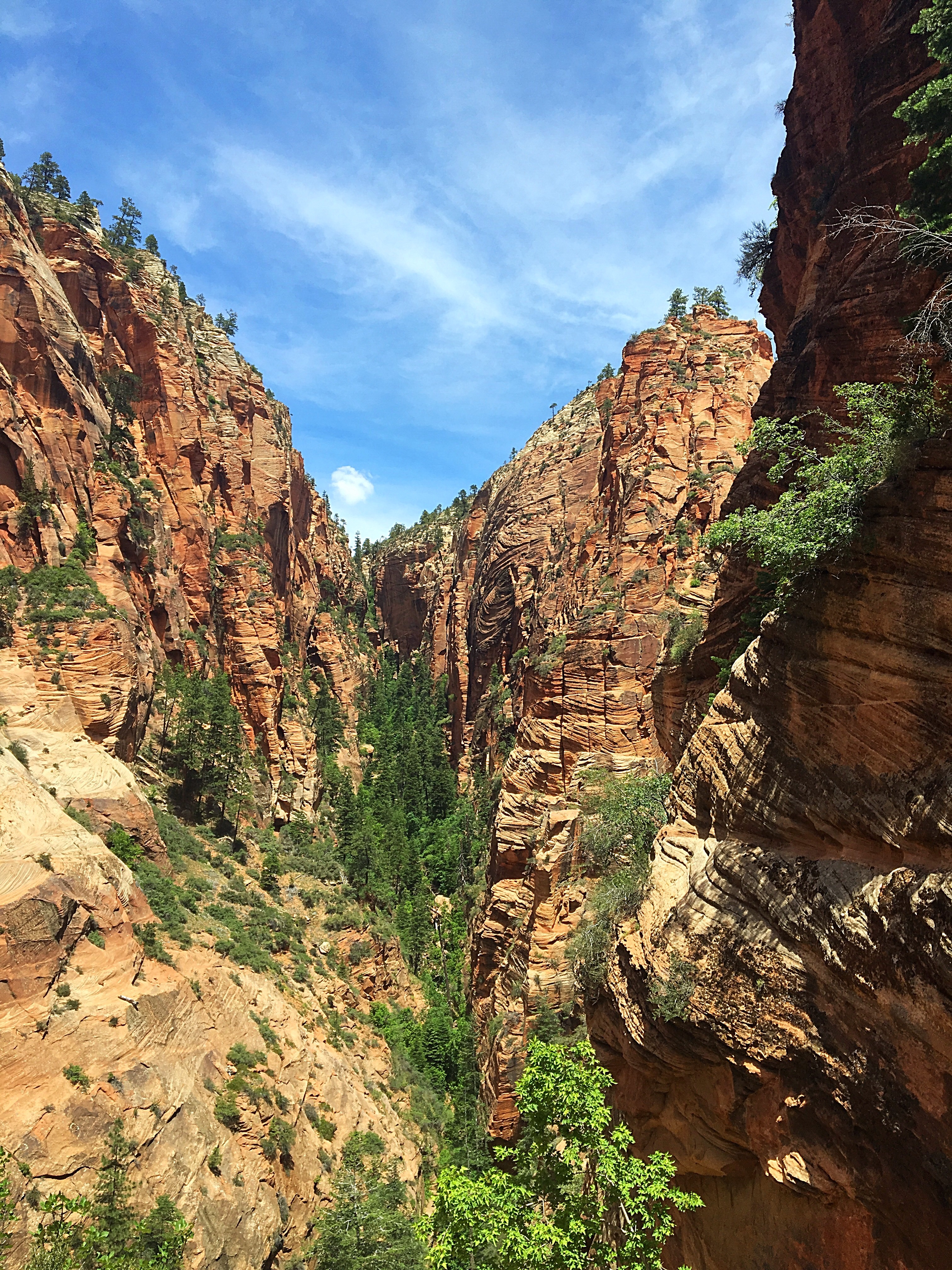
Narrow Canyon

Tiny Homes for the Homefree

In the days after I talked with my friends about using self-care to enhance their creativity, I saw them internalize the message by eating more fresh foods, meditating as a group, and taking an afternoon off to swim in the Yuba river. In just a short time they were vibrant and joyous as if they had never fallen into a slump; more importantly, after they dedicated themselves to self-care, they accessed crucial, nuanced elements that brought completion to several songs. When they played me a few tracks I was spellbound by the gravity and emotion of the music; one song even brought me to tears.

Witnessing my friends gain immediate, fruitful vitality and accomplishment spurred me to nourish my inner artist with greater depth.

I began by writing a list of fun, compelling, and invigorating activities to feed my soul and refill my creative well (as Julia Cameron would call it). To my surprise, as I reviewed my list, I found many hobbies like gardening, juicing and playing piano that I couldn’t do often — or at all — while living on the road. I realized I missed them like long-lost friends.

I turned my inner eye to the loneliness, uncertainty, and aimlessness I’ve felt in the past year from living homefree. I thought of the time and energy I’ve lost from worrying about where I would go, which friend could host me, where to write, and how I could shift the moving parts to make it happen.

For the last few weeks I’ve taken a break from constant travel and have stayed in a cottage on my aunt and uncle’s property. It’s the longest I have stayed in any one place for the last year! But could I call it home?

Despite the difficulties of homelessness, I love the thrill and adventure of transience. I love the way it’s forced me to grow and stabilize in the present moment. Settling into one place felt like it could end my carefree, rolling stone lifestyle.

But what does my inner artist want?

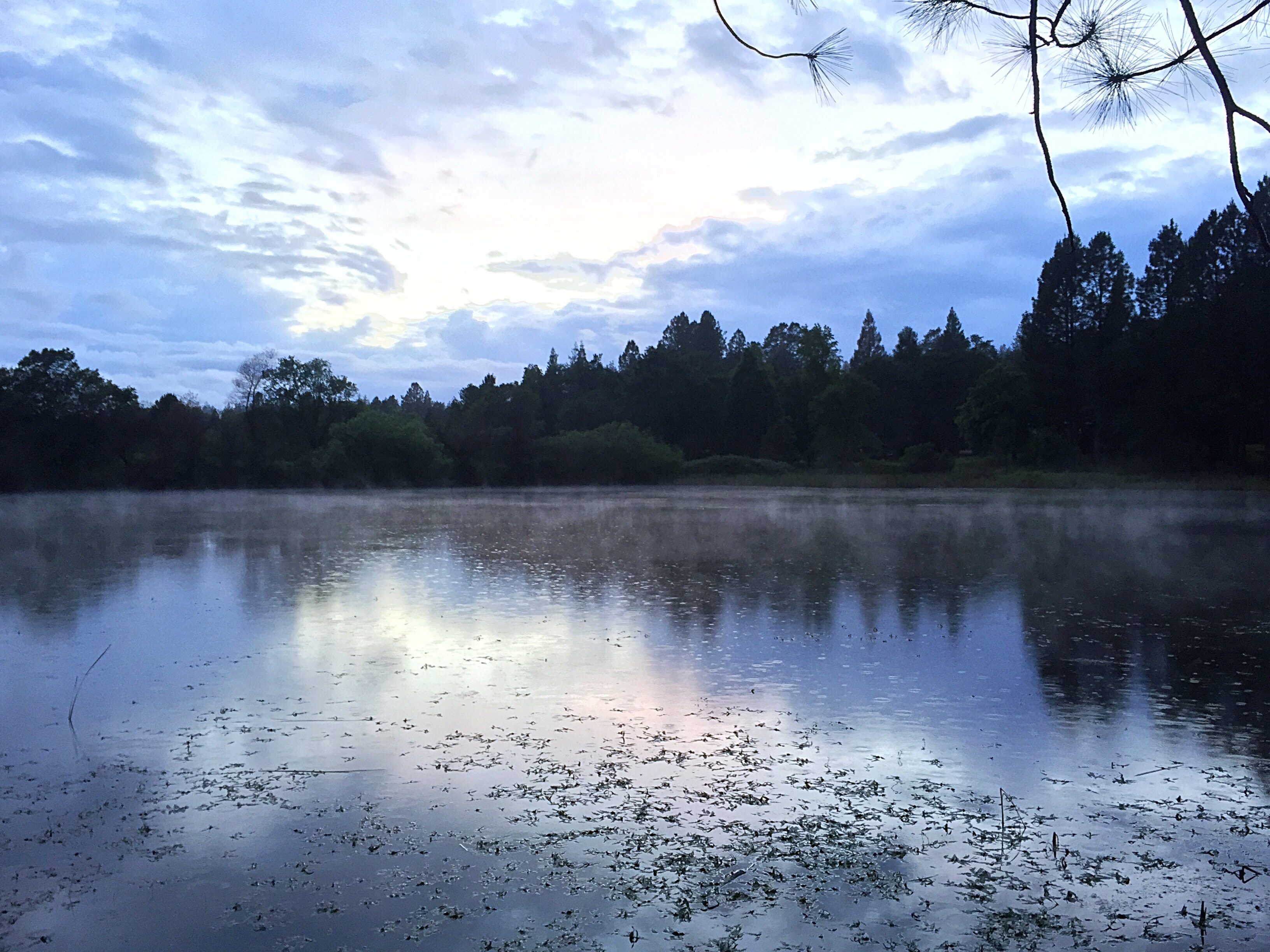
I walked out of the cottage to a nearby pond. Standing beneath pines amongst lupine I felt the beauty of the landscape seep into my bones. I breathed deeply listening to the freedom of birds singing from the trees. Still water reflected clouds, and looking into its depths, my mind became quiet.

Wouldn’t it be refreshing to have a home again? I thought of all the comforts a home would provide: a grounding place to go back to; a sacred space for meditation, prayer and writing; my own bed. I love domestic activities; they enrich my life and nourish me. With a home I could cuddle my cat, play my piano, plant some flowers, and create a space and momentum for words to flow. A home would make self-care easier and diminish my greatest stressors. It didn’t have to mean an end to my glamsient ways; if I wanted, it could make glamsienting more sustainable.

I turned back to look at the cottage — yes, I would make this my artist’s home.

Clouds Reflected in the Pond