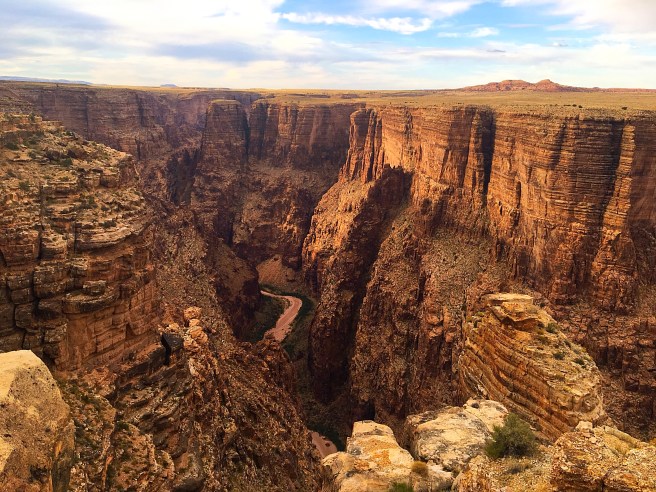
We cross into Reservation land in Northern Arizona. The desert before us, a desolate beauty with colorful streaks, glows beneath the pink hue of the setting sun.
On the outskirts of town the highway curves past hills. Gathered at their base, shanties and shacks form small a small line. Broken boards, torn roofs, tires, cars and trucks appear abandoned and disregarded. But I see there are children’s toys and someone walking into a shack and others sitting on steps and chairs out front.
We pass at 60 miles per hour. The extreme poverty fades into the rear-view mirror.
We stop at a gas station just after dusk. A man walks to the car parked next to me. He is, perhaps, ten years older than me. Our eyes meet on opposite sides of the window. A thought flashes into my mind — were his parents or grandparents among the stolen children, forced into Christian boarding schools in an attempt to decimate their culture?
The lineage of oppressors claim me as their citizen.
***
Early in the morning, a jewelry maker sits in a long line of artisans in Santa Fe’s town square; they’ve rolled out their wares and tell the tourists passing by, “feel free to handle.” The jewelry maker looks like he is sleeping, with eyes closed and arms folded around the large yellow “G” on his green sweatshirt. His porcupine quill jewelry has caught my eye, and I kneel down to look.
Amongst his jewelry, I find a feather pendant that is perfect for my niece.
“Excuse me,” I say.
His eyes open.
“Sorry to bother you.”
“No bother,” he smiles.
“How much is this one?”
He tells me the price. I say I’d like to purchase it and hand it to him.
An older white man stands above us and jokes that he would never buy from a Packers fan. “At least you’re not for the Cowboy’s,” the older man says as he continues down the block.
“Never a Cowboy’s fan,” the artisan jokes back as he places the necklace on a card, carefully stringing the chain through notches that will hold it in place. “Although my mother is probably smacking me right now for saying that.”
But the older man is too far to hear him.
“Your mother likes the Cowboys?” I ask, still kneeling, admiring the porcupine quills dangling from silver earrings.
“Oh yes,” he said. “All her life. Now she has passed and I’m sure she is angry with me for saying anything bad about them.”
Our eyes meet.
“I’m sorry you’ve lost your mom. I can only imagine what that feels like.”
He sighs. “She died on the fourth of July. It’s what she wanted. She was on dialysis for twelve years. My sisters convinced her to get the treatments when she first got sick. After twelve years she was tired. Every time she came home she was like this —” he rolled his eyes back, put his arms out, and swayed his chest like he was off-balance.
“That’s a long time to endure so much pain.”
“Yes, I understand her choice,” he says. He holds the little package containing the necklace in his right hand.
“Thank you for sharing that with me,” I say, looking up at him.
“I miss her. I think I will miss her for the rest of my life.”
I take in what he has said. “I miss my Gramma more now than I did two years ago when she passed.”
He nods and I ask about the porcupine quills.